Contents
- Blog
- Wireless, Network, Computing
The Telco AI Cloud and AI Grid: Infrastructure for Society in the AI Era
#AI-RAN #TelcoAICloud #PhysicalAI #LTM
Mar 16, 2026
SoftBank Corp.
Technology is only valuable when utilized by society. This principle guides our efforts in research, and is the North Star for our mission.
Fresh from the transformative energy of MWC 2026 in Barcelona, where the industry aligned on the necessity of high-performance connectivity, we are now looking ahead to NVIDIA GTC. At GTC, the conversation moves from connectivity to the physical reality of the AI Grid. As we transition deeper into the AI era, the challenge isn't just about building faster chips; it is about creating a distributed infrastructure that brings AI out of the data center and into the fabric of our physical world.
1. Why Mobile Operators Lead the AI Transition
Mobile Network Operators (MNOs) are uniquely positioned to deliver AI that society can rely on. Unlike centralized cloud providers, our infrastructure is built on geographically-distributed assets—cell sites and edge hubs already embedded in every community. This proximity is the only way to deliver the sub-millisecond latency required for the next generation of services.
Furthermore, telcos provide a foundation of trustworthiness and sovereignty. Because our networks are regulated and locally operated, we can ensure that data remains within national borders, meeting the highest standards for security and privacy. With widespread adoption already in place, the mobile network is not just a path for data; it is the most accessible and trusted gateway to deliver AI to reach every citizen.
2. The Telco AI Cloud: Connecting the Ecosystem
SoftBank’s Telco AI Cloud strategy is built on the belief that AI should be a ubiquitous resource. We aren't building this in a vacuum; we are aligning with global leaders to create a seamless continuum of compute.
Our strategy bridges the gap between massive AI Factories and high-speed, low-latency networks. By integrating AI directly into the mobile network through AI-RAN, we transform the telco footprint into a distributed "Social Infrastructure" that balances heavy-duty training with real-time, local inference—the very essence of the AI Grid.
3. Infrinia: The Connective Tissue from Core to Edge
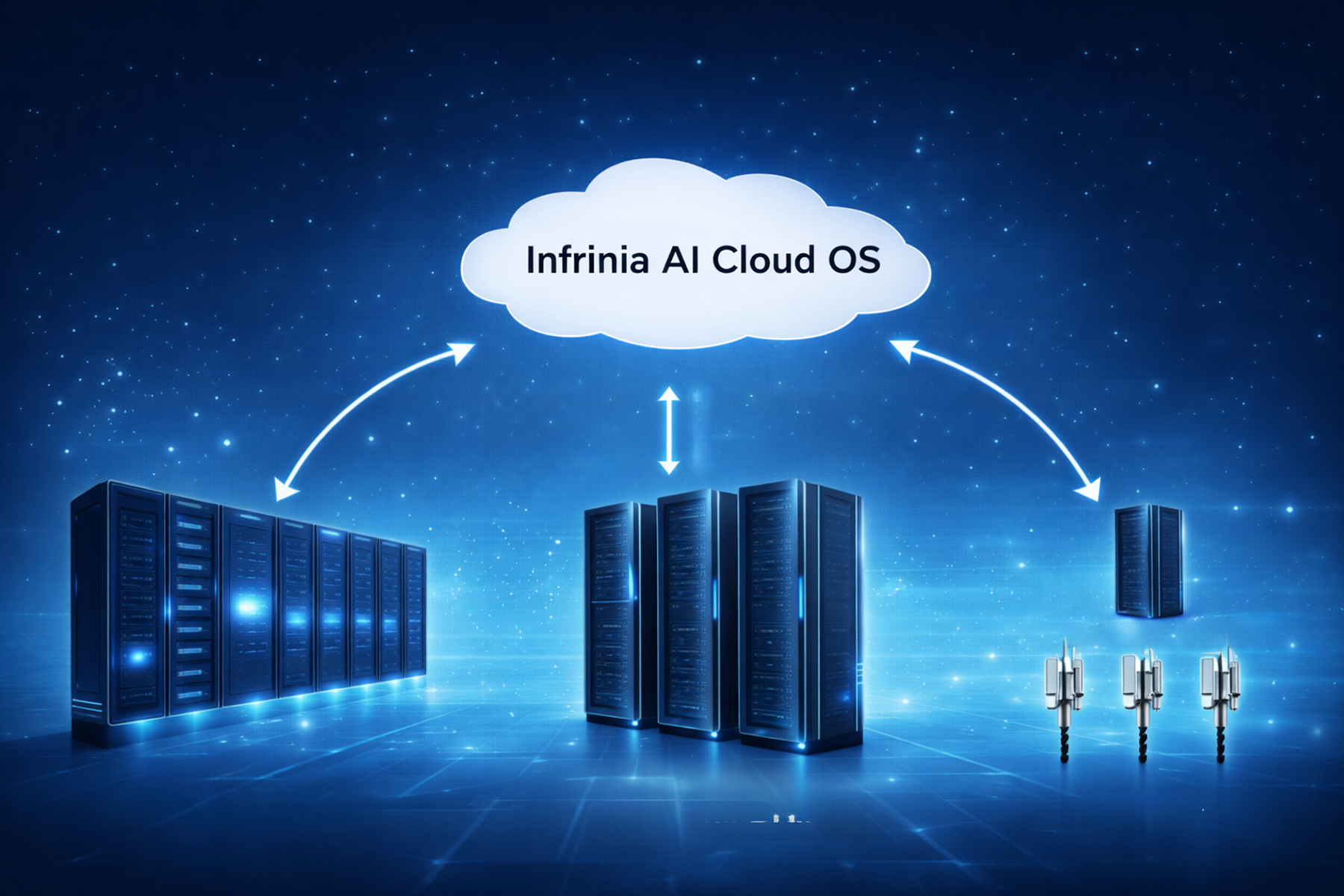
Moving AI to the edge requires a fundamental rethink of the software stack. Infrinia AI Cloud OS serves as the vital connective tissue across this entire continuum. It is designed to manage the complexity of AI workloads not just in large-scale data centers, but all the way to the extreme edge, including AI-RAN deployments.
By providing a unified software fabric, Infrinia allows for the seamless shifting of workloads between centralized AI data centers and localized cell sites. Whether it’s supporting our Large Telecom Model (LTM) or facilitating real-time Physical AI over public and private networks, Infrinia ensures that GPU compute, network fabric, and memory pools function as a single, cohesive organism. This end-to-end integration simplifies the operational burden, ensuring intelligence is delivered exactly where it’s needed.
4. Moving with Purpose: The Path Forward
To realize this vision, we embrace a culture of technical pragmatism—moving from "Zero to One" through Rough Consensus and Running Code. By prioritizing interoperability and open innovation through the AI-RAN Alliance, we ensure our infrastructure isn't just a technical marvel, but a platform that creates tangible utility and drives a strong return on capital.
The "cloud-first" era is evolving. As we build the next generation of trustworthy, autonomous AI systems, SoftBank is committed to providing the foundational infrastructure that will move society forward.
About the Author: Mauro Goncalves Filho
In February 2025, Mauro Goncalves Filho was appointed SVP, AI-RAN of SB Telecom America Corp., a wholly owned subsidiary of SoftBank Corp. He has over 25 years of experience in management, strategic planning, and business development in the technology, media, and telecommunications (TMT) sector.
He previously served as Senior Director at Google X and Chief Strategy Officer at Loon, an Alphabet company. He also held management roles at Telefonica Vivo and Gradus Consultants, leading global expansion efforts. Currently, he serves on the boards of Altave (computer vision) and Onovolab (innovation ecosystem), and is active as a startup mentor at The Alchemist Accelerator and a venture partner at Niu Ventures.