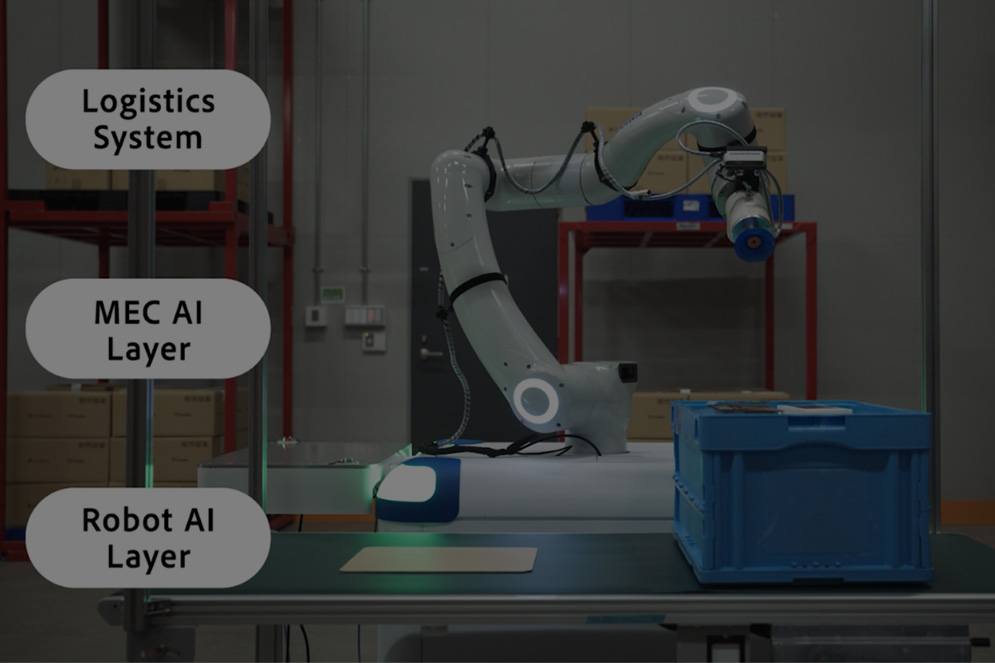
Bringing Physical AI to the Field: Learning and Verifying Real Tasks in a Logistics Warehouse

#AI-RAN #AITRAS #PhysicalAI

SoftBank Corp. collaborated with Yaskawa Electric Corporation ("Yaskawa Electric") to conduct validation of Physical AI in a SoftBank logistics warehouse. Through this series of validation trials, SoftBank confirmed that robots can perform flexible and highly accurate object picking and placement tasks by linking two AI (artificial intelligence) systems: a VLM (Vision-Language Model), which runs on SoftBank’s AI-RAN MEC (Multi-access Edge Computing) environment and understands the situation, and a VLA (Vision-Language-Action), which runs on Yaskawa Electric’s robot and generates actions.

This article introduces the background of the validation, the target tasks, and the value of testing Physical AI in an actual operational environment.

1. Development of Physical AI Using AI-RAN and the Background Behind It

SoftBank and Yaskawa Electric are working together toward the social implementation of Physical AI based on technology originating in Japan. Their initiative aims to equip robots with more advanced decision-making capabilities and expand the range of tasks they can handle by leveraging the large-scale computational resources and ultra-low-latency processing enabled by AI-RAN. The two companies have already jointly developed use cases for office-oriented Physical AI robots. In a smart office environment, they confirmed that robots can make advanced decisions based on real-time conditions and perform flexible actions by linking with next-generation building management systems and AI-RAN. They also demonstrated the potential to enable “multi-skilled” robots, in which a single robot can take on multiple roles.

Related Press Release: SoftBank Corp. and Yaskawa Electric Corporation Begin Collaboration on Social Implementation of "Physical AI" Utilizing AI-RAN(Dec 1, 2025)

This time, the scope of validation was expanded, and a new trial was conducted in a SoftBank logistics warehouse. Through these efforts, SoftBank will continue to advance the social implementation of Physical AI by enhancing the AI platform, collecting and accumulating data, and developing and improving AI models.

2. Why Physical AI Is Needed in Logistics Warehouses

In logistics warehouses, labor shortages across the industry are driving demand for the automation of tasks that have traditionally been performed by people. At the same time, many actual processes involve handling items whose shapes and placement are not consistent, creating challenges that differ from simple repetitive work.

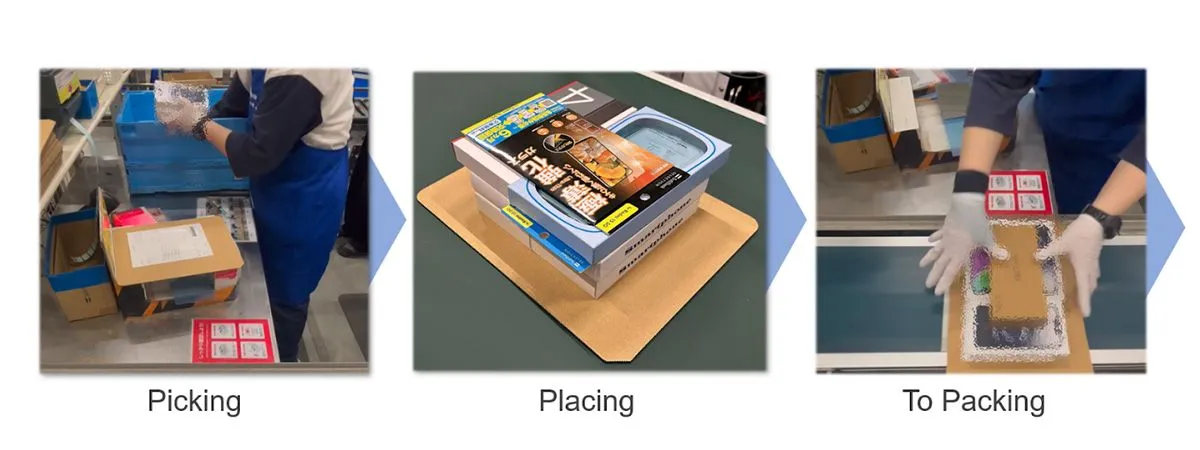
At SoftBank’s logistics warehouse as well, there are processes involving smartphones and related accessories. One such process requires workers to remove items placed in foldable boxes in an unarranged state and line them up on mounting boards for shrink packaging. In tasks like this, it is not enough simply to detect the target object. Decisions must also be made regarding which item to pick first, how to grasp it, and how to place it.

Real-environment task targeted in this verification

Real-environment task targeted in this verification

Because the conditions of such tasks change whenever a new product handled in the warehouse is introduced, it is difficult to define all conditions in advance as fixed rules. At present, on-site workers respond flexibly based on the shape and weight of each item. Against this backdrop, this validation used real tasks in a logistics warehouse as the subject of study and conducted learning and operational verification as a first step toward introducing Physical AI into actual worksites.

3. System Configuration Linking MEC AI and Robot AI

The logistics system works together with AI running on MEC that generates instructions for the robot in the form of subtasks (MEC AI), as well as AI that generates the robot’s specific actions (Robot AI).
・Logistics system: Manages item lists and task-related information handled at the logistics site
・MEC AI: Uses task-related information from the logistics system together with camera images to generate subtasks and issue instructions to the robot
・Robot AI: Uses the subtask instructions from MEC AI to generate the optimal robot control commands for the situation on site
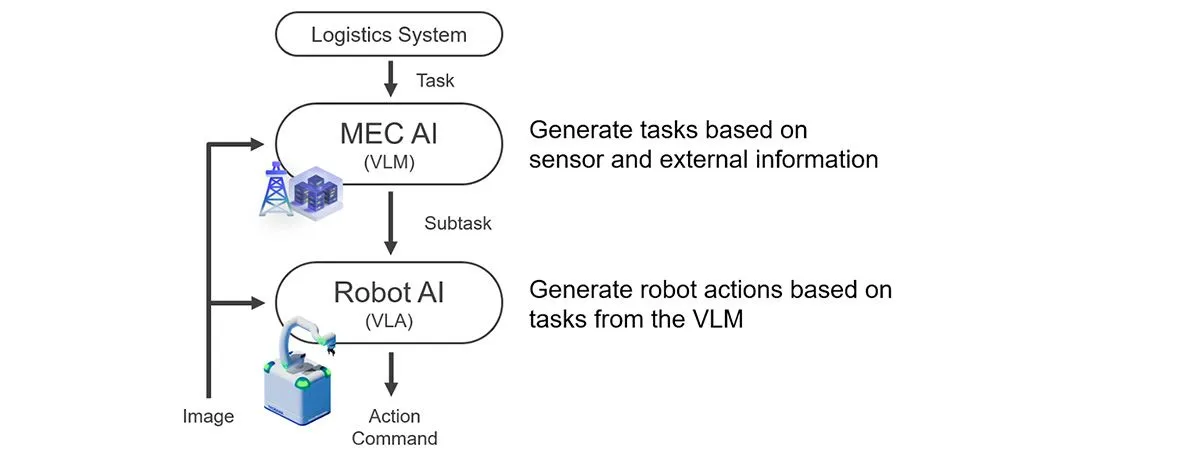
Configuration of the Physical AI system used in this verification

Configuration of the Physical AI system used in this verification

AI Running on the MEC Side

The VLM running on the MEC side takes as input a list of target objects to be placed on the mounting board together with camera images. It then outputs the positions of the objects to be grasped and the placement positions for the grasped objects.
To train the VLM, SoftBank used training data labeled on the basis of actual on-site operations. This data consisted of smartphones and related accessories arranged in various patterns inside foldable boxes, annotated with the order in which they should be grasped and the locations on the mounting board where they should be placed.
As a result, even when presented with arrangements it has not seen before, the system can output the positions of target objects to be grasped as well as placement position information.
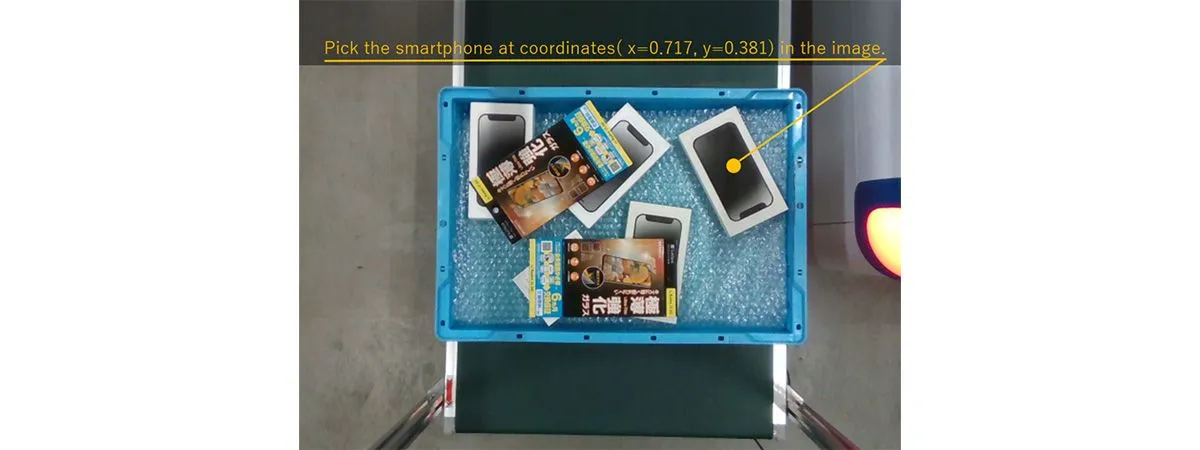
Example of training data used to train the VLM running on MEC

Example of training data used to train the VLM running on MEC

AI Running on the Robot Side

Processing that requires responsiveness and safety, such as generating grasping and placement actions according to the situation at hand, is handled by the VLA on the robot side.
The VLA takes as input the target object information included in the subtasks output by the VLM together with camera images, and outputs the joint angles required to determine how the target object should be grasped. By executing actions directly on the robot, the system can ensure the responsiveness and safety required for real-machine control while also linking with AI processing on the MEC side.
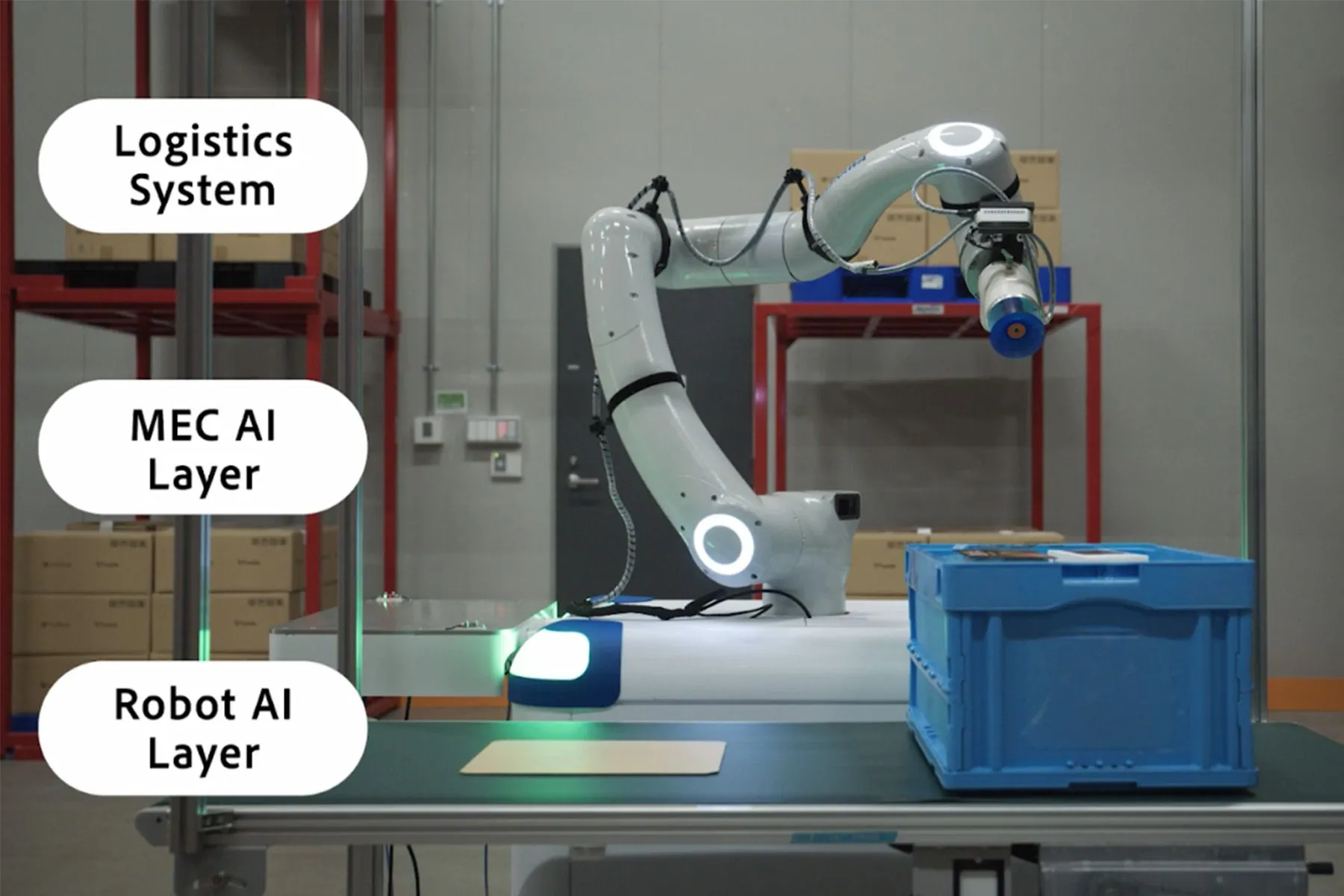
4. On-Site Demonstration

In this validation, SoftBank used real tasks in a logistics warehouse as the subject, trained the AI, and operated a system in which MEC and the robot worked together. This made it possible to execute the full workflow as a continuous process, from recognizing the target object to grasping and placing it.

5. The Value of Validating Physical AI in a Real Environment

For Physical AI, it is important not only to improve the performance of individual core technologies such as recognition and action generation, but also to determine how these elements should be configured according to real-world tasks and operated as a complete system. In addition, during the learning phase, it is essential to have a mechanism for continuously incorporating data obtained from actual machines and worksites and using it to improve the models.

SoftBank’s AI infrastructure is distinguished not only by its ability to run inference in an MEC environment enabled by AI-RAN, but also by its integration with a GPU platform for training, allowing field data to be rapidly fed back into model improvement. Through these efforts, by combining AI and communications technologies, SoftBank aims to realize “multi-skilled” robots in which a single robot can take on multiple roles, expand the range of tasks that can be handled, and contribute to a future in which people and robots can work safely and collaboratively in the same space.

 [Overview] AI-RAN, the Social Infrastructure Supporting the AI Era

Feb 13, 2026

Blog

[Overview] AI-RAN, the Social Infrastructure Supporting the AI Era

#AI-RAN #AITRAS #AI #RAN #AI-RAN Alliance

6. Toward the Practical Application of Physical AI in the Field

In this logistics warehouse validation, SoftBank trained Physical AI using real tasks from an actual worksite and conducted operational verification using a configuration that combines a VLM running on MEC utilizing AI-RAN with a VLA running on the robot.

By integrating next-generation infrastructure such as AI-RAN with robotics, SoftBank will continue advancing the application of Physical AI in real operational environments, accelerate deployment in the field, and further expand its possibilities.

Research Areas
研究概要