Contents
- Blog
- Wireless, Network, Computing
Inside SoftBank’s Full-Stack Sovereign AI Architecture for Autonomous Networks
#AI-RAN #AI #AIAgent #LargeTelecomModel
Jun 24, 2026
SoftBank Corp.
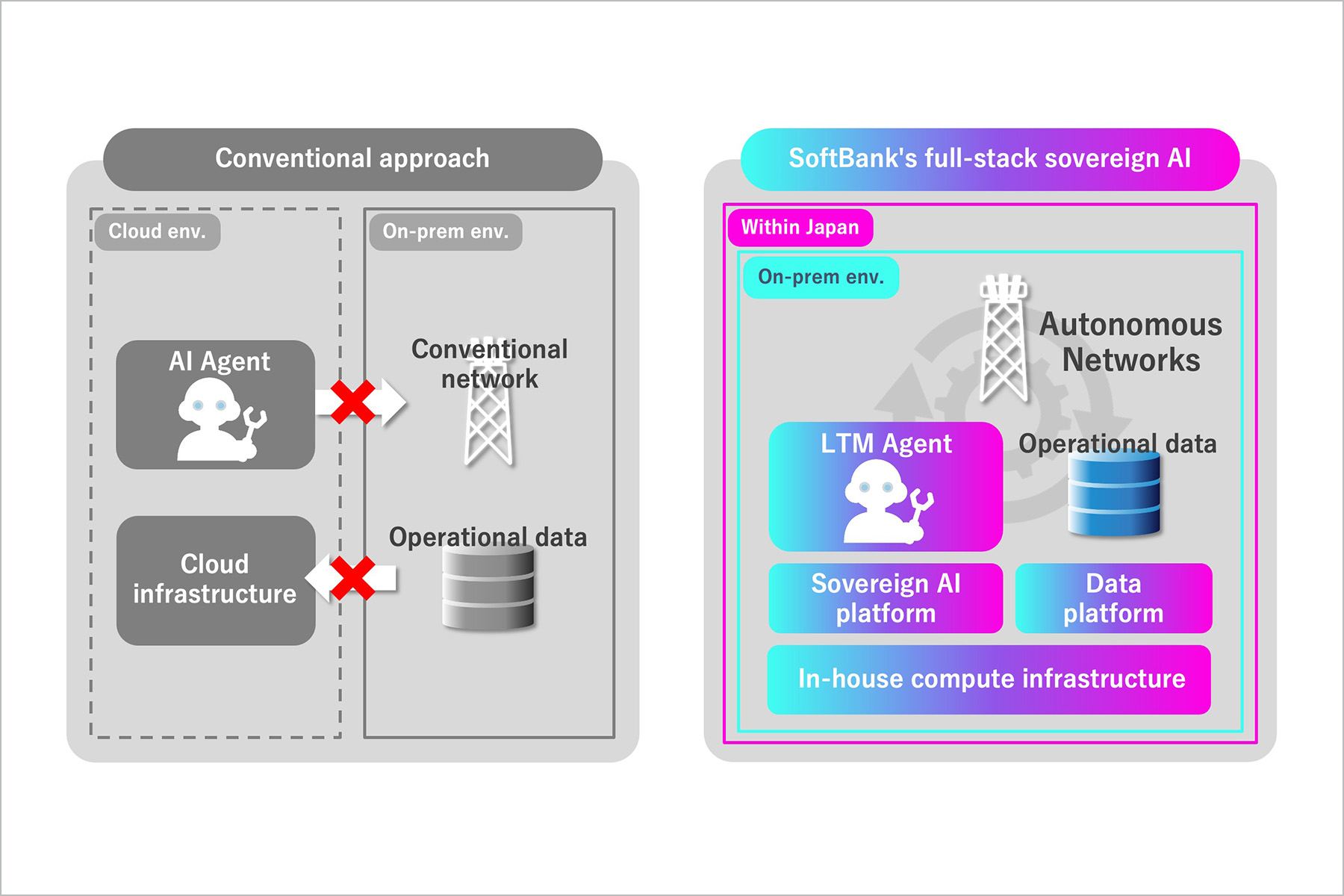
Recently, AI agents that autonomously execute tasks have been gaining significant attention. In this article, we will introduce SoftBank's full-stack sovereign AI architecture for the secure autonomous operation of telecommunication networks by AI agents, along with the technological foundation supporting it.
1. The Rise of AI Agents and the Necessity of Sovereignty for Telco Industries
1.1 Augmented Risks in the AI Agent Era
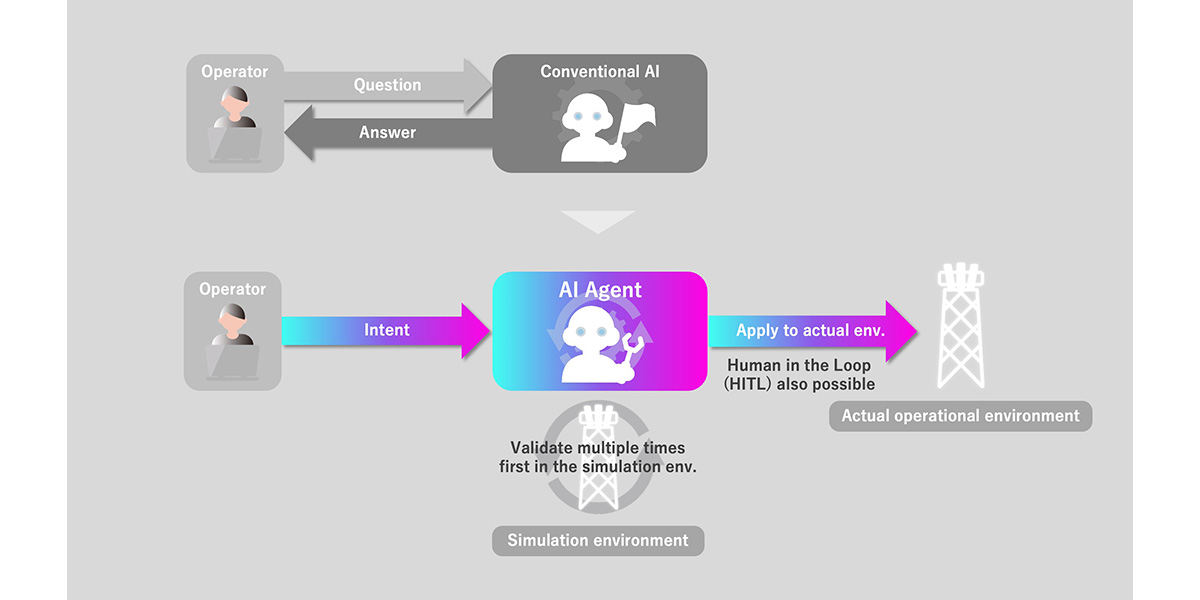
Traditional utilization of LLMs has focused on question-and-answer type tasks that output text in response to human prompts. However, such a “passive” mode of using Generative AI has now evolved into AI agents, such as coding agents, which autonomously make decisions and perform execution. In an environment where these AI agents independently plan tasks according to the situation and call external APIs and tools on-demand, the volume and complexity of the context processing increase.
Relying on external general-purpose cloud AI platforms in such autonomous systems involves the risk of critical data being processed outside the company's control. As the agent's thinking process and data processing become a black box, the company accepts the risks of unintended data leaks, changes in vendor policies, and ultimately the risk of the system being manipulated from within due to unintended agent behavior.
1.2 Telecom Use Case and Indispensable Sovereignty for the Critical Infrastructure
In the telecom industry, global standards from organizations like TM Forum are helping shape the operational automation of networks towards Autonomous Networks. At SoftBank, we are building on our Large Telecom Model (LTM) first introduced in March 2025 by advancing the development of operational use cases. For example, in order to dynamically adjust user allocation across LTE/5G and different frequency bands, we are building an agentic framework to test configurations through trial and error in a verification environment and apply only settings whose safety has been confirmed on the actual network. We explain these specific use cases and results in a separate blog.
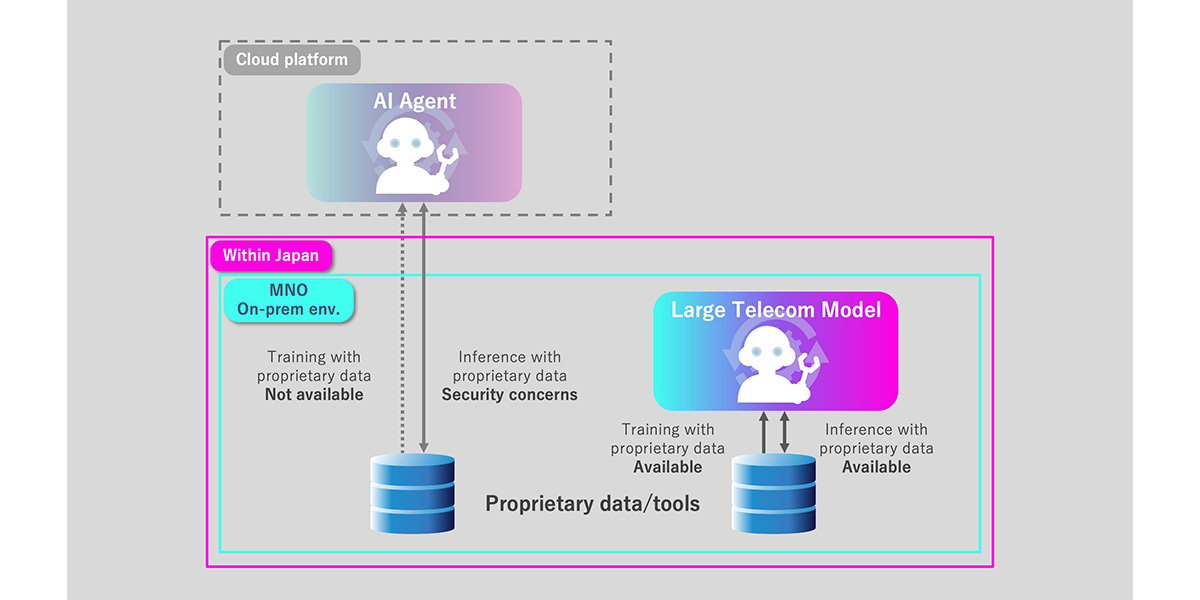
However, communication logs or equipment configuration data that agents handle in such autonomous operation environments are subject to strict adherence to the secrecy of communications, and are highly sensitive information directly linked to the stable operation of social infrastructure and national security. In a system environment where decisions and execution are autonomously repeated, relying on external systems not only leads to critical data leaks concerning the secrecy of communications, but also poses a severe threat where malicious intervention could compromise the agent, potentially leading to consequences such as direct modifications of base station configurations and the hijacking of the infrastructure.
Given the severity of risks such as the infrastructure hijacking, a telecommunications carrier responsible for critical social infrastructure cannot accept dependence on an external environment beyond its own control. Therefore, to safely circulate data obtained from communication automation environments and ensure stable operations, it is indispensable to secure a sovereign environment where we can consistently manage and govern not only the physical location of the data but also the behavior of the models and the entire system.
2. SoftBank’s Large Telecom Model: A Full-Stack Sovereign Approach
2.1 Domain-Specific Sovereign Model: "Large Telecom Model"
In order to automate the operation of telecommunication networks, an accurate understanding of specialized knowledge, such as complex parameters of wireless access and industry-specific protocols, is required. To address this challenge, SoftBank has been developing its own large language model specialized in the telecommunications domain, called "LTM (Large Telecom Model)."
The true value of building LTM lies not solely in acquiring specialized knowledge, but in eliminating the risk of data leaks associated with reliance on external platforms, and completely and consistently undertaking all development processes—from base model development to continual pre-training, fine-tuning, reinforcement learning, and final output control—entirely in-house.
This allows public open standard data, such as 3GPP specifications, to be safely combined with proprietary confidential data, such as vast system performance, alert logs and equipment configurations accumulated internally, enabling the in-house development of a model that serves as the source of truth for network operations without ever releasing data externally. By eliminating the black-box behavior and establishing an environment where model operations can be consistently audited and verified in-house, it becomes possible to guarantee controlled safety for the decisions made by AI agents.
2.2 Full-Stack Sovereignty Including the Infrastructure Layer
Furthermore, to secure this sovereign approach, it is necessary to control not only the model layer but also the computing infrastructure that supports it. SoftBank plans to run the Sovereign LTM on “Infrinia AI Cloud OS”, its own infrastructure platform.*1
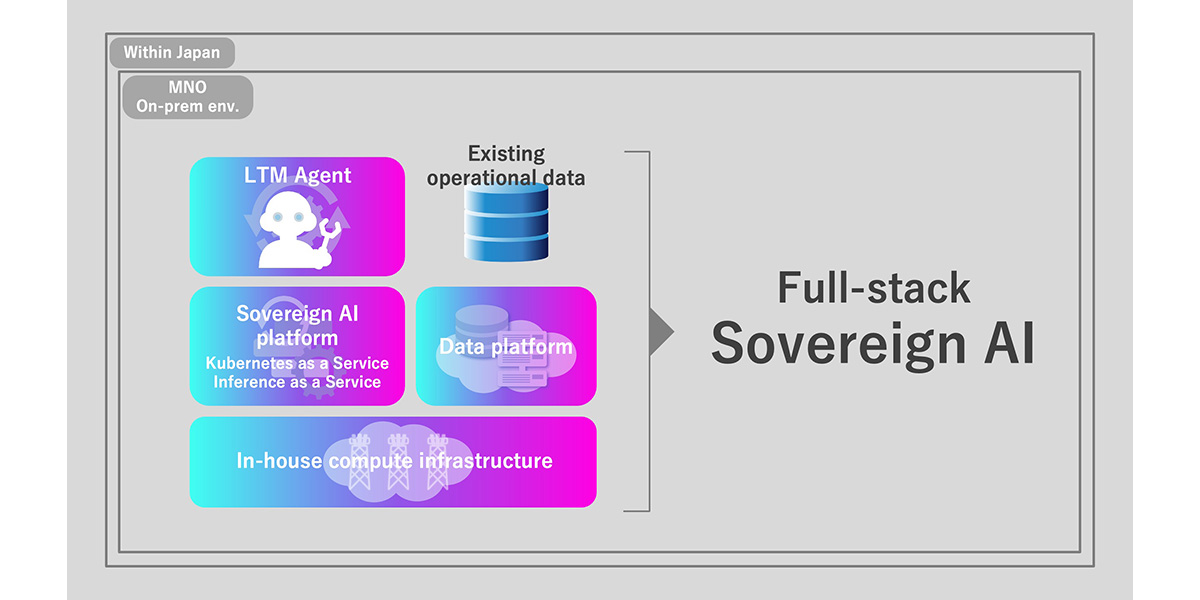
By vertically integrating all layers, from hardware computing resources to container orchestration, and up to the higher model and application layers, it becomes possible to ensure strict sovereignty during agent operations. By creating a structure where the infrastructure to the model can be managed holistically in-house, an independent and secure platform can be realized without depending on external platforms or worrying about information leakage.
*1 For details, please refer to SoftBank Corp.’s press release dated January 21, 2026, “SoftBank Corp. Announces "Infrinia AI Cloud OS," a Software Stack for AI Data Centers”.
3. Security Measures Supporting Autonomous Networks
3.1 Security Measures During AI Agent Training: Anonymization and Synthetic Data Generation
In order to continuously improve the accuracy of AI agents and advance autonomous network operations, learning and feedback loops based on real-time operational data are essential. However, bringing raw confidential data directly into development or training environments is sometimes difficult from a security standpoint. To address this challenge, SoftBank has been also working on the anonymization and synthetic data generation of real operational data.
The operational data used for training the LTM is the data utilized by SoftBank's in-house experts for daily operational improvements, and it contains no user-related information or personally identifiable information (PII). Nevertheless, because it still includes confidential infrastructure information such as base station addresses, appropriate masking and replacement are required. Even for information that is not individually sensitive, differential privacy—a technology that can set mathematical bounds on the possibility of an AI memorizing and reproducing the original information as a whole—is also crucial to eliminate such risks.
Implementation of security measures
Presently, SoftBank has implemented synthetic data generation and data anonymization using NVIDIA NeMo open libraries including the NVIDIA NeMo Safe Synthesizer and NVIDIA NeMo Anonymizer. NVIDIA NeMo Safe Synthesizer is software that generates synthetic data from structured data, such as RAN metrics, while preserving statistical properties and complex inter-column correlations by applying Differential Privacy techniques. SoftBank has already introduced this technology at scale into its LTM data processing, using it as a foundation for creating high-quality training data without directly handling confidential data.*2
NVIDIA NeMo Anonymizer is a library that performs context-aware anonymization on unstructured text, such as operational logs. It detects PII and other confidential entities, and replaces or paraphrases them while preserving semantic information as much as possible.
NVIDIA Blog: NVIDIA Brings Trusted, 24/7 AI Agents to Telecom Operations
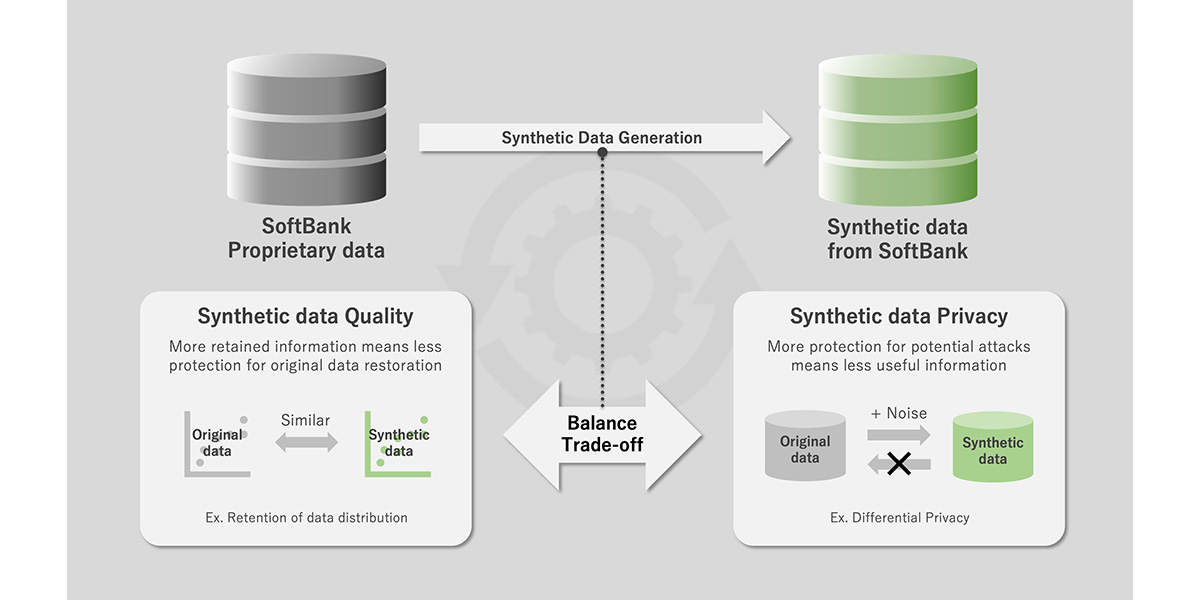
With the synthetic data generation and anonymization technologies in SoftBank’s LTM, AI agents can continue learning and improving with datasets that offer practical utility comparable to real operational data, without directly using actual confidential data.
*2 For more details, please refer to SoftBank Corp.’s press release dated March 17, 2026, “SoftBank Corp. Develops Synthetic Data Generation Pipeline to Enable Secure Training for its Large Telecom Model”.
3.2 Security Measures During AI Agent Inference: Sandboxes and Guardrails
However, no matter how much the risk of malfunction or data leakage is eliminated during training, in an environment where AI agents are expected to take any action autonomously, a framework to automatically and systematically reject unintended behavior is essential. As a specific approach to ensuring operational safety, SoftBank has introduced multi-layered defense mechanisms, including sandboxes and guardrails.
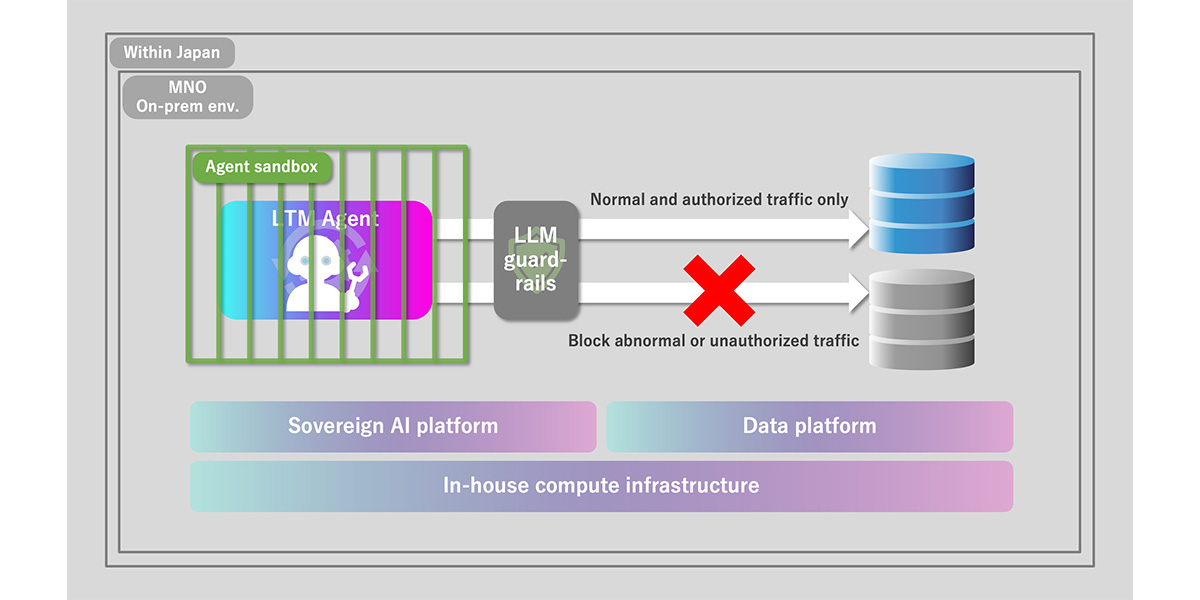
A sandbox is an execution environment that confines actions and tool calls by the AI agent within a completely isolated and safe area. By restricting the execution privileges and accessible resources granted to the AI agent based on predefined rule-based policies, even if the AI agent takes an unexpected action, it forcibly cuts off any impact on other systems or the actual environment. In the industry, this sandbox architecture is increasingly represented by open-source frameworks like NVIDIA OpenShell and its agent-integrated stack, NemoClaw. They offer a practical example of executing agent workflows without compromising broader system security, combining sandboxed execution, policy enforcement, network guardrails, and privacy-aware data routing.
On the other hand, guardrails are a mechanism to validate and control the natural language inputs and outputs of AI agents in real time. They not only prevent undesirable outputs such as hallucinations, but can also detect and block highly confidential or personally identifiable information before it is output, or paraphrase it into safe expressions. By deploying these security measures in multiple layers, it is possible to balance the agility unique to agentic operational automation with the stability required for telecommunications infrastructure.
4. Realizing Autonomous Network Operations with a Sovereign AI Foundation
Autonomous networks based on AI agents represent a paradigm shift that goes beyond simple operational automation, dramatically increasing the adaptability and robustness of telecommunications infrastructure. Even if the current role of AI is limited to monitoring and analysis, it is certain that AI agents will autonomously modify and optimize network configurations in the future, and entrusting this core operational capacity to black-box external models or unknown agents poses a fundamental risk. Depending on external entities, especially overseas vendors, for core system operations just because of the simplicity of integration is equivalent to surrendering operational sovereignty over critical infrastructure, an outcome that telecommunications carriers can never tolerate. Maintaining this sovereignty is a critical line of defense that shapes future security, and it is a boundary that must never be compromised.
SoftBank has built its unique sovereign AI foundation by integrating in-house managed computing infrastructure, our own telecom-specific model known as LTM, and multi-layered safety measures utilizing synthetic data, sandboxes, and guardrails. This approach of comprehensively managing all layers in-house is the only way to completely eliminate any dependence on external environments and establish robust sovereignty across the entire system. On this solid foundation of sovereignty, we will continue to develop and operate next-generation infrastructure toward the fully autonomous networks of the future.