Contents
- Blog
- Wireless, Network, Computing
AI Data Center GPU Cloud Supports the Learning Loop for Physical AI
#AI-RAN #PhysicalAI #Robotics #AIDataCenter #GPUCloud
Aug 03, 2026
SoftBank Corp.
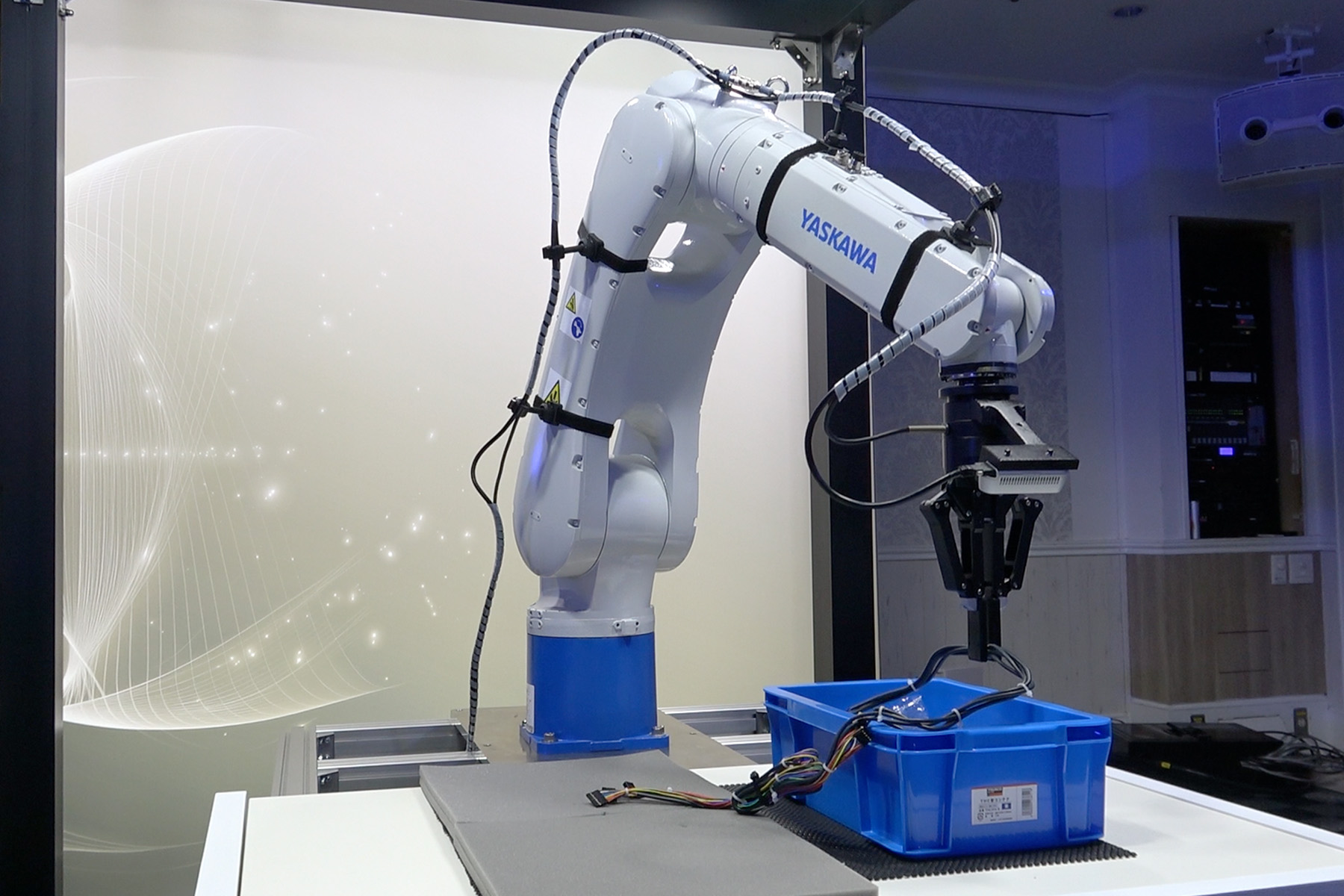
For robots to perform complex tasks in the real world, "Physical AI," which allows them to perceive their surroundings and determine actions based on the situation, is crucial.
Its implementation requires multiple steps: collecting real-world data, training AI models, evaluating through simulation, and applying to the physical robot. SoftBank has developed a Physical AI development support tool on the "AI Data Center GPU Cloud" that executes these processes in an integrated manner.
Related Press Release: SoftBank Corp. and Yaskawa Electric Corporation Demonstrate a Deformable Object Manipulation System Using "AI Data Center GPU Cloud" as a Physical AI Development Platform (July 13, 2026)
This time, in collaboration with Yaskawa Electric Corporation and NVIDIA, this tool was applied to Yaskawa Electric's flexible object handling system. This article introduces the structure and execution of the learning loop, as well as the robot's actions before and after training.
1. Learning Loop for Continuous Improvement of Physical AI
The Physical AI development support tool developed this time operates on the "AI Data Center GPU Cloud."
Related Press Release: SoftBank to Launch "AI Data Center GPU Cloud"Powered by "Infrinia AI Cloud OS"as Part of its Neocloud Business in October 2026 (May 25, 2026)
The "AI Data Center GPU Cloud" is a cloud service combining SoftBank's AI computing infrastructure with "Infrinia AI Cloud OS." It is designed as an environment capable of executing a wide range of AI workloads, from AI model training and inference to data processing.
In this Physical AI development, we constructed a learning loop on this GPU cloud that connects the following steps:
1. Collect operation data and sensor information from the physical robot.
2. Generate synthetic data based on the collected data.
3. Train the AI model using real-world data and synthetic data.
4. Evaluate the trained AI model in a simulation environment.
5. Apply the AI model that meets evaluation criteria to the physical robot.
6. Operate the robot with the updated AI model and collect new data.
This structure ensures continuous improvement of the AI model by feeding data obtained from the physical robot back into the next training cycle, rather than stopping after a single training session.
Generating Synthetic Data from Real-World Data
There is a limit to the data that can be collected by operating a robot in the real world.
For example, flexible objects change shape and position every time they are placed, meaning reproducing all possible states using only the physical machine and collecting data would take a significant amount of time.
Therefore, in this learning loop, synthetic data is generated using NVIDIA Cosmos based on the data collected from the physical machine. By adding various variations to the original data, we supplement the data that is difficult to collect sufficiently with only the physical machine, utilizing it for AI model training.
Evaluating Trained AI Models with Simulation
The trained AI model is not immediately applied to the physical robot.
It is first confirmed in a simulation environment whether the model performs the expected actions, completes the target task, and maintains basic performance.
The development support tool uses a simulator integrated with the NVIDIA Omniverse library. By applying the AI model that passes the simulation evaluation to the physical machine, the cycle of training and physical machine verification is efficiently advanced.
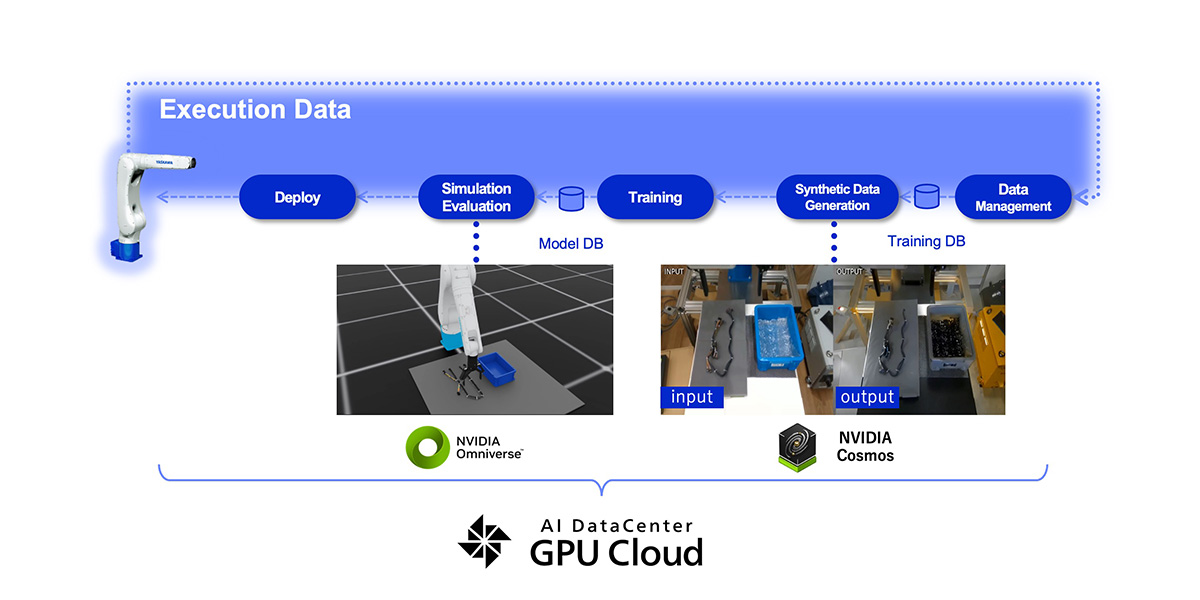
Figire1. Processing flow of the physical AI learning system
2. How the Learning Loop Operates: From Data Collection to Application to the Physical Robot
The status of the learning loop can be checked via a GUI (Graphical User Interface) operating on the GPU cloud.
This GUI primarily displays the following information:

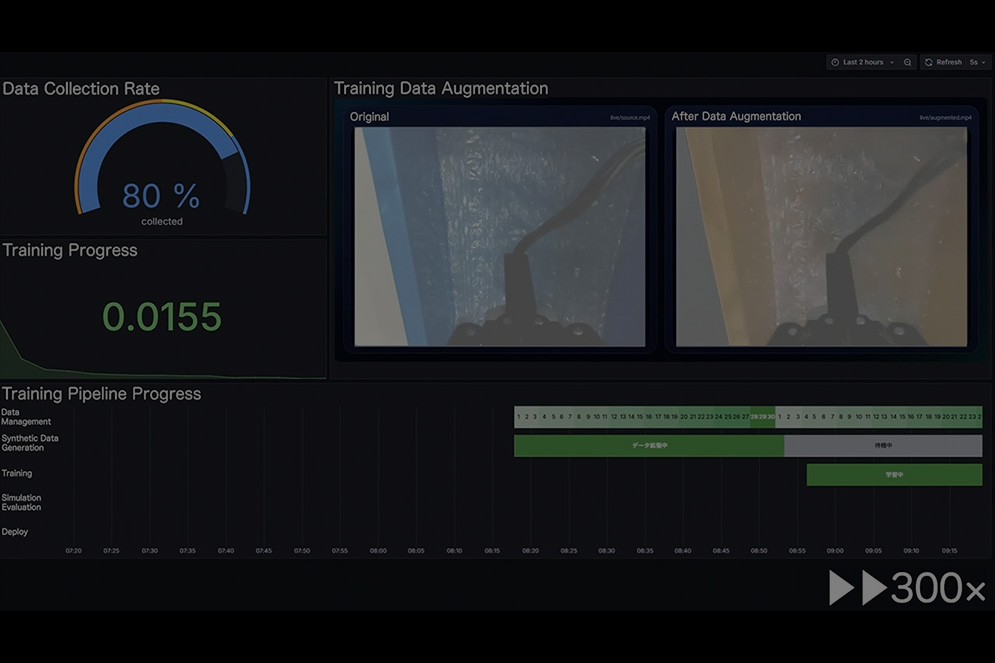
Data Collection Rate
The circular graph in the upper left of the screen indicates how much data has been collected relative to the amount required to start training.
As the robot operates, execution data accumulates, and the percentage in the circular graph increases. In this demonstration, the subsequent training pipeline is executed once the data reaches a certain quantity.
Training Progress
The status of the AI model training is displayed in the center left of the screen.
Once data augmentation is complete, AI model training begins using the collected and generated data. Engineers can monitor the model's status by checking the training progress and the transition of training metrics.
Training Data Augmentation
The upper right of the screen displays the original data obtained from the physical robot and the synthetic data generated from it.
Augmentation processing is performed on the data once obtained from the physical machine to increase the volume and variation of data used for AI model training.
Training Pipeline Progress
The bottom of the screen displays which stage of the training pipeline is being executed in chronological order.
In this demonstration, the process proceeds in the following sequence:
1. Data collection
2. Data augmentation
3. AI model training
4. Simulation evaluation
5. Evaluation result determination
6. Application to the physical robot
Visualizing multiple development stages in one GUI makes it easier to grasp which process is currently being executed. Once training is complete, the model is sent to the simulation environment. There, its performance for the target task is evaluated, and if it meets the criteria, it is applied to the physical robot.
In this way, the mechanism constructed this time not only uses the GPU to train the AI model but also connects the preceding and subsequent data processing, evaluation, and physical application as a single learning loop.
3.How Did the Robot's Behavior Change Through Training?
In this demonstration, the robot performed the task of storing a wire harness into a box, a flexible object handling task. The position and shape of the wire harness change with each operation. Furthermore, it is prone to bending, tangling, or folding, making it difficult to pre-determine the correct position to grasp it.
It is not easy to stably handle such flexible objects with rule-based control that presupposes fixed shapes and arrangements.
Recognizing Object Status Using VLA
The flexible object handling system developed by Yaskawa Electric uses VLA (Vision-Language-Action) to recognize the status of the object based on visual information obtained from cameras and work instructions.
The robot captures the position and shape of the wire harness from visual information and performs the necessary movements for grasping and manipulation.
Also, not all robot movements are replaced by AI. Stable operations handled by conventional robot control are separated from operations where Physical AI is effective (such as object status recognition and grasp position determination), and Physical AI is integrated as a functional module into the existing robot system.
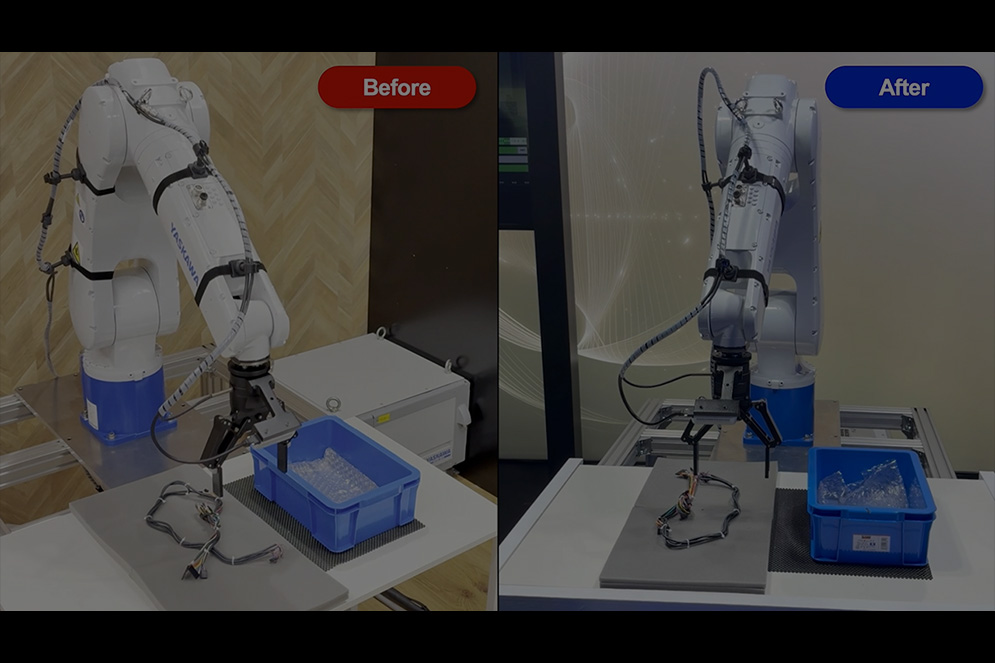
Robot Actions Before and After Training
Comparing the robot's actions before and after training, before training, the arm shows adjustments and hesitation in its movement from approaching the wire harness to grasping it.
In contrast, after training, the arm approaches the object smoothly and grasps the wire harness stably. Subsequently, it performs the continuous sequence of lifting the grasped wire harness, transporting it to the adjacent box, and storing it, all smoothly.
This comparison confirms that training improved the grasping action according to the object's condition, enabling more stable handling of flexible objects with inconsistent shapes and arrangements.
4. Technical Highlights of This Development and Demonstration
The key point of this initiative is the construction of a continuous development cycle connecting the physical machine and the GPU cloud, not just individual AI technologies.
Feeding Real-World Data Back to the Next Training Cycle
As the robot operates in the field, new operation data and sensor information are obtained. This information is accumulated on the GPU cloud and used for training the next AI model. Continuously feeding data obtained from the actual environment back into training leads to model improvements that adapt to changes in objects and working conditions.
Supplementing Real-World Data with Synthetic Data
While collecting real-world data is important, covering all various conditions only with the physical machine takes time. By combining synthetic data, the variation of training data is increased starting from the real-world data, allowing model training to proceed while minimizing the burden associated with data collection.
Applying to the Physical Machine After Simulation
The trained model is evaluated in a simulation environment before being applied to the physical machine. By checking the behavior not only for the target task but also for multiple tasks, it verifies that the basic performance of the model has not been lost due to the new training.
Connecting Development Processes within a Single Environment
Data collection, data augmentation, training, simulation evaluation, and physical application are not carried out separately but managed as a series of processes on the "AI Data Center GPU Cloud."
This aims to streamline the setup of the training environment and the development cycle, and to realize an environment where real-world data, AI model execution data, and synthetic data obtained by each company can be accumulated as assets and easily deployed to other operations and robots.
5. Future Development
In this demonstration, we constructed a learning loop—from real-world data collection, synthetic data generation, AI model training, simulation evaluation, to physical application—through the task of storing a wire harness into a box.
Going forward, it will be important to verify the application to more advanced tasks and to broaden the types of objects, working conditions, and robots involved.
SoftBank will expand the verification of Physical AI utilizing the "AI Data Center GPU Cloud," promoting the sophistication of robot development using diverse data and the establishment of a Physical AI development foundation.
The goal is to achieve Physical AI that can continuously improve while adapting to changes in the field, by feeding data obtained from the physical machine back into training and reapplying the evaluated AI model to the physical machine—a loop that is repeated.