Contents
- Blog
- HAPS
Explanation: World’s First Successful Demonstration of Laser Ranging by Tracking a HAPS from the Ground
#HAPS #FreeSpaceOpticalCommunication #CCR #SLR
Sep 17, 2026
SoftBank Corp.
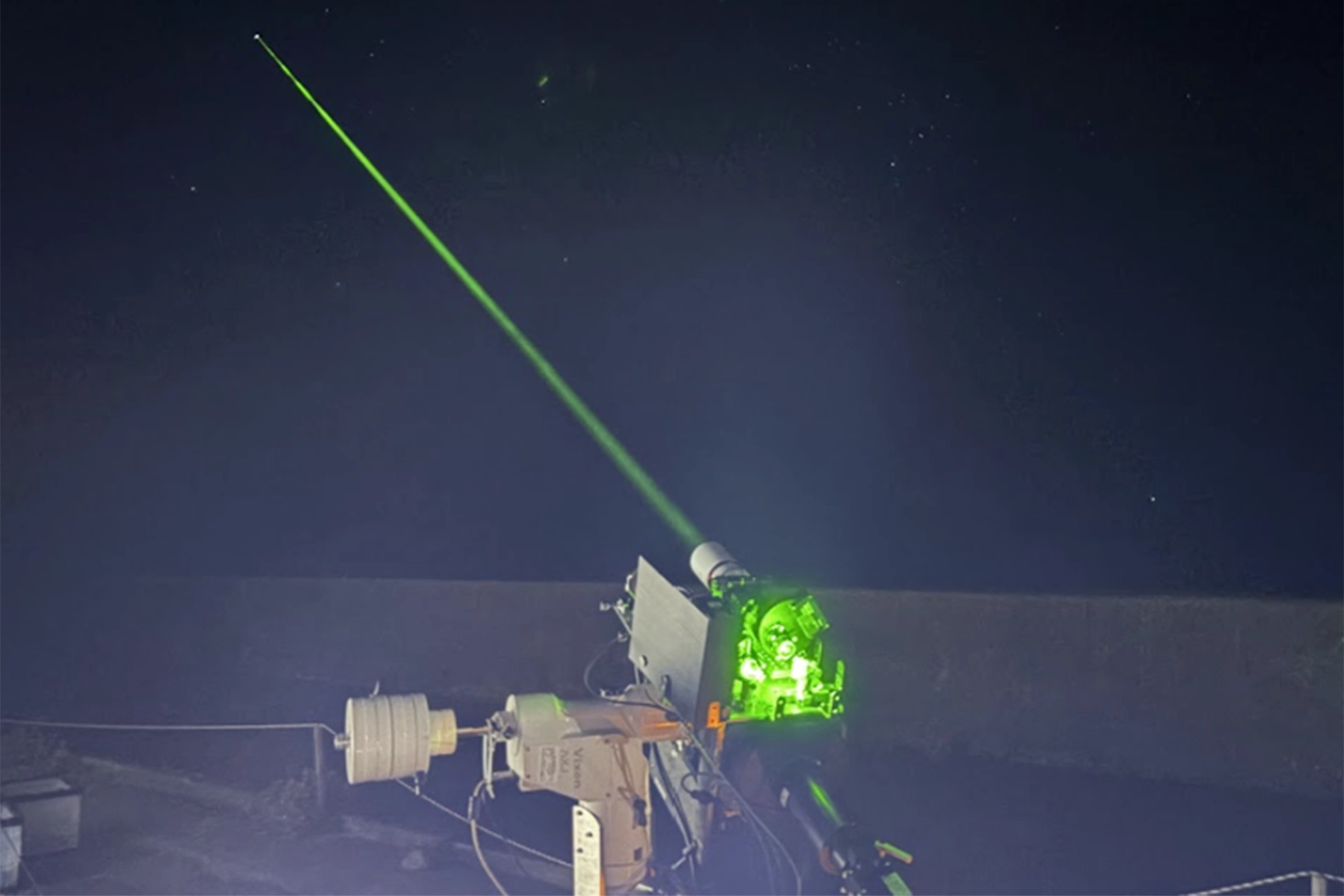
SoftBank is developing optical wireless communication technologies for the stratosphere as part of its efforts to realize next-generation communication networks using HAPS (High Altitude Platform Stations). As an important step toward this goal, we equipped a HAPS aircraft with a CCR (Corner Cube Reflector) and successfully received laser light transmitted from the ground and reflected back from the aircraft.
This unprecedented demonstration of a round-trip optical link between the ground and the stratosphere marks an important step toward future HAPS-based optical wireless communications. In this article, we look at how this experiment differs from previous stratospheric optical communication trials and explore the technical significance of this achievement.
1. Taking the First Step Toward Connecting HAPS with Optical Links
SoftBank is conducting a wide range of research and development initiatives toward realizing next-generation communication networks using HAPS, a stratospheric telecommunications platform. One of the key technologies being explored is optical wireless communication using laser light.
In future HAPS networks, HAPS will not only provide communication services to smartphones and other devices on the ground, but will also need high-speed links to ground stations, satellites, and other infrastructure. While optical wireless communication has the potential to provide high-capacity connectivity, it requires extremely narrow laser beams to be precisely directed at targets over long distances.
HAPS aircraft operate in the stratosphere, with their position and orientation constantly changing. Optically acquiring an aircraft flying at an altitude of approximately 20 km, tracking its movement, and precisely directing a laser beam toward it are therefore key challenges that must be overcome to enable full-scale optical wireless communications.
With the next step of installing optical wireless communication equipment on HAPS in mind, SoftBank conducted a demonstration using a CCR (Corner Cube Reflector).
2. Pointing Toward the Stratosphere and a New Approach: Establishing a Round-Trip Optical Path
A CCR (Corner Cube Reflector) is a special type of reflector that returns incident light in the direction from which it came. LRAs (Laser Retroreflector Arrays), which consist of multiple CCRs, are widely used for applications such as precision ranging to satellites.
In this experiment, SoftBank installed a CCR (LRA) on a HAPS aircraft and transmitted a laser beam from the ground toward the aircraft. The laser light reflected by the HAPS was then successfully detected back on the ground, demonstrating the successful acquisition of a laser return.
Several optical-link experiments involving stratospheric platforms have previously been conducted.
One notable example is STROPEX (Stratospheric Optical Payload Experiment), conducted by the German Aerospace Center (DLR). In 2005, an optical communication terminal was installed on a stratospheric balloon flying at an altitude of approximately 22 km, demonstrating high-speed optical communications at data rates of up to 1.25 Gbit/s from the balloon to an optical ground station.
Another example is SOLD (Stratospheric Optical Link Demonstration), conducted in 2023 by the U.S. Naval Information Warfare Center Pacific (NIWC Pacific), with support from NASA Ames Research Center and other organizations. An optical communication system was installed on an Aerostar high-altitude balloon, demonstrating an optical communication link from the ground to the stratospheric balloon.
While both were important pioneering demonstrations of optical communications in the stratosphere, their approaches differed from that of SoftBank's latest experiment.
In this experiment, SoftBank's first objective was neither to transmit communication signals from the HAPS nor to receive communication data transmitted from the ground at the HAPS. Instead, a passive CCR was installed on the HAPS, a laser beam was directed at it from the ground, and the same light was reflected back from the HAPS to the ground, where the extremely weak return signal was successfully detected.
Based on our review of publicly available information, we found no previous experiments in which a CCR (LRA) was installed on a HAPS aircraft flying in the stratosphere, irradiated with a laser from the ground, and the resulting return signal successfully detected. (*Based on research conducted by SoftBank, Hitotsubashi University, and the National Institute of Polar Research using publicly available information as of September 8, 2026.) This represents an unprecedented approach to establishing a round-trip optical path between the ground and the stratosphere, distinct from conventional optical links designed primarily for data communications.
SLR also requires beam-pointing and receive-tracking angular accuracy that is known to be approximately an order of magnitude higher than that required in these conventional optical communication links. This is because the light reflected by the CCR is returned within an extremely narrow angular range rather than being widely dispersed.
3. Why Detecting the Reflected Light Matters
At first glance, the experiment might seem as simple as “directing a laser at the HAPS and detecting the light reflected back.” However, from the perspective of realizing HAPS-based optical wireless communications, this experiment has significant technical implications.
One of the most challenging technologies in optical wireless communications is PAT (Pointing, Acquisition, and Tracking).
It is necessary to predict the location of a HAPS aircraft at a considerable distance, optically acquire it, precisely point a laser beam toward it, and continuously track the aircraft as it flies. Accomplishing all of this for a moving platform tens of kilometers away requires consideration of a wide range of factors, including not only positional information but also the tracking performance of the ground station, laser propagation, and atmospheric fluctuations.
Successfully acquiring a return from the CCR demonstrates that the entire process—optically acquiring a HAPS aircraft flying in the stratosphere from the ground, directing a laser beam so that it reaches the aircraft, and then detecting the returned light back on the ground—can be achieved in a real-world environment.
In addition, a CCR is a passive optical device that requires no power. This makes it possible to evaluate optical acquisition and tracking as well as propagation characteristics in the HAPS flight environment even before a full-scale optical communication terminal is installed on the aircraft.
In other words, this experiment is not an end in itself. Rather, it represents a step toward future optical wireless communications by progressively reducing the technical uncertainties that must be addressed along the way.
4. From “Returning Light” to “Connecting with Light”
The next goal is to build on this achievement and advance toward full-scale optical wireless communications.
While a CCR is a passive device that simply reflects incoming light, optical wireless communications require HAPS to be equipped with optical transceivers that transmit and receive laser beams carrying data while mutually acquiring and tracking their counterparts. This presents an even greater technical challenge. However, the gimbal system for the optical wireless communication terminal currently under development uses the same software architecture as the SLR system, which is also capable of satellite tracking. The experience gained through this experiment therefore significantly lowers the technical hurdles for the next stage.
In the future, establishing optical links between HAPS and the ground, as well as between HAPS and low Earth orbit (LEO) satellites, could pave the way for a new communications network that integrates the ground, stratosphere, and space.
For example, HAPS could provide connectivity to smartphones and other devices on the ground, relay their communications to satellites via optical wireless links, and then transmit the data onward to remote locations. In such a three-dimensional network, optical wireless communications are expected to serve as a high-capacity backbone for carrying large volumes of data.
STROPEX demonstrated optical communications “from the stratosphere to the ground” in 2005, while SOLD demonstrated communications “from the ground to the stratosphere” in 2023. Together, these experiments have demonstrated the potential of optical communication technologies in the stratosphere. SoftBank has now taken a different approach, establishing a round trip for light “from the ground to the stratosphere and back to the ground” via a CCR installed on a HAPS aircraft.
From “delivering light” to “returning light.” And next, to “connecting with light.”
Building on the knowledge gained through this demonstration, SoftBank will move forward with the next phase of optical wireless communication trials as it works toward realizing a next-generation network that seamlessly connects the ground, stratosphere, and space.
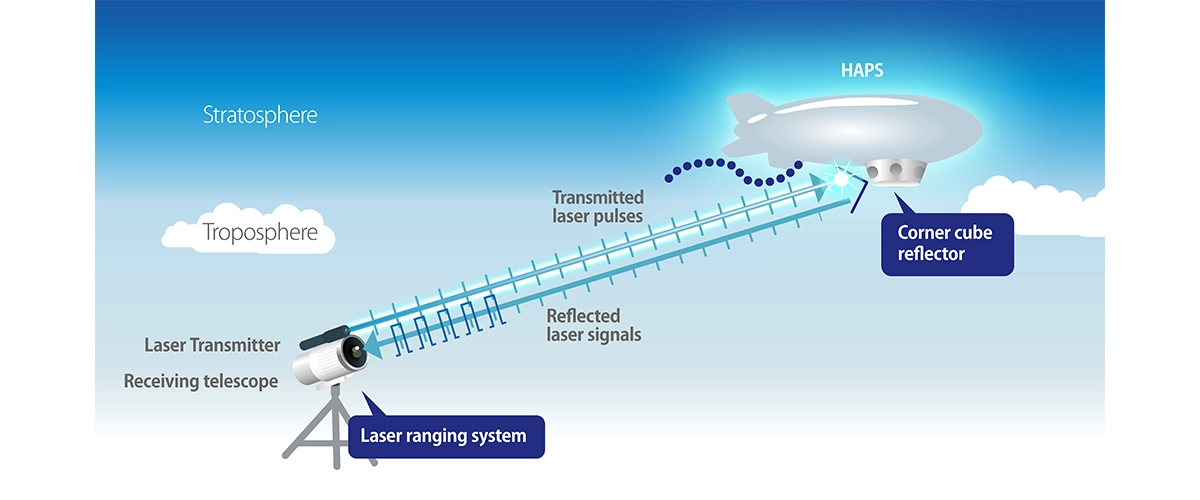
Figure 1. Illustration of HAPS Ranging Using SLR (Satellite Laser Ranging) Technology*
* An SLR system on the ground precisely directs short laser pulses toward a HAPS aircraft flying in the stratosphere. A receiving telescope then detects the faint reflected light returned by the onboard CCR (Corner Cube Reflector).
The distance to the HAPS is precisely measured based on the round-trip travel time of the laser pulses, while the HAPS is tracked with high accuracy throughout its flight. To ensure safe laser operation, laser transmission and observation are conducted while avoiding the directions of aircraft, the Sun, and other potential hazards.
Author