Contents
- Blog
The Journey and Future Vision of our US Site
(Division of SB Telecom America, the US Subsidiary of SoftBank Corp.)
#AI-RAN #Other #LargeTelecomModel #Transformer #OfficeTour
Nov 21, 2025
SoftBank Corp.
Topics
Dr. Rajeev Koodli is a distinguished global technology leader with over two decades of pioneering work in mobile communications, Internetworking and distributed cloud computing. With his vast expertise in leadership, strategy, architecture, product development, research, and innovation, Dr. Koodli has influenced the telecommunications and technology sectors through his transformative contributions to 4G/5G systems, hyperscale cloud infrastructure, IPv6 networking, and AI. His innovations have had significant impact on global mobile networking standards and his technical leadership has contributed to reshaping the industry.
1. Briefly, tell us about yourself
I am currently a Principal Fellow at SoftBank Research Institute of Advanced Technology (RIAT) and SVP at SB Telecom America, the US subsidiary of SoftBank Corp.. I lead the Silicon Valley site, a product engineering team for AI infrastructure as well as R&D on AI foundations for Mobile Networks. Previously, I have held leadership positions at Intel, Google, Starent (acquired by Cisco) and Nokia working on AI, hyperscale computing, 4G/5G networks, IP mobility & networking and distributed systems.
2. How did we get started?
It was a serendipitous meeting with Dr. Ryuji Wakikawa, Head of SoftBank’s RIAT, in early 2024 that led to where we are now. Dr. Wakikawa was looking to launch AI-RAN in the US in collaboration with NVIDIA and I was looking to take a deeper dive into AI. Things went into high gear quickly and before long, two budding engineers Shun Tamura and Yuto Kawai joined me as we started our US site in April 2024! Our initial goal was to grow SoftBank’s AI-RAN technology in partnership with NVIDIA. We started in NVIDIA Building K in Santa Clara, with access to a rack of GPU clusters which we used for AI-RAN and AI training. Over the course of time, our scope began to grow which I will explain below, and we were fortunate to find a new office in the heart of Sunnyvale downtown.
Yuto Kawai and Shun Tamura, Engineers
3. Okay, Why Silicon Valley Office however?
As the AI transformation reshapes the societies around the world, we have an amazing opportunity to be an active contributor to the way AI Infrastructure, Software and Models are created and consumed in the areas of the society served by SoftBank Corp..
These areas, notably the AI Data Centers and Mobile Edge AI, have global societal impact in the years to come and are important for SoftBank. With Silicon Valley being the hub of AI innovation and home to strategic partners like NVIDIA and startups leading this transformation, it is imperative that we innovate locally in Silicon Valley in order to lead in AI. Doing so presents us with immense potential of talent from across the world, top-notch Universities as well as access to collaborators and customers.
4. “Zero to One”
One of the topics I had discussed in our serendipitous meeting was building a foundation model for mobile telecom networks! My vision was (and still is) to leverage the vast amounts of private telco data at SoftBank to transform network operations and wireless signal processing.
The development of SoftBank’s Large Telecom Model (LTM) marks a classic “0 to 1” journey for us – moving from a concept to a foundation model. Bootstrapped after the establishment of our U.S. office in Spring 2024, this effort involved transforming raw telecom data and decades of engineering intuition into a functional, high-performance AI system. The AI challenge was foundational but setting up the infrastructure was deeply complex: securing terabytes of production network data from fragmented operational sources, establishing secure GPU compute and storage infrastructure, and building robust data pipelines capable of handling diverse, messy, real-world telemetry. Much of our work was highly iterative - training loops, evaluation frameworks, and continuous feedback between model behavior and data quality. This cycle - train, evaluate, tune, and repeat - was not just technical optimization, but the encoding of deep, operational telecom knowledge into a generative AI foundation model.
Equally, the development of the Transformer Model for Wireless Signal Processing is another “0 to 1” milestone for us. We started asking the question in the summer of 2024: “Could a dense transformer architecture do better than classic Neural Networks for signal processing?” I had a “hunch” that the “Self Attention” mechanism has to be able to produce “more” (if not “better”) from input context than Convolutional Neural Networks, which had shown promising results in our previous Channel Interpolation work. However, this was generally seen as unnecessary and impractical. However, as we debated, my intuition grew stronger: “If only” we could encode the wireless signals in a tensor form that can be turned into temporo-spatial embeddings for Self Attention and decoded as wireless tasks (like interpolation), this could work! However my team was not fully convinced. But, we persisted. Through frustratingly and excitingly long cycles of design, experimentation and evaluation, we managed to show the feasibility for a Neural Receiver, second only to the perfect CSI! The model has now shown low latency capability - around 330 microseconds for channel interpolation task!
Furthermore, the model has shown very promising capabilities to generalize for a variety of tasks including Massive MIMO, SRS Prediction, Multi-user Pairing and others.
Both the LTM and Transformer Machine AI have been progressing steadily. It is very encouraging to see LTM being incorporated into Sarashina, the LLM with Japanese language capabilities as well as LTM use cases being trialed at SoftBank business unit for operations. Similarly, Transformer Machine AI is now growing to include a large number of use cases!
5. How did the new Sunnyvale site come about?
Good question! While we were busy with LTM, I started looking at the evolving infrastructure industry focused on AI. Unlike classic cloud, one could argue that AI workloads are more specific around training, finetuning and inferencing which translate to GPU-centered infrastructure (compared to classic cloud focused on CPU, networking, databases, enterprise integrations and so on). Of course the cloud hyperscalers are major players, there is also the emergence of "Neo Clouds" for AI. These new developments have provided us with an opportunity to bootstrap and build our own AI Infrastructure Software Product for SoftBank Corp.. With the support from leadership, we have indeed embarked on this ambitious project which necessitated finding a suitable site to accommodate a larger team, space, lab etc. While much work needs to be done considering our aggressive timelines, we have built a strong core team and a nice office. And, we continue to hire strong candidates!
Our Sunnyvale, CA Office
6. What are your closing thoughts?
The US site focus now includes creating:
■ Infrastructure Software Product for AI: This serves as the crucial foundation for supporting AI workloads (training, finetuning and inference) running on centralized and edge data centers and managing the underlying infrastructure. This is a product program.
■ A broader ecosystem around the AI RAN momentum: These activities include continuing our on-going strong development effort with NVIDIA, establishing new partnerships with Universities and Government agencies as well as industry leadership roles in the AI RAN Alliance.
■ AI Foundation Models for Mobile Networks: As we have discussed, these models are the basis for general expertise and transfer learning for various use cases involving mobile networks. LTM is for Telco Opex reduction and Transformer Machine AI for Telco Capex improvement. We continue to evolve them with the AI advances in reasoning and Reinforcement Learning. This is an Advanced R&D program.
The team has grown considerably during the first half of 2025, so it was a good thing we planned ahead and established a new office in the beautiful Sunnyvale downtown! We have put together a strong core team for AI Infrastructure and continue to actively grow the next batch, especially in Test Infrastructure and AI frameworks as we embark on deployment of the GB200 platform in Japan.
AI-RAN continues to grow, with the Alliance now over a hundred members!
Personally, it's been a rewarding experience bootstrapping a new site and team. Throughout this journey, the team and I have had lots of fun working in a start-up-like environment. I am grateful to Wakikawa-san and SoftBank leadership for their unwavering support and confidence! I am excited to see the "Zero to One+" accomplishment on the R&D side. I am really looking forward to what we accomplish on the AI Infrastructure Software Product! Stay tuned, exciting times ahead.
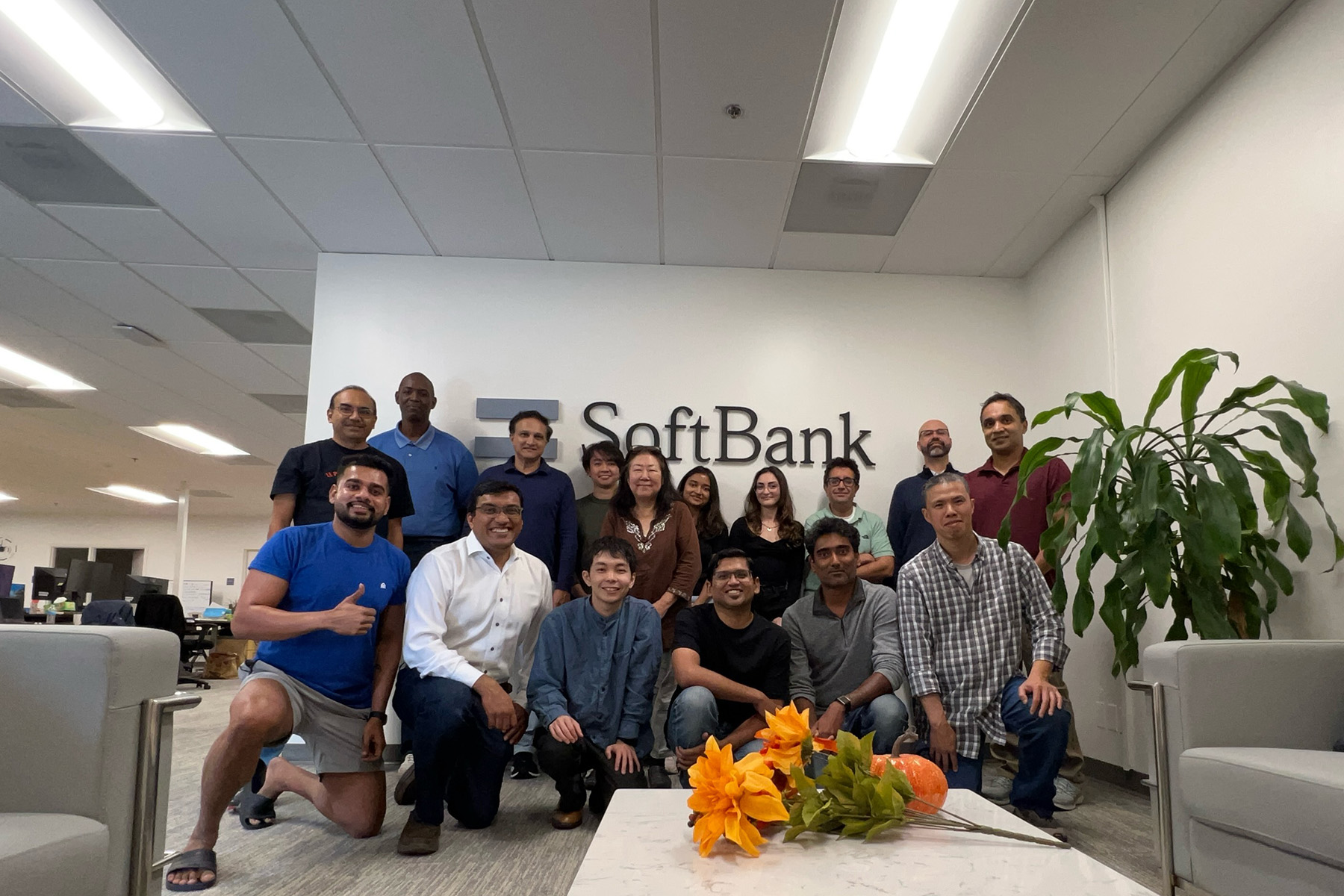
Our Team
References
Large Telecom Model
Press Release: SoftBank Corp. Develops a Foundational Large Telecom Model
Press Release: SoftBank Corp.’s Large Telecom Model - a Generative AI Foundation for the Telecom Industry- Evolved into a Domestic AI Model and Launched for Internal Use
Webinar Archive: Archive Now Available: GenAI Large Telecom Model: The Future of Mobile Network Operations
Transformer Model for Wireless Signal Processing
Press Release: SoftBank Corp. Boosts 5G AI-RAN Throughput by 30% with New Transformer AI
Preprint Research Paper: A Unified Transformer Architecture for Low-Latency and Scalable Wireless Signal Processing
Webinar Archive: AI-Native Mobile RAN Signal Processing - A Transformer-based Approach