
The English edition of SoftBank Corp.’s (TOKYO: 9434) Integrated Report for 2025, published on October 31, 2025, provides a comprehensive overview that includes a look back at the fiscal year ended March 31, 2025 (FY2024), management’s perspectives on medium- to long-term growth strategies centered on AI, financial strategies, and shareholder returns. It also introduces SoftBank’s strategies aimed at realizing “Next-generation Social Infrastructure,” as well as its initiatives related to ESG and risk management.
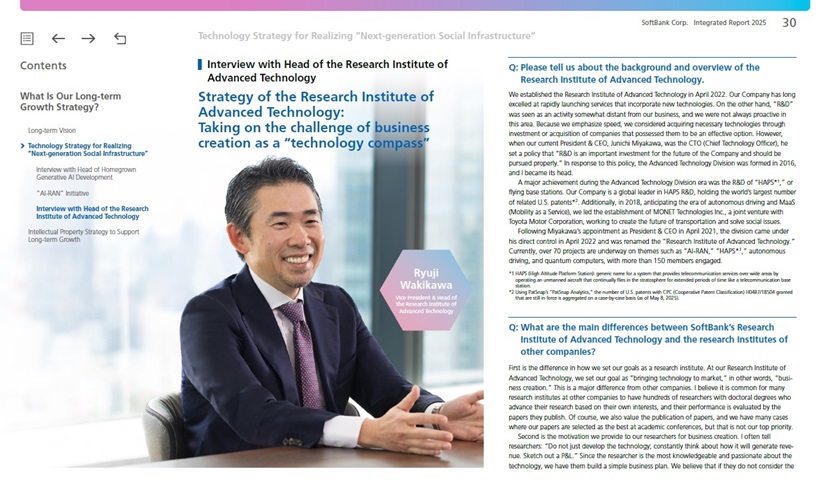
To achieve its Long-term Vision, SoftBank is pursuing various technology strategies, and in April 2022, the SoftBank Research Institute of Advanced Technology was newly launched to conduct R&D aimed at the practical realization of new technologies. In the report, Ryuji Wakikawa, Vice President & Head of the Research Institute of Advanced Technology, was interviewed to explain the Institute’s characteristics, the strategic goals of “AI-RAN” and other key research areas. Below is an excerpt.
SoftBank Integrated Report 2025

Every year, SoftBank publishes an Integrated Report, a comprehensive document that includes information on its vision, medium- to long-term growth strategies, value creation processes, materiality, and financial and non-financial information.
Overview of the Research Institute of Advanced Technology
Please tell us about the background of the Research Institute of Advanced Technology.
We established the Research Institute of Advanced Technology in April 2022. Our Company has long excelled at rapidly launching services that incorporate new technologies. On the other hand, “R&D” was seen as an activity somewhat distant from our business, and we were not always proactive in this area. Because we emphasize speed, we considered acquiring necessary technologies through investment or acquisition of companies that possessed them to be an effective option. However, when our current President & CEO, Junichi Miyakawa, was the CTO (Chief Technology Officer), he set a policy that “R&D is an important investment for the future of the Company and should be pursued properly.” In response to this policy, the Advanced Technology Division was formed in 2016, and I became its head.
A major achievement during the Advanced Technology Division era was the R&D of “HAPS*¹,” or flying base stations. Our Company is a global leader in HAPS R&D, holding the world's largest number of related U.S. patents*². Additionally, in 2018, anticipating the era of autonomous driving and MaaS (Mobility as a Service), we led the establishment of MONET Technologies Inc., a joint venture with Toyota Motor Corporation, working to create the future of transportation and solve social issues.
Following Miyakawa's appointment as President & CEO in April 2021, the division came under his direct control in April 2022 and was renamed the “Research Institute of Advanced Technology.” Currently, over 70 projects are underway on themes such as “AI-RAN,” “HAPS*1,” autonomous driving, and quantum computers, with more than 150 members engaged.
- *¹
HAPS (High Altitude Platform Station): generic name for a system that provides telecommunication services over wide areas by operating an unmanned aircraft that continually flies in the stratosphere for extended periods of time like a telecommunication base station.
- *²
Using PatSnap's “PatSnap Analytics,” the number of U.S. patents with CPC (Cooperative Patent Classification) H04B7/18504 granted that are still in force is aggregated on a case-by-case basis (as of May 8, 2025).
The story behind the “AI-RAN” concept
How was the “AI-RAN” concept born?
The “AI-RAN” concept was born as we addressed the massive computation associated with virtualization (realizing with software the processing previously handled by dedicated communications hardware). In 2019, Rakuten Mobile, Inc. announced that it had achieved virtualization on its network, which became a major topic in the telecommunications industry. Virtualization has significant merits such as flexibly scaling base stations according to mobile traffic demand, cost, and the ease of adding functions via software updates. However, our assessment was that the technology was not yet mature enough to handle the massive traffic by our more than 20 million smartphone subscribers at that time.
So, when we considered how to achieve virtualization in the future, we focused on the GPU. We thought that the technology cultivated in graphics processing and its parallel processing capabilities were well-suited for the massive signal processing of radio units. Initially, the GPU performance was not sufficient, and we could not get the performance we wanted. As we continued through trial and error, NVIDIA announced an AI computing infrastructure equipped with a high-performance GPU, which led to the hypothesis that “If we use this to create a mechanism for signal processing of radio units with AI, we could create something amazing.” This was the catalyst for the birth of the “AI-RAN” concept.

The entire interview can be found here.
(Posted on November 14, 2025)
by SoftBank News Editors



