
Held in October against the backdrop of Kyushu’s rich natural landscapes and vibrant cities, the “Mynavi Tour de Kyushu 2025” brought together top cyclists from Japan and abroad in a premier road race. To ensure uninterrupted live streaming that captured both the stunning backdrops and the intensity of the race, SoftBank Corp. (TOKYO: 9434) provided technical support for the event by deploying Eutelsat’s OneWeb LEO constellation, a global low Earth orbit (LEO) satellite network service.
Streaming live video across a mountainous, high-altitude course

Launched in 2023 as a symbol of recovery from natural disasters that occurred in Kyushu, Japan's third-largest and most southerly main island, and to drive cycle tourism, the Mynavi Tour de Kyushu is a prestigious road race certified by the Union Cycliste Internationale (UCI).
Mynavi Tour de Kyushu 2025 – Official Website
Since its launch in 2023, the annual event showcases breathtaking landscapes and historic towns along the route. However, in the previous two races, live footage was occasionally interrupted in mountainous areas with limited cellular connectivity. This was especially problematic during the “Kumamoto Aso Stage,” where the course winds through one of the world’s largest calderas, reaching elevations of approximately 900 meters with elevation changes of up to 500 meters. The dramatic climbs and descents, which play into key moments of the race, were previously difficult to transmit to viewers.
To overcome this challenge, TV-Kumamoto, the local broadcaster responsible for video broadcasting, tried a new transmission approach using Eutelsat’s OneWeb LEO constellation. At TV-Kumamoto’s request, SoftBank provided technical support for the live broadcast.
Operating at an altitude of approximately 1,200 kilometers, Eutelsat’s OneWeb LEO constellation delivers connectivity across the planet, even in locations where ground-based cellular signals struggle to reach.
Extensive testing done in advance for high-speed, on-the-move broadcasting

To get an in-depth look at how Eutelsat’s OneWeb LEO constellation was used in the race, SoftBank News spoke with Seiichi Fukuda of TV Kumamoto and Ryohei Yamaguchi, who provided technical support for the project.

Seiichi Fukuda
Technical Department
TV-Kumamoto
Responsible for transmission technology for terrestrial TV broadcasts, Fukuda joined TV-Kumamoto in 2015. He served as a Technical Director for Tour de Kyushu coverage for the third time, taking on the challenge of implementing video transmission in mountainous terrain.

Ryohei Yamaguchi
Satellite Planning Department
Product Technology Division
SoftBank Corp.
Yamaguchi joined SoftBank in 2020. He worked as a systems engineer addressing enterprise network challenges before transferring to the technical team for Eutelsat’s OneWeb LEO constellation.
Yamaguchi supported this project by focusing on problem-solving for enterprises and satellite connectivity utilization.
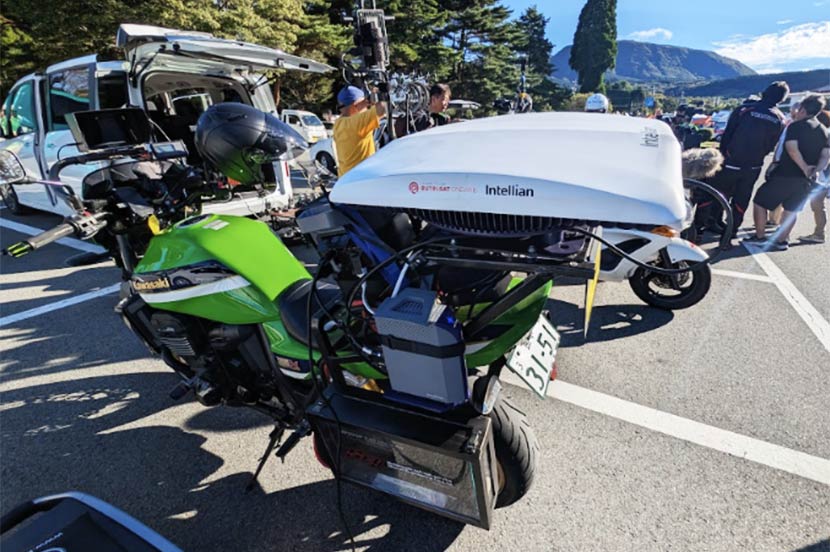
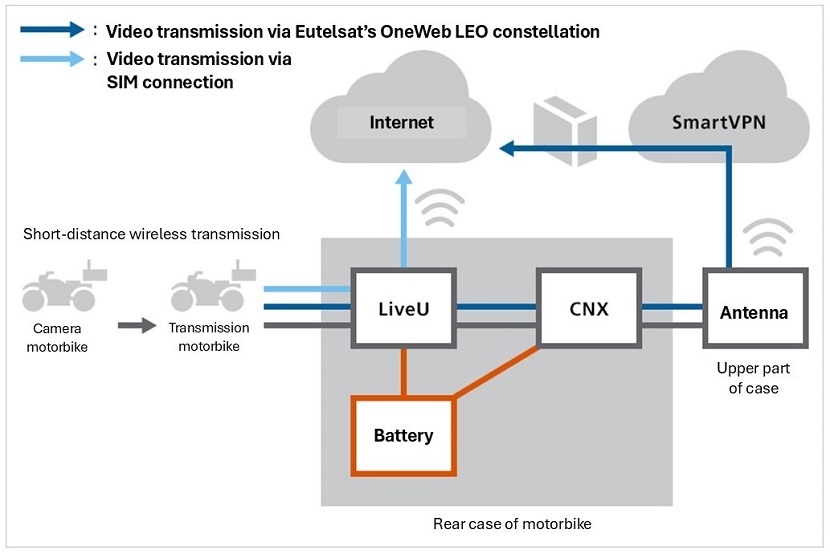
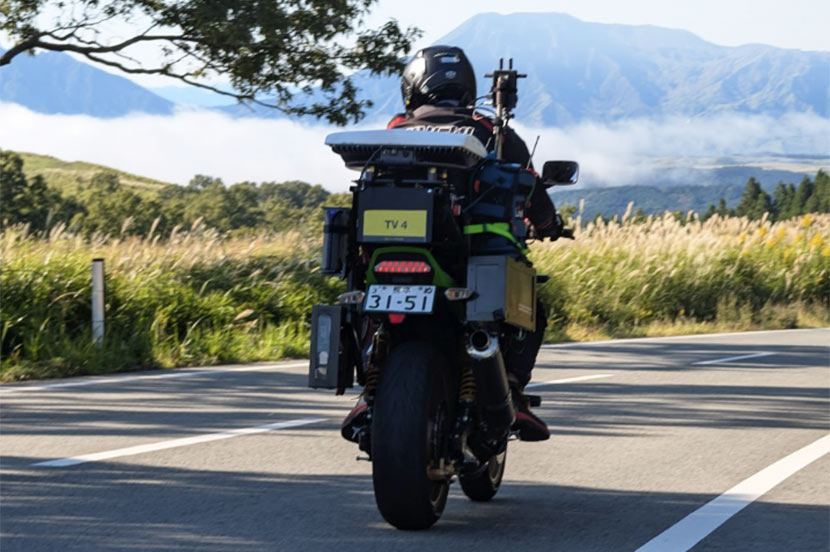
The setup involved a motorcycle equipped with an antenna for Eutelsat's OneWeb LEO constellation and a LiveU video transmission device that also used a cellular data connection. Footage from a separate motorcycle equipped with a camera was sent to the transmitting motorcycle and then uplinked via a connection with Eutelsat's OneWeb LEO constellation.
Why did you decide to adopt Eutelsat’s OneWeb LEO constellation for this race?
Fukuda: During races, cyclist speeds can get up to around 70 km/h. Our camera crews ride motorcycles at nearly the same speed as the cyclists, and at a close proximity to them. Frankly, covering the race can be life-threatening. We want every second of that footage to reach viewers. So after the 2024 race, we began exploring new video transmission methods with that goal in mind.
How did the evaluation process go?
Fukuda: We had the experience of using Starlink for other broadcasts and were confident with the stability of LEO satellite communications. However, Starlink doesn’t support data transmission on the move, so we kept searching. When we learned about Eutelsat’s OneWeb LEO constellation, we immediately felt this was the solution and consulted with SoftBank.
To transmit footage at actual race speeds, mounting the antenna on a highly mobile motorcycle was essential. Initially, the antenna size made that impractical, but SoftBank later proposed a new type of compact antenna, and that made the concept feasible.
What was your first impression when TV-Kumamoto approached you about this project?
Yamaguchi: There was no precedent for mounting a satellite antenna on a motorcycle, and I knew tree cover on mountain roads would inevitably block reception at times. Honestly, the idea felt like a major challenge. At the same time, if successful, it would perfectly demonstrate the advantages of Eutelsat’s OneWeb LEO constellation, which is maintaining connectivity while moving in and out of areas without cellular coverage. This made the project very exciting.
What advantages did you see in Eutelsat’s OneWeb LEO constellation?
Fukuda: The biggest advantage was that it works on the move. Stable connectivity in mountainous areas outside mobile coverage areas was another major benefit. We also considered using Field Pickup Units (FPUs), but covering such an expansive course would have been extremely difficult. The ability of Eutelsat's OneWeb LEO constellation to maintain communication quality at high speeds was very appealing. Originally, we planned to mount all equipment on a single motorcycle with the camera gear, but size constraints made that impractical. After consulting with and getting permission from the race organizers, we added a dedicated video transmission motorcycle.

How did the on-course testing go?
Fukuda: We mounted the borrowed equipment on motorcycles and conducted test runs on the actual Kumamoto Aso course. Connectivity occasionally dropped off in heavily forested areas, but the signal reconnected almost instantly when the sky opened up. It proved to be a very effective method for covering a fast-paced race.
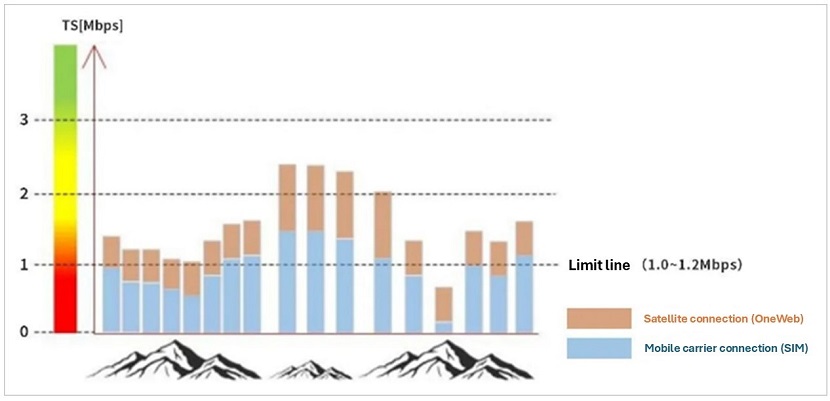
Testing across the entire course showed that video transmission success rates improved dramatically, from around 30% using mobile carrier data alone to approximately 80% when combined with Eutelsat’s OneWeb LEO constellation.
What technical considerations did you look at for testing and installation?
Yamaguchi: We carefully looked at power requirements and antenna placement, factoring in satellite visibility and safety. During test runs, we identified mobile dead zones and unstable sections, then verified connectivity with Eutelsat's OneWeb LEO constellation. The results demonstrated a significant improvement in transmission success compared to mobile data alone.
Delivering Footage of Aso’s Dramatic Landscapes and Race Developments to Viewers in Real Time

How did colleagues and stakeholders react to the introduction of Eutelsat's OneWeb LEO constellation?
Fukuda: After doing test runs at the Aso course in mid-July, we conducted real-world trials at another road race in August. Expectations rose quickly, but we prepared extensively. We had to carefully explain the transmission methods between motorbikes and coordinate distance rules with race organizers to ensure we had their understanding and approval.
How did you prepare for the risk of transmission failure?
Fukuda: Once the race starts, the ability to do on-site troubleshooting is extremely limited. With a tight schedule, we had to build and test both motorcycles in parallel, which was really challenging.
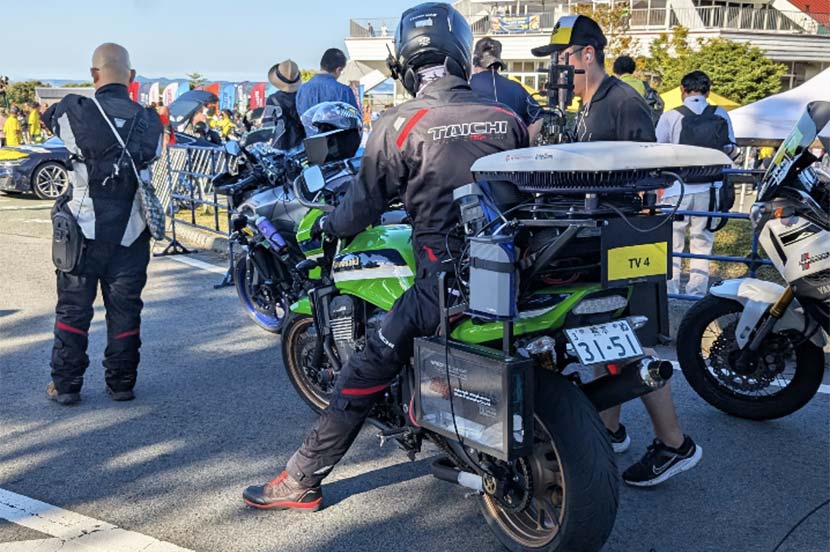
Yamaguchi: As the race proceeds at a high speed, the only immediate response to an outage after the race starts would be restarting power systems. So we prepared spare devices and backup connections, and implemented comprehensive preventive measures up to the last minute.
What left a lasting impression?
Fukuda: In previous years, live footage dropped off right after the start of the race. This time, we delivered clear video extensively, from the race action to Aso’s sweeping scenery. The weather was perfect, with even a sea of clouds visible.
Yamaguchi: We conducted final checks early in the morning and monitored connectivity remotely throughout the race. Even in mountainous areas without cellular coverage, many transmission segments succeeded. We received a great deal of positive feedback about the effectiveness of Eutelsat's OneWeb LEO constellation.
Drones were also used to capture footage, right?
Fukuda: With frequent elevation changes, the communication environment shifts rapidly. By taking motorcycle-captured footage and combining it with feeds from drones and fixed cameras, we could deliver the most suitable visuals. Motorcycle feeds switched dynamically between Eutelsat's OneWeb LEO constellation and mobile data as backup.
Did this improve the live commentary about the race as well?
Fukuda: When video isn’t available, commentators rely on GPS mapping, which can be inaccurate. This year, with far more live footage, they could describe the status of cyclists and race conditions more accurately and in greater detail.
How did viewers respond?
Fukuda: During the YouTube livestream, viewers commented early on about the race and scenery. In past years, there were comments like “come back, signal,” which reflected connectivity issues. This year, that tone completely changed. It felt more like viewers were cheering on a signal that was already working. There were fewer comments about connectivity and more about the weather, mountains, flora and race tactics. That shows that viewers were fully immersed in the race itself.


Where do you see future use cases for Eutelsat's OneWeb LEO constellation?
Yamaguchi: Demand for connectivity while on the move in areas without mobile coverage extends beyond broadcasting. This kind of connectivity is also needed for disaster response, infrastructure inspection, and more. Eutelsat's OneWeb LEO constellation also offers security advantages by enabling direct access to closed networks without going through the public internet. At SoftBank we aim to expand the use of Eutelsat's OneWeb LEO constellation into infrastructure and disaster prevention fields as well.
Mynavi Tour de Kyushu 2025

The official Mynavi Tour de Kyushu YouTube channel features archived footage of the race supported by SoftBank Corp. Don’t miss the chance to see thrilling competition.
Related Articles


(Posted on January 16, 2026)
by SoftBank News Editors



