
Around the world, studies are underway to identify new spectrum bands for 6G, the next generation of mobile communications.
SoftBank Corp. (TOKYO: 9434) is focused on the 7 GHz band—considered to be one of the strongest candidates—and, together with Nokia, conducted outdoor field trials to demonstrate that the band can provide solid area coverage and high communication quality, even in dense urban environments.
On November 19, 2025, SoftBank hosted a media briefing, and held a technical conference on 6G development, which welcomed participants from Japan’s Ministry of Internal Affairs and Communications (MIC), telecommunications operators and research institutions involved in 6G spectrum allocation. During the events, SoftBank presented results from its outdoor experiments and outlined network concepts for supporting an AI-driven society in the 6G era.
New spectrum requirements for 6G and mid-band and centimeter wave characteristics
Driven further by the expansion of AI-powered services, global mobile traffic is expected to surge by a factor of five to nine in the coming years. At this rate, the currently utilized 3.9 GHz band, primarily used for 5G, could reach capacity around the year 2030.
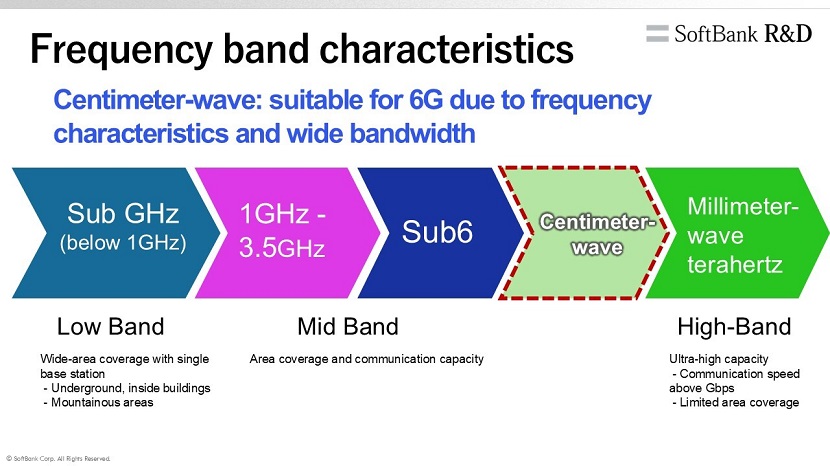
To address this issue, securing new spectrum bands will be essential for 6G. International discussions have been focusing on higher mid-band frequencies (approximately 1-10 GHz), particularly the 6.4–8.4 GHz range. With wavelengths of roughly 3-5 centimeters, this spectrum is referred to as centimeter wave (or “centi-wave”), and is known to exhibit radiowave propagation characteristics similar to Sub-6 GHz frequencies. Compared to 5G millimeter wave, centimeter wave signals experience less attenuation and can diffract more effectively around buildings, making them a promising candidate for balancing coverage and high bandwidth.
For 6G, 200 MHz or 400 MHz bandwidth requirements, wider than those used for 5G, are under consideration. Because centimeter-wave spectrum can support several hundred MHz of contiguous bandwidth more easily, SoftBank has been engaged in the early research and development of this spectrum. SoftBank conducted urban field trials to assess its feasibility in the real world.
Field trials in Tokyo’s Ginza district demonstrate coverage and performance comparable to 3.9 GHz
During the media briefing, SoftBank presented findings from 7 GHz trials conducted outdoors in Tokyo’s Ginza district since June 2025.
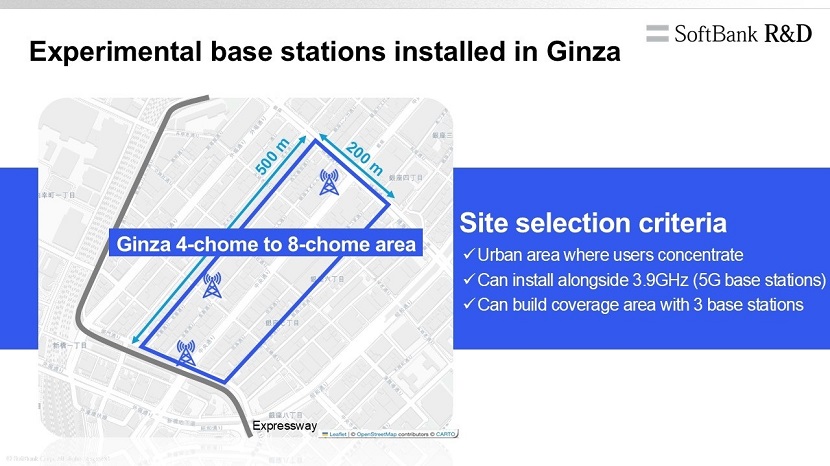
A highly dense urban environment, Ginza was intentionally selected to evaluate how well the higher-frequency 7 GHz band can secure coverage and communication quality in actual metropolitan conditions.
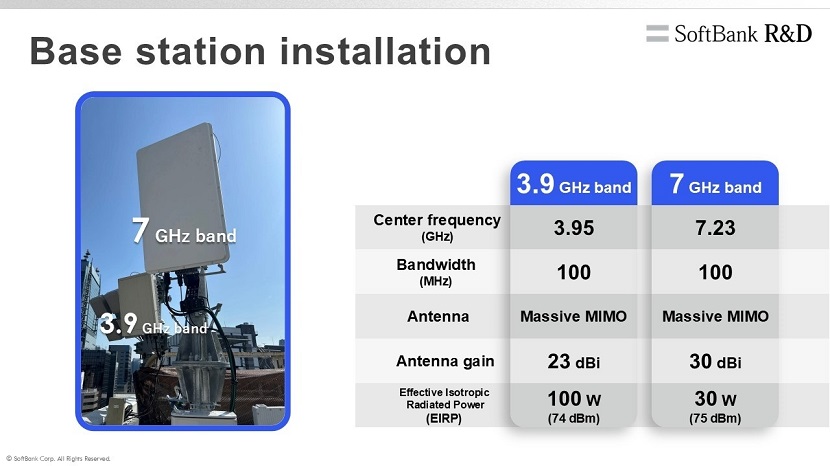
For the trial, SoftBank handled network construction and test environment preparation, while partner Nokia provided base stations and test equipment supporting the 7 GHz band. Three experimental base stations were deployed across the test area to evaluate propagation characteristics, coverage performance and communication quality. Results were compared to existing 3.9 GHz base stations.
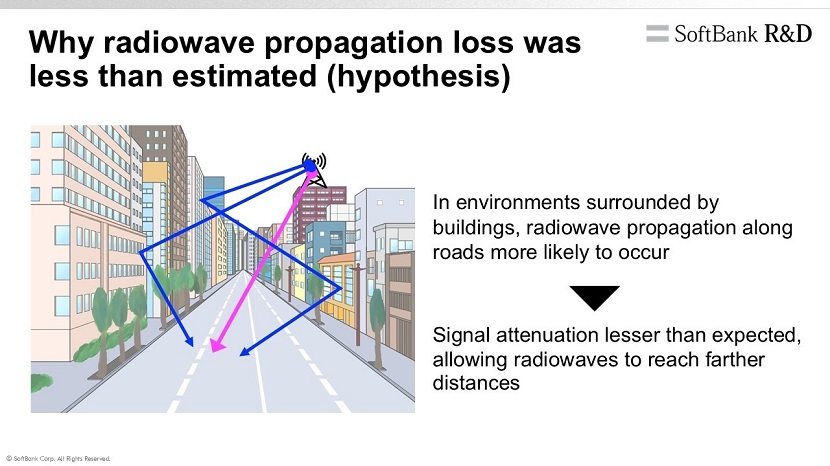
Measurements revealed that 7 GHz performance in urban settings was comparable to that of the 3.9 GHz band. In line-of-sight environments, the 7 GHz band, despite its theoretical disadvantages, benefited from the urban “canyon effect,” enabling signals to propagate as effectively as, or even better than, 3.9 GHz. The canyon effect occurs when signals reflect and diffract off building surfaces, reducing signal escape and minimizing attenuation. This phenomenon allowed SoftBank to achieve broader-than-expected coverage.
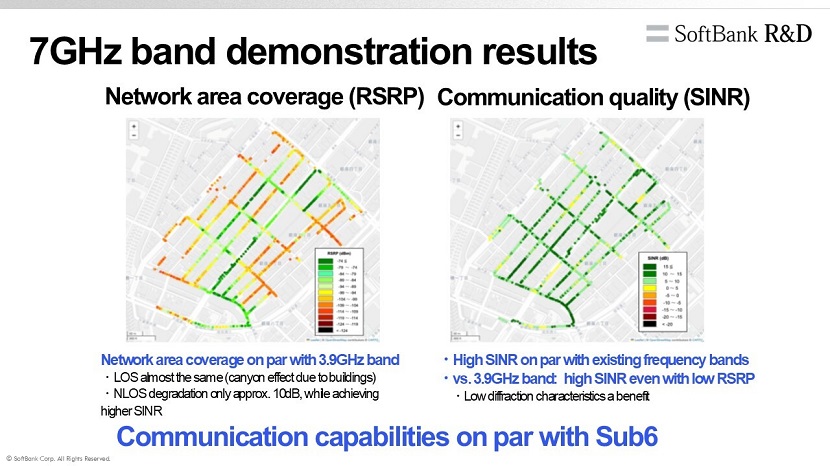
Even in non-line-of-sight areas, the trials showed almost no outage, confirming that a sufficiently practical and stable network could be built. Because 7 GHz beams are narrower, the limited number of test base stations experienced less interference from other bands, and reflections contributed to stable radiowave propagation to support high communication quality.
Demonstration conducted using a vehicle equipped with a 7 GHz antenna
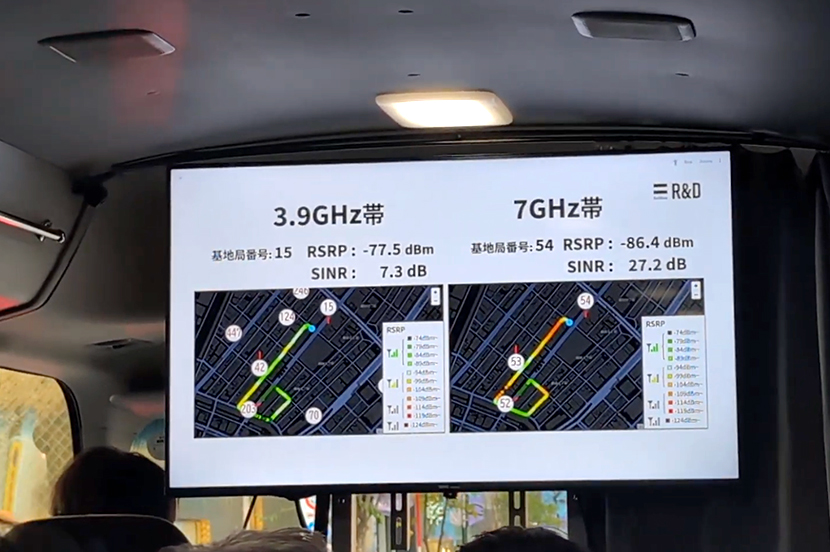
Following the briefing, a demonstration was conducted using a vehicle equipped with a 7 GHz antenna and dedicated terminal, which drove through the Ginza test area to confirm coverage performance, communication quality and radiowave propagation characteristics.


A monitor mounted at the front of the vehicle displayed real-time maps of RSRP (Reference Signal Received Power)*¹ and SINR (Signal to Interference plus Noise Ratio)*² values along the driving route, allowing comparisons between 3.9 GHz and 7 GHz. Both indicators remained consistently strong throughout the demonstration, validating the effectiveness of the 7 GHz band in dense urban environments.
- *¹
RSRP (Reference Signal Received Power) indicates the signal strength in a mobile network, measured in dBm (the closer to 0, the stronger the signal).
- *²
SINR (Signal to Interference plus Noise Ratio) expresses the ratio of signal power to interference and noise, measured in dB (higher values indicate more stable and faster communications).
Advocating the Value of the 7 GHz Band for the 6G Era

Apart from this field trial, SoftBank and Nokia have been collaborating on AI-RAN development and next-generation network technologies for 6G, working together as strategic partners to realize communication infrastructure for the future.
Building on these efforts, SoftBank hosted its “6G Tech Conference” as a forum for key stakeholders from the industry, academia and public institutions involved in evaluating communication methods and spectrum allocation for 6G. The conference presentations looked at why the 7 GHz band is a strong candidate for 6G and technologies expected to underpin next-generation communication platforms.
Maximizing the “Golden Band” for 6G

During the conference, Ari Kynäslahti, Senior Vice President, CTO Mobile Networks Strategy and Technology, Nokia, identified the 6.4–8.4 GHz range as the “Golden Band for 6G.” He explained that many countries around the world are actively evaluating mid-band frequencies as potential spectrum for 6G.
Kynäslahti also highlighted the 7 GHz base station used in SoftBank’s field trials.
“It’s comparable in size to 3.5 GHz equipment but can incorporate more antenna elements. It provides sufficient beamforming performance at higher frequencies and can be deployed in the same site configurations as 3.5 GHz,” he noted, emphasizing its design advantages.

Drawing on the field trial results, he concluded that unlike millimeter wave, the 7 GHz range offers relatively low attenuation both indoors and outdoors and can leverage existing infrastructure. This, he said, increases the likelihood that mid-band frequencies will become the primary spectrum used for 6G.
Making better use of a finite resource

Next, Ryuji Wakikawa, SoftBank Vice President and Head of the Research Institute of Advanced Technology, spoke about SoftBank’s commitment to advance networks for an AI-centric society.
“SoftBank today is fully shifting toward an AI-native society. Networks themselves will evolve into infrastructure that carries AI,” he noted, outlining current initiatives aligned with the anticipated growth of AI-driven services.
A new network architecture needed for the AI era
Traditional mobile networks were primarily designed for smartphone use. However, traffic volumes are rapidly increasing due to AI adoption, while services such as autonomous driving and telemedicine require both ultra-low latency and high-capacity transmission. As a result, the demands placed on networks have changed dramatically.
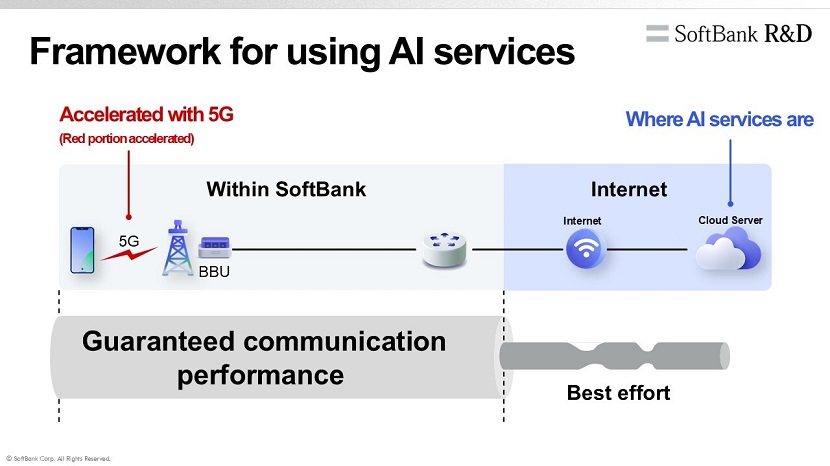
Wakikawa pointed out a challenge today’s networks face. “5G achieves high speed and high capacity, but because application processing occurs in the cloud beyond the public Internet, best-effort constraints in that space often prevent us from fully realizing 5G’s potential,” he said. He highlighted edge computing, which processes data closer to a device, as a key solution for minimizing latency and ensuring stable communication.
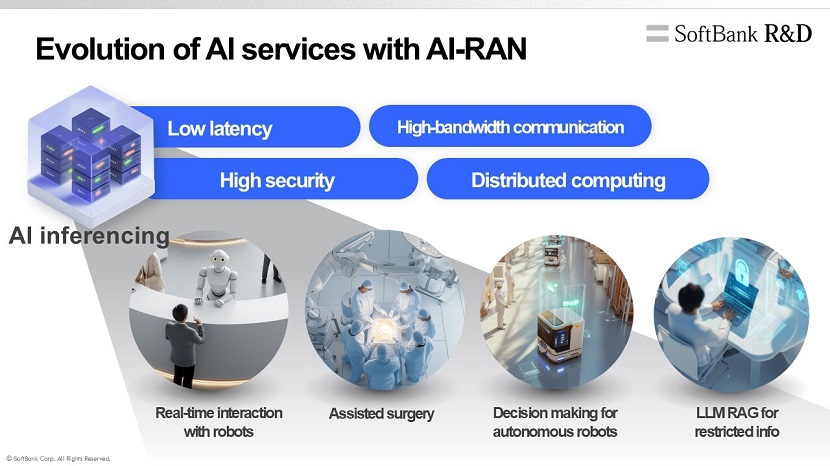
However, he also noted that edge computing lacks sufficient applications that run natively at the edge. “Physical AI for robotics or remote surgery are ideal use cases for edge AI, and AI-RAN will enable an environment where such edge AI workloads can run seamlessly,” he explained.
AI-RAN as an “AnyG” solution
Wakikawa then introduced SoftBank’s AI-RAN product, AITRAS. “Thanks to the versatility of GPUs, both radio processing and AI processing can operate on the same platform. AITRAS is built by combining various technologies SoftBank has been developing, and it serves as a foundation for next-generation networks by enabling AI inference optimization, automated radio environment tuning, and more,” he said.
He emphasized that AI-RAN is not only for 6G, noting it is an “AnyG” initiative that can also be applied to 4G and 5G, underscoring that practical deployment is not far off.
Regarding the 7 GHz band used in the field trial, Wakikawa addressed the conventional concern that wider bandwidths lead to interference when base stations are densely deployed. “Because 7 GHz can form sharper beams than 3.9 GHz, radio paths are easier to predict, making the band more usable than expected,” he said. He also emphasized the importance of global coordination as spectrum discussions move toward the World Radiocommunication Conference (WRC) in 2027, where the 7 GHz band will be formally reviewed.
Enabling dynamic spectrum sharing through “spectrum sensing”

Wakikawa also introduced “spectrum sensing,” a technology designed to make efficient use of limited spectrum resources. Using AI, the system detects surrounding spectrum usage in real time and automatically utilizes available channels.
In Japan, the 6.5–8 GHz range is currently used for satellite communications and broadcasting, and spectrum sharing with other services is actively discussed. Wakikawa noted that AI-powered sensing could allow coexistence without interfering with existing systems, suggesting that AI has the potential to fundamentally change how spectrum is managed.
Achieving international alignment and domestic readiness for AI and communications standardization

In his keynote lecture, Dr. Akihiro Nakao, Professor at the Graduate School of Engineering, The University of Tokyo, and Co-Chairman of XG Mobile Promotion Forum (XGMF), emphasized that the fusion of AI and communications will be key to next-generation networks.
He described ongoing efforts within the AI-RAN Alliance, of which The University of Tokyo is a member, and at “6G MIRAI-HARMONY,” a Japan–EU joint research project that advances AI-enabled network optimization and communication standardization.
“To achieve both international harmonization and domestic readiness, coexistence with existing services must be assumed,” he stressed. He noted that discussions within Japan’s XGMF, which involves Japan’s Ministry of Internal Affairs and Communications, telecommunications operators, and research institutions, will play a critical role in shaping Japan’s future 6G strategy. He emphasized the importance of close collaboration between private and public entities and academia.
Related News


(Posted on January 13, 2026)
by SoftBank News Editors



