
Over the past 25 years, the effects of climate change have seriously impacted many parts of the world, with Japan being no exception. According to the Japan Meteorological Agency and other government agencies, since 2000, the number of extremely hot days has increased by 2.6 times, flash floods by 1.3 times and landslides by 1.5 times on an annual basis. The economic damage resulting from typhoons and forest fires has also reached record levels.
Since they absorb CO2, forests play a crucial role in mitigating climate change. Forests lose their ability to absorb CO2 as they age, however, and accordingly, they must be protected, restored and sustainably managed. According to Japan’s Forestry Agency, approximately 80% of Japan’s trees are now over 51 years old, and over the 10 year period from 2014 to 2023, the amount of CO2 forests absorbed fell by 26% (in other words, they absorbed 61 million tons in 2014 versus 45 million tons in 2023).
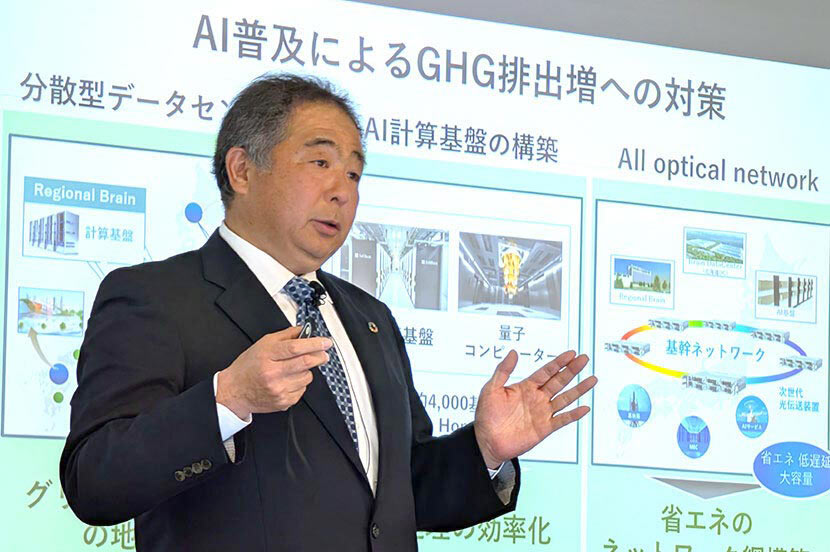
To help address this issue, on July 30, 2025, SoftBank Corp. (TOKYO: 9434) unveiled two new initiatives to help conserve forests and realize a decarbonized society. At a press conference held in Tokyo, President & CEO Junichi Miyakawa, CEOs from group companies, and government representatives at the national and prefectural level assembled to talk about them in detail.
Forest conservation support for Japan’s Prefectures nationwide

In his presentation, Miyakawa unveiled the first initiative—a project designed to restore and regenerate Japan’s forests. Using the Corporate Hometown Tax Donation Program*, SoftBank will donate over 4 billion yen to 46 of Japan’s Prefectures and Hachioji City in Tokyo to support forest conservation activities from 2025 to 2040. Assuming the entire amount is allocated to planting trees, the donation will yield approximately 1.8 million trees over the 15 year span.
- *
A program that enables companies to receive tax credits on their corporate taxes when they make donations to regional revitalization projects certified by the national government.
While forests cover about 70% of Japan’s landmass, challenges such as more artificial forests reaching logging maturity, as well as aging and neglected forests, are becoming apparent. To address this, SoftBank is collaborating with local governments to systematically promote forest conservation efforts tailored to local conditions, including restoring abandoned forests, addressing wind and pest damage and re-greening former forest development sites.
Promoting eco-friendly actions by leveraging customer services with “NatureBank”

Miyakawa then unveiled the second initiative: “NatureBank.” Launched on July 30, 2025, NatureBank is a tree-planting contribution program driven by customer participation. At the time of launch, the program consists of 16 eco-friendly actions based on services offered by SoftBank and its group companies, creating a framework that allows customers to see and feel how they are reducing greenhouse gas (GHG) emissions through their daily actions.

In accordance with the amount of CO2 reduced through eco-actions by customers, SoftBank will support the planting of trees that absorb the equivalent amount of CO2. NatureBank is designed so the number of trees planted increases in proportion with the growth of eco-friendly actions, creating a system where increased customer participation leads to more support for forest conservation.
CEOs from SoftBank’s group companies presented some specific examples about how their services support NatureBank.

Takeshi Idezawa, President and Representative Director, CEO of LY Corporation, said that when users of “Yahoo! JAPAN” transit guide and car navigation services choose routes with lower environmental impacts, trees will be planted in line with their actions.

Ichiro Nakayama, Representative Director, President, Corporate Officer, CEO of PayPay Corporation, explained that since “PayPay” is a cashless service, GHG emissions resulting from its transactions are about one-fourth compared to cash-based transactions. He also mentioned PayPay Bank’s use of digital bankbooks and other paperless initiatives are helping to reduce environmental impacts.
At the press conference, Government Ministers, Prefectural Governors, and others expressed their support for the forest conservation initiative. One attendee stated, “To achieve results in forest conservation, it’s essential for citizens, businesses, and local governments to work together. This initiative will help address challenges and support local communities.”

Related Articles

(Posted on August 4, 2025)
by SoftBank News Editors



