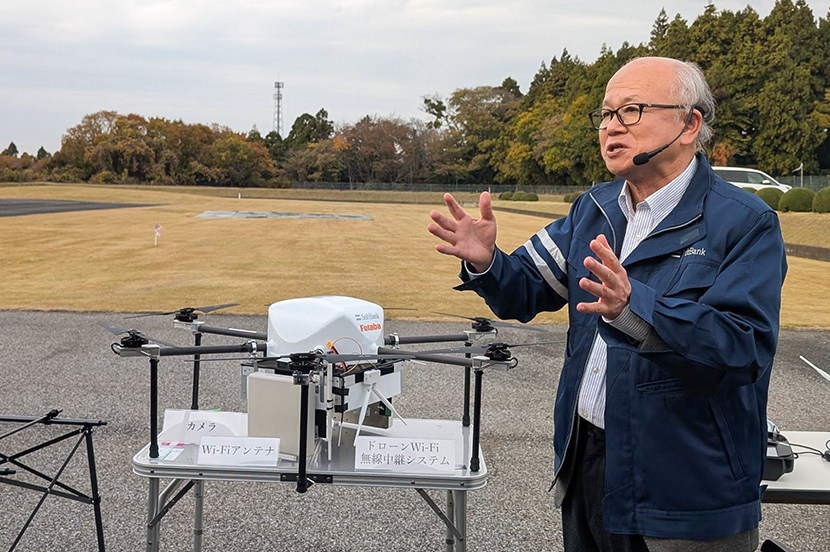
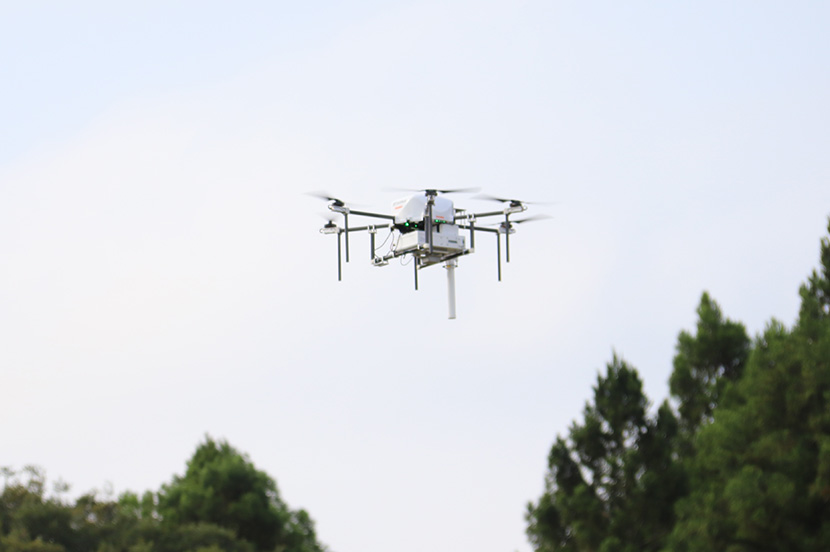
The Institute of Science Tokyo and SoftBank Corp. (TOKYO: 9434) are jointly developing a system that utilizes drones and Wi-Fi to determine the location of people in search and rescue operations. On November 27, 2025, members of the press were invited to a briefing and demonstration held in Ichihara City, Chiba Prefecture, to see how the technology works firsthand. Led by Teruya Fujii—a Specially Appointed Professor at the School of Engineering, Institute of Science Tokyo, and a Fellow at SoftBank’s Technology Research Laboratory—the event introduced a new system that can locate missing persons without relying on the services of mobile operators used either by the missing person or the search team.

Teruya Fujii
Specially Appointed Professor
School of Engineering
Institute of Science Tokyo
Fujii is a Specially Appointed Professor with the Fujii/Ohta Laboratory, which is a part of the Department of Electrical and Electronic Engineering within the School of Engineering at the Institute of Science Tokyo, and was established as a joint research program with SoftBank. His research covers a broad range of wireless communications, focusing mainly on technologies related to Beyond 5G/6G, drone-based wireless relays, and three-dimensional radiowave propagation.
A new search system that does not depend on mobile carrier services
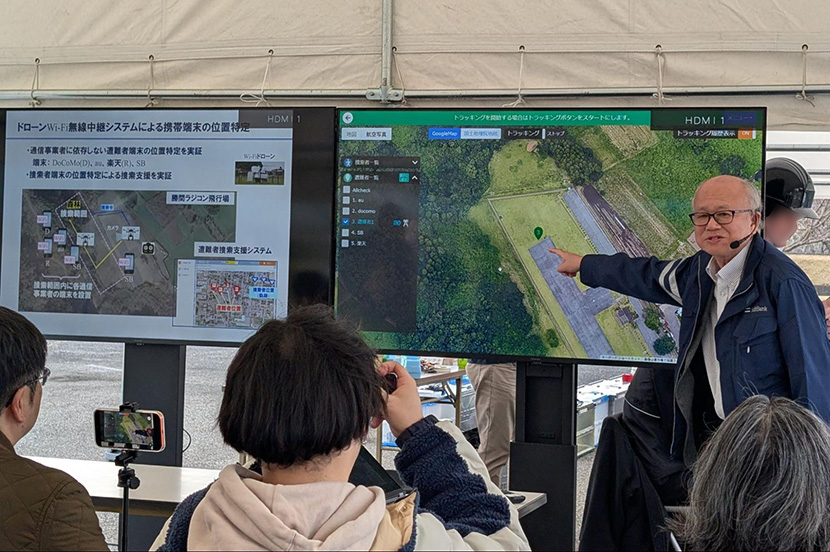
The Institute of Science Tokyo and SoftBank have been developing a system that uses drones equipped with mobile relay devices to acquire the location of people who become lost in alpine regions. However, the traditional approach faced two major challenges. The first challenge was the system’s dependency on the wireless services of mobile carriers. Because the usable frequency band was limited to SoftBank’s wireless network, the system could not obtain location information for people using the services of other mobile operators.
The second challenge was complying with regulatory restrictions defined in Japan’s Examination Standards Related to the Radio Act, which set safety and technical requirements for operating radio equipment in the air. Under these standards, drones equipped with mobile relay devices had to be tethered to cables, preventing them from flying freely across large areas and limiting their ability to conduct searches with the flexibility required in the field.
“To address these issues, we shifted to a new approach that uses Wi-Fi,” Fujii explained. “Wi-Fi isn’t dependent on any specific mobile carrier, and the 2.4 GHz band used in this system is permitted for aerial operation, making it possible for us to overcome previous limitations.”
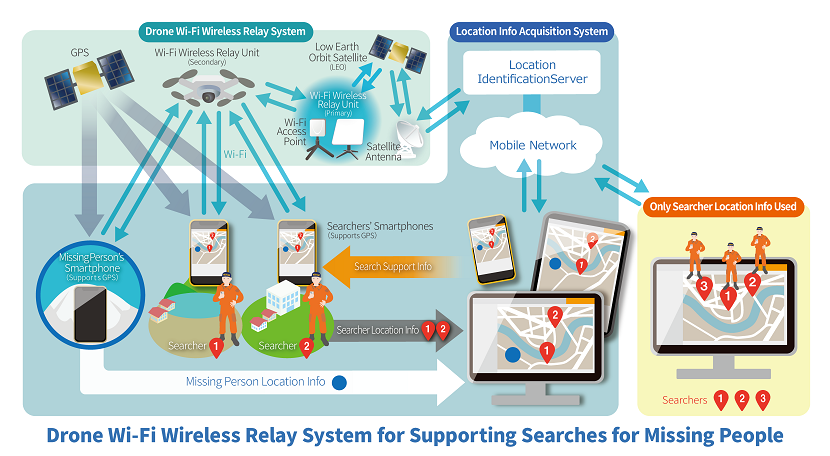
“By equipping drones with high-gain directional antennas capable of emitting stronger radiowave signals, a single drone flight can now cover an extensive area of 3 to 4 kilometers,” he added.
Voice relay function enables searches for people without smartphones
By equipping drones with microphones and speakers, the system now allows for two-way communication, enabling search teams to call out to missing persons and capture their responses.
Fujii explained the motive behind this feature. “Search teams asked if we could also support searches for people who don’t have smartphones on them. Large drones generate significant rotor noise and create strong downdrafts directly below them, making it impossible for a microphone mounted on the drone body to capture voices from the ground. To get around this issue, we introduced a system that lowers a microphone and speaker up to 80 meters using a cable winch. By distancing the microphone from the drone, we could minimize noise interference to allow clearer voice transmission and improved detection of responses from missing persons.”
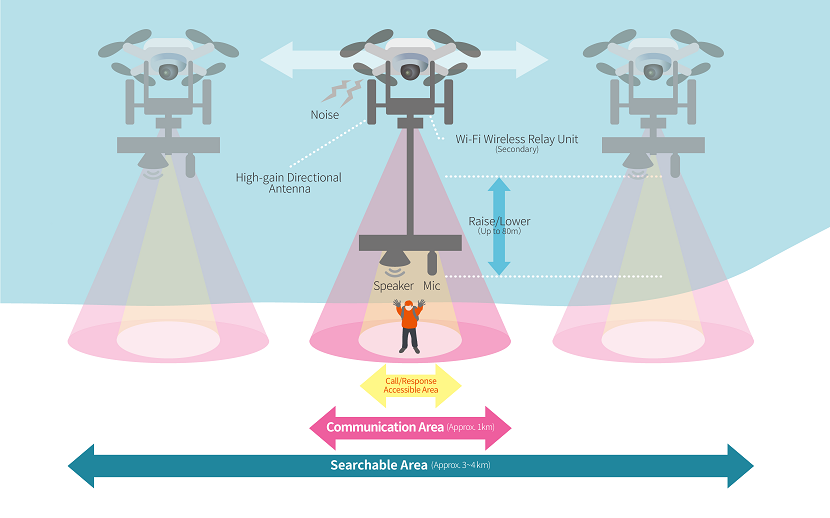
This voice relay feature also enables remote communication, not only on-site, but from distant locations as well. For example, parents who are far away can directly call out to a missing child, providing psychological reassurance. AI voice conversion technology is also implemented to enhance clarity, allowing voices to be automatically transformed into, for example, a high-pitched female voice for better listenability.
The Institute of Science Tokyo and SoftBank are aiming to commercialize an integrated system that combines the “Drone Wi-Fi Wireless Relay System for Supporting Searches for Missing People” and the “Wi-Fi–enabled Mobile Device System for Locating Missing People.” To strengthen disaster response capabilities, they will continue conducting research in collaboration with municipalities, public agencies and companies.
Related News

(Posted on January 7, 2026)
by SoftBank News Editors



