
“With their ability to think and act independently, I believe AI agents will usher in a social transformation that surpasses the ones brought by previous Industrial Revolutions.”
So remarked Junichi Miyakawa, President & CEO of SoftBank Corp. (TOKYO: 9434), during his keynote presentation at SoftBank World 2025, a major event for enterprise customers in Tokyo, on July 16, 2025. Over the course of his talk, Miyakawa explained to Japan’s business leaders how AI agents will reshape the industry landscape.
The evolution of society’s driving forces
Miyakawa opened his address by looking back at the “The War of the Currents,” a historical rivalry between Nikola Tesla and Thomas Edison, illustrating how groundbreaking technologies have repeatedly become society’s primary drivers of change.
“In the early days, electricity merely lit lamps. But Tesla’s invention of the alternating current (AC) motor powered machinery ignited the Second Industrial Revolution. It was an invention that fundamentally altered the very structure of society.”
Miyakawa traced the succession of technological driving forces—from the motor that powered machines in the Second Industrial Revolution, to the integrated circuit that powered information technology in the Third Industrial Revolution—to today’s arrival of an entirely new driver.
“In the form of AI agents, ‘the power of intelligence’ has now arrived as a driving force. These systems can think and take action on their own. This will bring a scale of transformation that makes earlier Industrial Revolutions pale by comparison. The Fourth Industrial Revolution is now truly underway.”
From knowledge to action: AI agents that evolve autonomously
“The pace of AI’s evolution has reached levels beyond our imaginations. AI models improve a thousandfold every four years,” Miyakawa noted.
“AI’s progression has shifted from mere the expansion of knowledge, using knowledge models, to acquiring reasoning abilities that think independently with autonomous models. This year, fully autonomous AI—or AI agents—have finally emerged.”
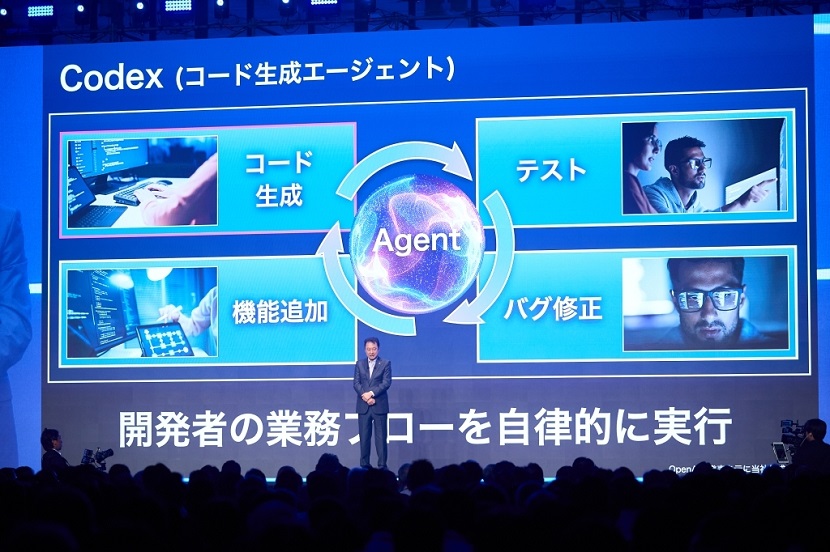
As an example, Miyakawa cited OpenAI’s “Codex,” which autonomously cycles through code generation, testing, debugging and feature enhancement until a program is complete. Codex’s contest scores rival those of top human programmers, proving that advanced development is no longer the sole domain of experts. He even showed how he used Codex to develop a game based on Othello.
“With just verbal instructions, the AI produced a finished Othello game in minutes—and added a play-against-the-AI feature in under five minutes. I can even develop software now. Complex development steps that once required specialist engineers are becoming accessible to anyone. I truly believe that this year marks a fundamental shift.”
In this sense, AI agents are democratizing expertise, heralding an era in which anyone can unleash their creativity.
AI agents acting as “digital labor”
So how will self-thinking, self-acting AI agents transform business? Miyakawa presented two case studies from SoftBank Corp. group companies to answer this question.
- Research agent (using “Sarashina,” developed by SB Intuitions):
Give it a topic or question, and the agent frames research tasks, identifies new questions midstream, digs deeper and delivers a detailed report in five minutes. - Call center agent (being developed by by Gen-AX Corp.):
The agent handles requests like travel booking changes through natural conversations. Behind the scenes, multiple specialized AI agents coordinate under an orchestrator that acts like a conductor to link multiple AI agents, systems and controls to check availability, propose plans and manage customer data.
These case studies show AI agents doing more than just streamlining tasks—they embed themselves in processes to autonomously create value as genuine “digital labor.” Miyakawa predicts this shift could even transform the traditional relationship between consumers and businesses, and how companies transact among themselves.
“Companies that hesitate to adopt AI agents may no longer meet consumer needs. As businesses and consumers increasingly deploy AI agents, we’ll eventually enter an ‘A2A’ era, a time where agents interact directly with one another,” Miyakawa said.
Now is not the time to sit on the sidelines

How should companies respond to AI’s breakneck pace of evolution? Miyakawa was clear about SoftBank’s stance.
“In a time of accelerating AI progress, sitting on the sidelines is not an option. At SoftBank, we refuse to stand by; we’re driving the full-scale adoption of AI. Two years ago, we rolled out generative AI to every employee and have since held nine AI contests internally, which brought in more than 210,000 submissions.”
He highlighted two standout AI agent initiatives that were born from these contests.
- Agent that investigates traffic accidents
Traditionally, accident investigation and reporting takes over four months in Japan. By combining EDR (Event Data Recorder, a device in a vehicle that records driving data before and after a collision) vehicle data and high-precision GPS in a cloud-based digital twin, an AI agent now generates detailed reports in hours—transforming insurance assessments and social systems. - Agent that creates presentations
Automates presentation slide creation. Even dense, unfocused content is restructured into clear, company-branded presentations in minutes, drastically cutting the hours employees spend on deck building.
Apart from individual projects like these, Miyakawa explained that SoftBank is rolling out a company-wide initiative to create AI agents.
“At our June monthly morning meeting for employees, we showed how easy it is to build an AI agent in ten minutes. We then challenged every employee to create 100 agents by the end of August. In six weeks, 20,000 employees created 900,000 agents.”
SoftBank now leads the world in the number of agents—and our momentum continues to grow.
Co-creating the future with partners in the AI Era
Miyakawa closed by linking AI agents to SoftBank’s vision to become a provider of next-generation social infrastructure.
“Owning vast GPU resources requires massive investment. By providing these resources as a cloud-based service, we’re enabling any company to easily build and operate AI-powered systems—for instance, a 24/7 call center— and scale up usage as needed. Yet, no amount of AI agent hype matters unless our customers’ data is organized and integrated. SoftBank stands ready to support that data integration.”
Lastly, Miyakawa issued a call to action for Japan’s business leaders.
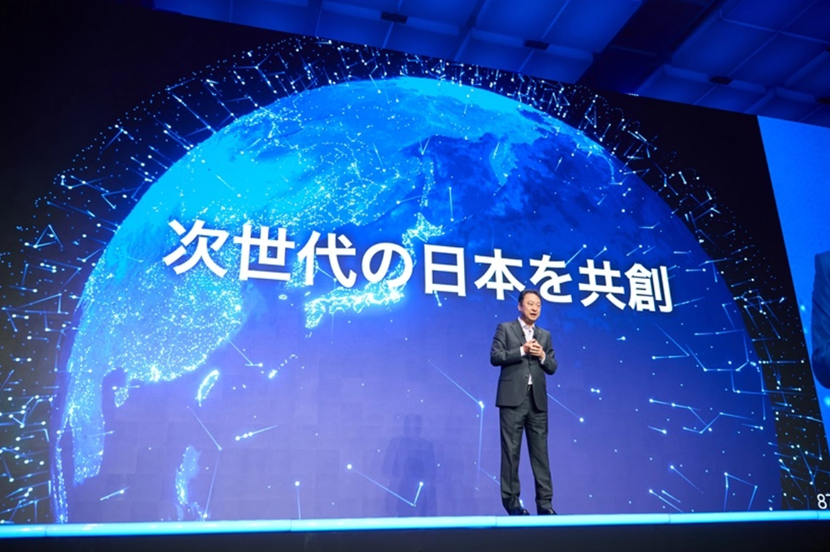
“AI systems continue to evolve. You may ask yourselves, ‘When is the right time to implement AI?’ The answer is now. Don’t overthink things—just get started. AI will unquestionably become society’s next driving force, and how we leverage it depends on our leadership. The choice is ours—become obsolete by sitting on the sidelines or seize the driver of tomorrow by acting today. Together, let’s build a stronger, next-generation Japan.”
Related Article


(Posted on July 23, 2025)
by SoftBank News Editors



