
The English edition of SoftBank Corp.’s (TOKYO: 9434) Integrated Report for 2025, published on October 31, 2025, provides a comprehensive overview that includes a look back at the fiscal year ended March 31, 2025 (FY2024), management’s perspectives on medium- to long-term growth strategies centered on AI, financial strategies, and shareholder returns. It also introduces SoftBank’s strategies aimed at realizing “Next-generation Social Infrastructure,” as well as its initiatives related to ESG and risk management.
Establishing effective corporate governance is essential to achieving sustainable growth in corporate value. In 2025, the Company strengthened the supervisory function of its board by appointing 6 of the 11 of the Board Directors (including four women) as independent external directors.
In the report, External Director Naomi Koshi was asked about the protection of minority shareholders in the context of parent-subsidiary listings, specific measures to promote DE&I, and other topics. Below is an excerpt.
SoftBank Integrated Report 2025

Every year, SoftBank publishes an Integrated Report, a comprehensive document that includes information on its vision, medium- to long-term growth strategies, value creation processes, materiality, and financial and non-financial information.
Interview with External Director
In the context of parent-subsidiary listings, what points do you focus on to protect minority shareholders and manage conflicts of interest?
Our relationship with our parent company, SoftBank Group Corp., brings strategic opportunities to the Company, such as our partnership with U.S.-based OpenAI. However, because both companies are listed, when conducting transactions with SoftBank Group Corp., we must ensure thorough governance that protects the interests of our minority shareholders, with a particular focus on conflicts of interest. When dealing with matters involving SoftBank Group Corp., we must negotiate contract terms from the perspective of SoftBank's growth and risks. Furthermore, especially with respect to matters concerning OpenAI, I believe it is necessary to not only consider conflicts of interest but also to carefully review the balance of risk and return in a field where business models have not yet been established, and make the best decisions to maximize our corporate value.
With respect to LY, while the Company is its parent, we must also be mindful that LY has responsibilities to its own minority shareholders. After I was appointed as an external director, there was an information security incident at LY, which caused concern not only among shareholders but also customers. Regarding this issue, I believe that as the parent company, we have a responsibility to ensure and strengthen the security of our Group companies. On the business side, I think it is important to continue working together on initiatives such as AI.
The Company had established a Special Committee, consisting solely of external directors, to deliberate important matters where conflicts of interest could be a concern, such as transactions with the parent company or mergers and acquisitions. In June 2024, because external directors came to comprise a majority of the Board of Directors, it was determined that this function could be sufficiently fulfilled by the Board of Directors in accordance with the Corporate Governance Code, and the Special Committee was abolished. However, because I believed a forum for independent external directors alone to consider the interests of minority shareholders was extremely important, I proposed maintaining such an independent venue. As a result of this proposal, the “Independent External Directors' Meeting” was newly established. This new meeting effectively takes over the role of the Special Committee, and it is a mechanism that further strengthens the governance functions of external directors.
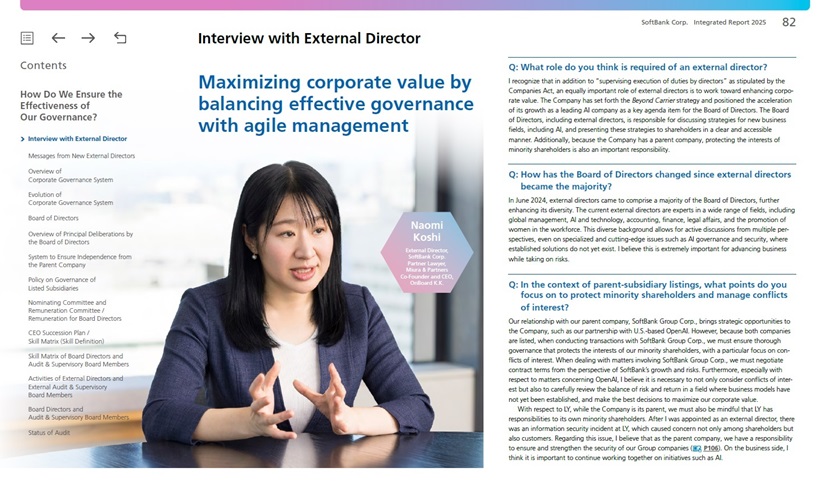
Could you tell us about the challenges in promoting DE&I and what countermeasures are being taken?
Since being appointed as an external director, I have served as an advisor to the Company's Committee for the Promotion of Women in the Workforce. The Company has a goal of increasing the ratio of women in management positions to 20% or more by the end of FY2035. To achieve this goal, a strong commitment from top management is extremely important. At the Company, President & CEO Miyakawa serves as the chair of the Committee for the Promotion of Women in the Workforce and communicates a clear message. I also find it distinctive that the Company analyzes data and surveys in detail and identifies issues based on that analysis. As a result of data analysis, issues have been identified, such as a difference in the promotion rate to management positions despite no gender bias in the personnel evaluation itself, and this has led to countermeasures.
Furthermore, a structural issue seen not only at the Company but across Japanese society is that the percentage of women who wish to become managers is lower than that of men. This is likely due to time constraints from household chores and childcare, as well as a sense of anxiety that “I may not be able to do the job.” In response to this, the Company is strengthening its mentoring system, providing opportunities for women who are not yet managers to learn from mentors in management positions about how to do the job and the rewards it brings. As a result of these efforts, women are now aiming for promotions while raising children, even in job categories where there were previously few women in management positions. I am confident that if the Company promotes workstyle reforms and a shift in mindset among managers, enabling them to eliminate unconscious bias and assign and support challenging tasks, it will be fully capable of achieving its goal.
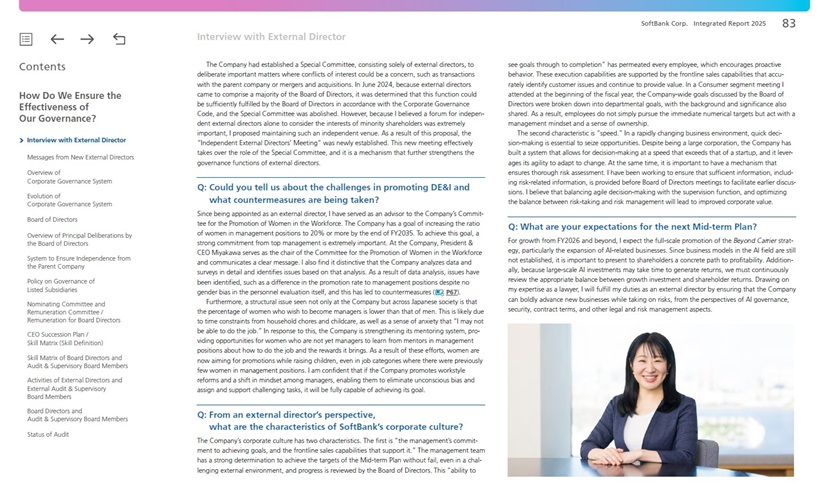
The entire interview can be found here.
(Posted on November 25, 2025)
by SoftBank News Editors



