Press Releases 2026
SoftBank Corp. and Ericsson
Conduct Japan’s First Trial of Ericsson AI in RAN
on a 5G Commercial Network
Validating the effectiveness of AI in the radio access network (RAN)
August 20, 2026
SoftBank Corp.
Ericsson Japan K.K.
SoftBank Corp. (President & CEO: Junichi Miyakawa, "SoftBank") and Ericsson Japan K.K. ("Ericsson") have jointly conducted Japan's first*1 validation of the AI-native Scheduler for Link Adaptation, a feature of Ericsson AI in RAN software, on SoftBank's 5G commercial network and verified its effectiveness. The validation applied AI directly within the radio access network (RAN) using Ericsson AI in RAN software and enabled it to operate in real time.
The two companies evaluated spectral efficiency*2, user throughput, robustness and stability on SoftBank's 5G commercial network. The results indicate gains of up to approximately 25 percent in spectral efficiency and up to approximately 50 percent in downlink user throughput compared with conventional technology. Across all evaluated locations, both spectral efficiency and downlink user throughput improved by approximately 10 percent on average. These results mark an important step toward the evolution of AI-native mobile networks.
Background to the validation
With the growing adoption of generative AI and related technologies, AI assistants, autonomous agents and immersive applications are increasingly being used in everyday situations. As the use of these services expands, mobile networks must address not only rising traffic volumes but also new traffic patterns and more advanced connectivity needs. Providing reliable communication services wherever they are needed is therefore becoming increasingly important.
Meeting these evolving demands requires more than simply adding network capacity. By applying AI directly within the RAN, operators can adapt more effectively to changing radio and traffic conditions, optimize network performance and efficiency, and make better use of existing resources. By validating the AI-native Scheduler for Link Adaptation, one of the features of Ericsson AI in RAN, on a 5G commercial network, SoftBank and Ericsson confirmed that AI-native technology can enhance the performance of existing networks and contribute to building the high-performing connectivity foundation required for next-generation AI-powered services.
Applying AI to the RAN: Optimizing 5G performance in real time
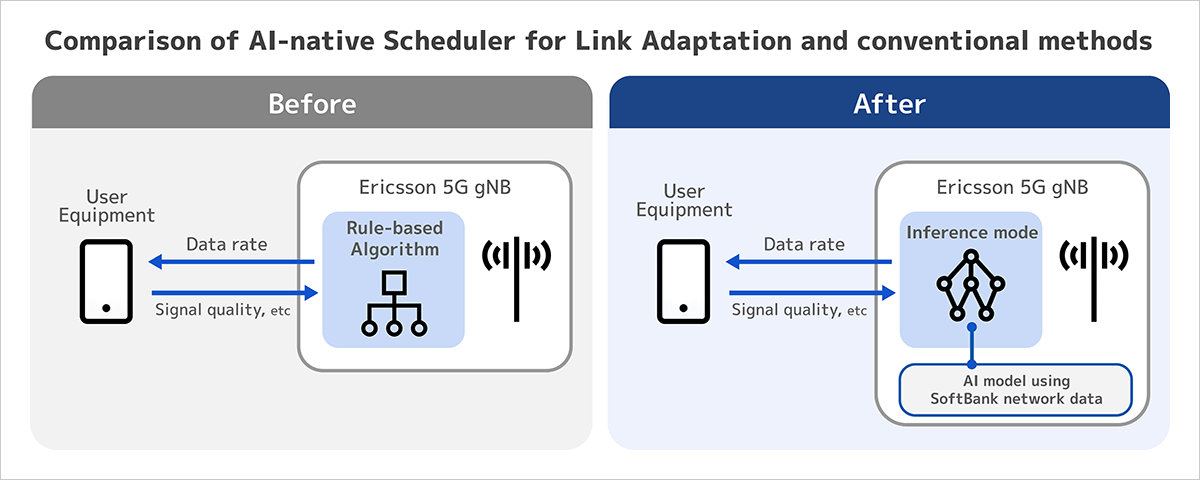
While conventional Link Adaptation*3 optimization methods have primarily relied on rule-based algorithms based on offline analysis and static parameter configuration, Ericsson's AI-native Scheduler for Link Adaptation runs on baseband equipment based on real-time AI decisions. By learning from and performing inference on complex and constantly changing radio environments, the AI model enables the following:
- Optimization of link parameters for users located at cell edges or in areas with high interference
- Stabilization of user throughput under challenging radio conditions, such as at cell edges and in congested areas
- Accommodation of more traffic within existing frequency bands through improved spectral efficiency
Through this validation, SoftBank and Ericsson confirmed that AI can contribute to the realization of high-performing, secure and flexible networks as the two companies collaborate toward 5G-Advanced and 6G in the future.
Technical collaboration toward AI-native RAN
This validation was conducted as part of the collaboration between SoftBank and Ericsson toward realizing AI-native RAN.
Other roles of each company
- SoftBank: Defined the requirements for the evaluation areas based on traffic characteristics
- Ericsson: Trained the AI-native Scheduler for Link Adaptation model using actual network data, then implemented and tuned it to predict channel capacity and select the appropriate downlink transmission rate in real time.
- Both companies: Collaborated continuously from parameter design through evaluation
By combining insights from SoftBank's network with Ericsson's AI in RAN expertise, the two companies will aim to further improve network performance in line with SoftBank's operating environment and support the continued evolution of AI-native RAN software.
Teruyuki Oya, Senior Vice President & CNO of SoftBank Corp., says: "Under our growth strategy, 'Activate AI for Society,' SoftBank aims to bring the benefits of AI to more people and industries. As the implementation of AI in society advances rapidly, mobile networks are required to handle larger volumes of traffic with greater variability than ever before. Together with Ericsson, we have demonstrated the effectiveness of the AI-native scheduler for Link Adaptation on SoftBank's 5G commercial network. This achievement marks an important milestone in advancing the RAN through AI and represents a major step toward realizing networks that will support the future AI era. SoftBank will continue to accelerate its efforts toward realizing AI-native networks."
Mårten Lerner, Head of Networks Strategy & Product Management, at Ericsson says: "This collaboration with SoftBank is an important proof point for Ericsson's AI-native RAN strategy and technology leadership. By bringing telco-grade AI into the RAN, we are enabling real-time optimization using Ericsson Silicon in today's installed base, improving network performance and efficiency in 5G commercial networks. The results show how advanced AI capabilities, combined with operator expertise and responsibly handled data, can translate AI innovation into measurable improvements and a better user experience."
Jawad Manssour, President and Representative Director of Ericsson Japan, says: "Ericsson believes that the role of mobile networks in delivering the full value of AI will become increasingly important. This field trial demonstrated that by directly applying AI to the Radio Access Network, significant gains are achievable in a network using commercially available hardware and software. Together with SoftBank, we are committed to further enhancing network performance and efficiency through AI-native technology, and to contributing to the realization of a network infrastructure capable of improving the customer experience and meeting future AI traffic demands. We will continue to further strengthen the partnership between our two companies and bring advanced network solutions originating from Japan to the world."
- [Notes]
-
-
*1
According to Ericsson Japan research based on deployments of Ericsson equipment in Japan, as of July 31, 2026.
-
*2
Spectral efficiency is a measure of how much traffic can be transmitted within a given amount of frequency bandwidth.
-
*3
Link Adaptation is a technology that optimizes data rates by adjusting the modulation scheme and coding rate in real time according to radio conditions.
-
*1
Ericsson AI in RAN (Ericsson portfolio)
AI RAN for smarter network connectivity - Ericsson
Ericsson advances AI-native networks through AI in RAN (June 2026)
ABOUT ERICSSON:
Ericsson's high-performing, programmable networks provide connectivity for billions of people every day. For 150 years, we've been pioneers in creating technology for communication. We offer mobile communication and connectivity solutions for service providers and enterprises. Together with our customers and partners, we make the digital world of tomorrow a reality. www.ericsson.com
- SoftBank, the SoftBank name and logo are registered trademarks or trademarks of SoftBank Group Corp. in Japan and other countries.
- Other company, product and service names in this press release are registered trademarks or trademarks of the respective companies.
- About SoftBank Corp.'s Network Initiatives
-
Leveraging AI and big data to improve network quality and advance network operations, SoftBank Corp. ("SoftBank") is building the communications infrastructure needed for an AI-powered society.
To realize a society where everyone can live with peace of mind, SoftBank is enhancing and improving the reliability of its communications network. To provide a stable communications environment for both ordinary times and after disasters, SoftBank is enhancing its terrestrial network across Japan, increasing its resilience in preparation for disasters and integrating it with Non-Terrestrial Networks (NTN). SoftBank's three key areas of focus for its communications network are as follows.
- To enhance network quality for ordinary times, SoftBank is leveraging AI and big data to efficiently manage its communications network according to traffic conditions while strengthening its 5G Standalone (SA)-centered network infrastructure in urban areas and other regions across Japan. These initiatives are continually improving the customer quality of experience.
- When demand for communications surges during large-scale events, in the wake of natural disasters and during other extraordinary times, SoftBank works to secure a stable communications environment by deploying additional measures, such as mobile base station vehicles, portable communication equipment and drone-based base stations.
- Under its vision for Ubiquitous Transformation (UTX), SoftBank is advancing the development of communications infrastructure that can be used in all environments, whether on land, sea or in the air. By integrating its terrestrial mobile network with NTN, including satellite communications and stratospheric communication platforms (HAPS), SoftBank will enable the rapid restoration of communications services following disasters and expand service coverage to mountainous regions and remote islands.