ESG Policy and Structure
Sustainability Basic Policy and Promotion Structure were established as a guideline and serve as the foundation for sustainable growth by earning the trust and support of all our stakeholders, including customers, shareholders, employees, and business partners. In compliance with this basic policy, we aim to solve social issues in order to enhance corporate value and realize a sustainable society.
Sustainability basic policy
At SoftBank, we will work to resolve various social issues through our corporate and business activities to realize a sustainable society in which all things, information and minds are connected.
- We will provide wonder, peace of mind, and delight through customer-oriented business approach.
- To meet stakeholder expectations, we will continue to challenge ourselves to achieve corporate growth and clearly disclose information.
- Employee satisfaction, pride, uniqueness and diversity will be encouraged and valued.
- Mutual trust and fair trade with our suppliers will be a priority (to prevent corruption and degeneracy, etc.).
- To create a better future for everyone, we will continue to drive an information-based society, support education for the next generation, increase communication for our diverse society, protect the environment and manage resources in a sustainable manner, conserve biodiversity, and provide disaster response and relief.
Oversight structure
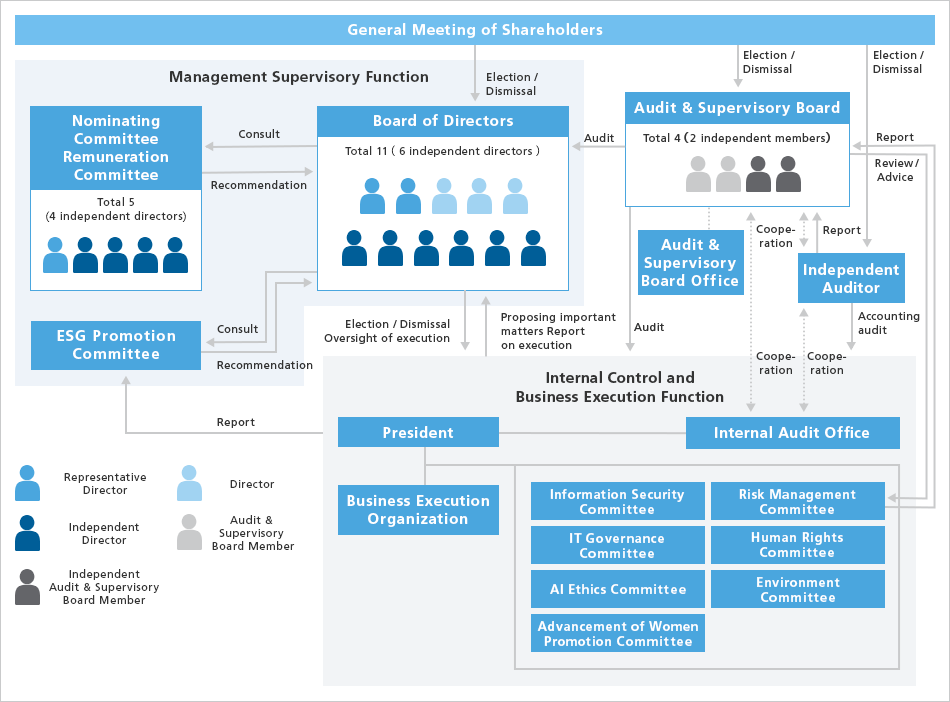
To further advance sustainability-driven management, the Board of Directors deliberates and resolves on key sustainability matters and oversees the progress of sustainability initiatives. In addition, to reinforce the Company’s governance oversight in the sustainability area, the Company has established the ESG Promotion Committee, chaired by Junichi Miyagawa, Representative Director, President & CEO, as an advisory body to the Board of Directors. The Committee convenes quarterly, four times a year with additional meetings as needed, to monitor the progress of the Group’s sustainability activities, including Material Issues KPIs, and submit recommendations to the Board of Directors. In its decision-making, the Board of Directors gives full consideration to the Committee’s position and recommendations, thereby ensuring that sustainability perspectives are appropriately reflected in the Company’s management.
The Company also invites external experts to the ESG Promotion Committee and regularly holds lectures and opinion exchange sessions on the latest sustainability trends, regulations, and social issues in order to enhance the sustainability-related knowledge and oversight capabilities of Directors and Committee members. Through these efforts, the Company promotes a deeper understanding of sustainability among management and enhances the effectiveness of its oversight function.
Through the sustainability-related management oversight functions of the Board of Directors and the ESG Promotion Committee, the Company will continue to appropriately supervise business execution and work toward the ongoing integration of its growth strategy with sustainability.
Executive structure
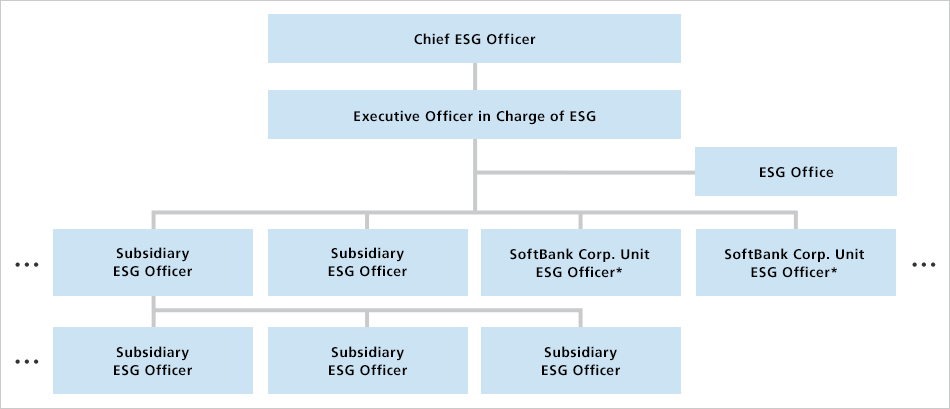
Junichi Miyagawa, President & CEO, is ultimately responsible for promoting ESG, and leads SoftBank Corp. and its subsidiaries (hereinafter the "SoftBank Corp. Group") in pursuing sustainability activities. Yasuyuki Genda, Senior Vice President & CHRO, is the executive officer in charge of ESG, with the ESG Office established to promote sustainability activities across the SoftBank Corp. Group.
- [Note]
-
- *Non-administration divisions are under the Division ESG Officer
- *
Sustainability initiatives driven by the Group
SoftBank Corp. and its group companies view sustainability as a new business opportunity and organize the SDGs Action Award as an initiative to share insights from business and value creation efforts across the group that contribute to solving social challenges.
Sustainability reporting policy
This Site outlines our company's policies, strategies, governance structure, material issues, and specific initiatives related to sustainability. The content is formulated in accordance with globally recognized reporting guidelines and with consideration of the information disclosure needs of our stakeholders.