Press Releases 2026
SoftBank Corp. Achieves Japan's First HAPS Trial Service
in Preparation for Commercialization
- Sceye's HAPS achieved long period of operation in Japan airspace after crossing the Pacific Ocean from the United States in the stratosphere
- Conducted communications trials with limited durations, areas and devices, working toward commercialization of HAPS services from 2027 onward
- Confirmed stable operation of HAPS-based voice calls on smartphones and high-capacity data communications, as well as an emergency alert messaging system designed for use during large-scale disasters
- Successfully conducted technical verification of HAPS-to-drone communications, working toward realizing a three-dimensional communications network, as well as the world's first technical verification of HAPS-based edge computing
September 2, 2026
SoftBank Corp.
SoftBank Corp. (President & CEO: Junichi Miyakawa, "SoftBank") and U.S.-based Sceye, Inc. (Founder and CEO: Mikkel Vestergaard Frandsen, "Sceye") announced they successfully provided trial services in preparation for the commercialization of HAPS in Japan using Sceye's LTA (Lighter Than Air)-type*1 High Altitude Platform Station ("HAPS"). This achievement marks the first successful stratospheric-based communications test in Japan using a HAPS in Japan's airspace.*2
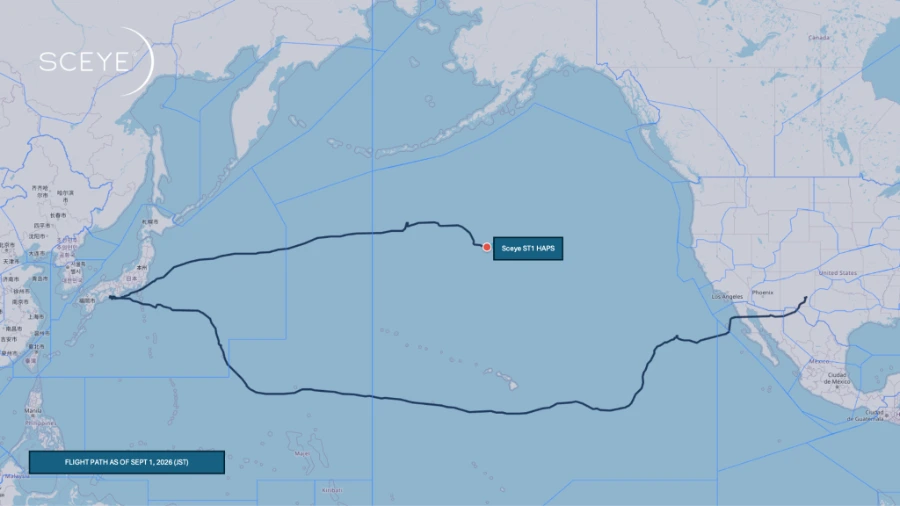
For this trial, Sceye's HAPS departed from Roswell, New Mexico, U.S., and flew more than 15,000 km in the stratosphere across the Pacific Ocean to Japan. It then remained over a target area of operation off Cape Muroto in Kochi Prefecture for an extended period of time, where communications tests were conducted through SoftBank's core network. The companies confirmed the stable operation of voice calls, including emergency calls, and text messaging using smartphones, as well as high-capacity data communications, such as video streaming and video calls. They also verified the operation of an emergency alert messaging system designed for use during large-scale disasters. In addition, SoftBank and Sceye successfully validated HAPS-to-drone communications, working toward the realization of a three-dimensional communications network. They also conducted the world's first*3 technical verification of HAPS-enabled edge computing, with a view to future service deployment.
SoftBank and Sceye will leverage the data and insights gained through these trial services to advance preparations for the commercialization of HAPS in Japan from 2027 onward, including the development of operational frameworks and further improvements in communications quality.
- [Notes]
-
- *1An LTA (Lighter Than Air)-type HAPS is a lighter-than-air platform that uses buoyancy to remain aloft.
- *2This marks the first successful communications test in Japan between a HAPS and smartphones, as well as between a HAPS and drones. Based on publicly available information as of August 23, 2026 (according to SoftBank research).
- *3The world's first successful trial in which a mobile core network and web server were installed on a HAPS, enabling communications from smartphones to be processed entirely within the HAPS without being routed through a terrestrial network, with the results relayed back to smartphones. Based on publicly available information as of August 23, 2026 (according to SoftBank research).
- *1
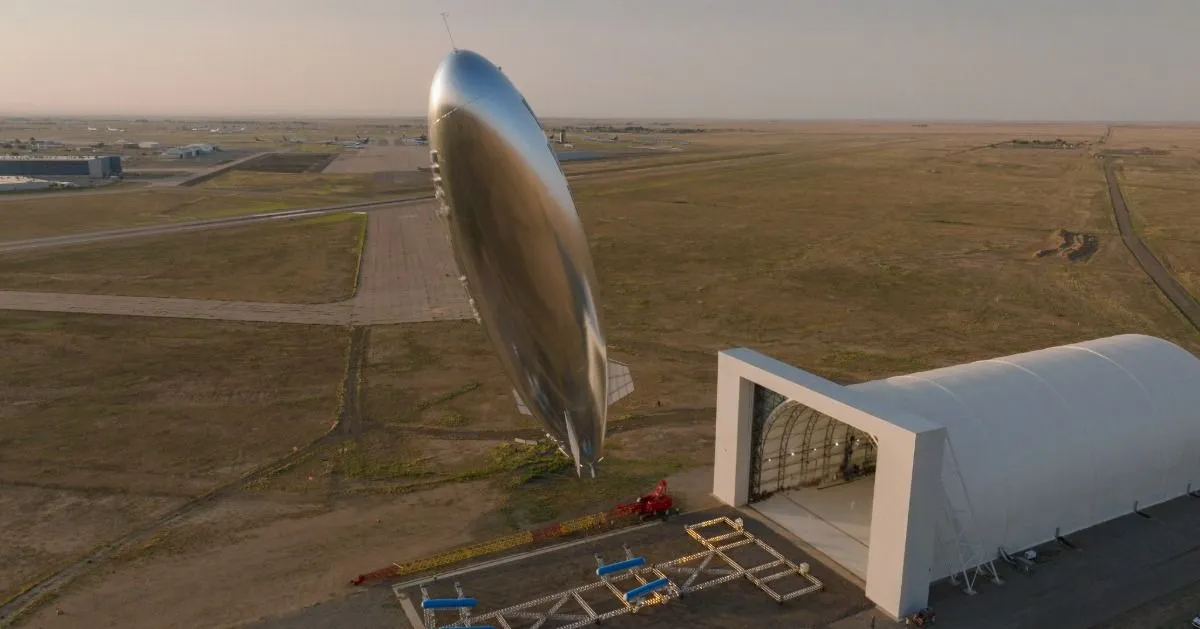
1. Confirmed platform's long-duration flight capabilities and ability to remain in operation area for extended periods
The Sceye HAPS used for this trial departed from New Mexico, U.S., at 10:00 p.m. Japan Standard Time (JST) on August 9, 2026. It flew more than 15,000 km across the Pacific Ocean in the stratosphere for approximately 13 days and reached Japanese airspace at 7:11 a.m. JST on August 23.
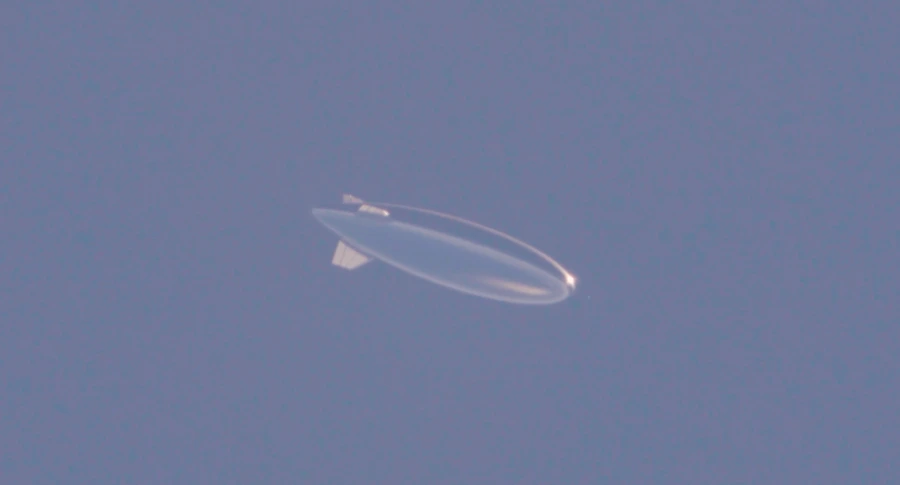
After arriving in Japan, the HAPS operated over an area around Muroto City, Kochi Prefecture, off Cape Muroto, which was selected for testing scenarios involving a large-scale disaster, such as an earthquake occurring at the Nankai Trough. Taking into account stratospheric weather conditions, including wind direction and wind speed, Sceye was able to maintain the platform's position over the target area of operation for an extended period within a radius as small as 5 km. This achievement confirmed both the platform's long-distance and long-duration flight capabilities and its ability to remain over a target area of operation for an extended period under conditions in Japan.
Following the completion of the trials in Japan, the HAPS began crossing the Pacific Ocean again to return to the U.S. As of September 2, performance verification of the platform through extended continuous flight remains ongoing.
2. Verification of HAPS-based communications performance using smartphones on the ground
Two-way communications tests were conducted between the HAPS in the stratosphere and smartphones on the ground in an area around Muroto City, Kochi Prefecture. For the tests, a 4G LTE-equivalent base station installed on Sceye's HAPS was connected to SoftBank's core network through a ground gateway.
The tests confirmed stable voice calls and text messaging, the use of apps, such as social media services, and high-capacity data communications, including video calls and video streaming. SoftBank and Sceye also verified the operation of emergency alert messaging systems for earthquake early warnings and tsunami warnings, as well as voice calls to the 118 maritime emergency number in cooperation with the Japan Coast Guard.
In the data communications tests, the companies confirmed that communications performance equivalent to that of terrestrial networks could be achieved while reducing radio interference with terrestrial base stations. These results demonstrated that stable communications services can be provided from a HAPS operating in the stratosphere in Japan airspace to smartphones on the ground. The tests also provided operational insights into the equipment and network configurations required for the commercialization of HAPS.
3. Successful communications between HAPS and drones
SoftBank aims to build a three-dimensional communications network that uses HAPS not only to provide communications services to people on the ground during large-scale disasters and other emergencies, but also to provide stable connectivity to aerial mobility systems, such as drones. As part of this initiative, communications tests were conducted between the HAPS and a drone.
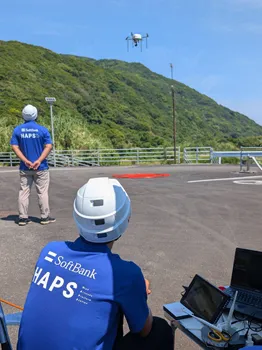
In the tests, automated drone flight was conducted by remote control using HAPS connectivity. SoftBank confirmed that flight control, transmission of location information from the drone and video transmission could all be performed with stability.
The use of HAPS is expected to enable a wide range of drone applications, including assessing damage and transporting supplies during disasters, monitoring remote islands and offshore areas, supporting logistics in mountainous regions, inspecting infrastructure, such as power transmission lines and roads, and monitoring forests.
4. World's first successful technical verification of HAPS-based edge computing
As the use of AI expands beyond information generation into areas such as Physical AI,*4 lower-latency communications and data processing will become increasingly important. To explore the potential of edge computing in the stratosphere, a processing server was installed on the HAPS to conduct data processing directly on the platform.
The tests showed that the average round-trip response time for processing on the server onboard the HAPS was 68 milliseconds, reducing communications latency by more than 40% compared with processing in the cloud via the Internet. This marks the world's first successful test in which a mobile core network and a web server for processing were installed on a HAPS, enabling response processing to be performed entirely onboard the HAPS and the results to be relayed back to smartphones.
By combining the wide-area communications coverage provided by HAPS with edge computing technologies, SoftBank aims to enable new use cases that require both broad coverage and low latency, including applications in the field of Physical AI and real-time video analytics.
- [Note]
-
- *4Physical AI refers to technology that enables AI to analyze and make decisions based on information obtained from robotic sensors and cameras, as well as external systems, allowing robots to perform flexible and complex movements based on those decisions.
- *4
5. Future developments
SoftBank and Sceye will leverage the data and insights gained through these HAPS trial services, including those related to HAPS flight, operations, and communications, to further develop operational frameworks and improve communications quality, with the aim of commercializing HAPS services in Japan from 2027 onward.
Looking ahead to the 6G era, SoftBank also aims to realize a next-generation three-dimensional communications network by seamlessly integrating satellite, HAPS, and terrestrial communications networks to provide stable connectivity not only on the ground but also to aerial mobility systems, such as drones. In the future, SoftBank will explore the use of technologies including HAPS-based edge computing and AI-RAN to expand HAPS use cases as part of next-generation communications infrastructure.
6. Executive comments
Junichi Miyakawa, President & CEO of SoftBank Corp., commented as follows:
"SoftBank aims to build next-generation communications infrastructure that seamlessly connects the ground, the sky and space. The fact that Sceye's HAPS reached Japan from the United States and successfully provided Japan's first trial services from the stratosphere in Japan's airspace marks an important step toward the commercialization of HAPS, which is at the core of this vision. By combining the HAPS flight and operational technologies that Sceye has developed with SoftBank's communications technologies, we have gained confidence to realize a three-dimensional communications network utilizing HAPS. Going forward, in collaboration with Sceye, we will continue to integrate a wide range of technologies, including communications and AI, to develop HAPS into a new form of social infrastructure."
Mikkel Vestergaard Frandsen, Founder and CEO of Sceye, said:
"This flight marks a defining moment for Sceye and for the commercial potential of HAPS. Flying from the US to Japan demonstrates the endurance and precision required to make the stratosphere a viable layer of infrastructure. By integrating with SoftBank's network and demonstrating connectivity to devices on the ground and in the air, we are showing how HAPS can complement existing networks and deliver persistent connectivity at scale. Together with SoftBank Corp., we are moving beyond proving the technology toward building the infrastructure that will make HAPS a commercial reality."
- SoftBank, the SoftBank name and logo are registered trademarks or trademarks of SoftBank Group Corp. in Japan and other countries.
- Other company, product and service names in this press release are registered trademarks or trademarks of the respective companies.