Press Releases 2026
Advanced workload shifting
social demonstration project launched
aiming to realize a “virtual hyperscaler”
by integrating control of communications, power, and computing resources
October 7, 2026
MESH-X Inc.
NHK Technologies, Inc.
Kyushu University
KDDI Corporation
SoftBank Corp.
TAKAOKA TOKO CO., LTD.
The University of Tokyo
TEPCO Power Grid, Incorporated
Tokyo Electric Power Company Holdings, Inc.
Fujitsu Limited
Hokkaido University
Morgenrot Inc.
Tokyo, Kawasaki, Sapporo and Fukuoka, Japan, October 7, 2026 — MESH-X Inc. (MESH-X), NHK Technologies, Inc. (NHK Technologies), Kyushu University, KDDI Corporation (KDDI), SoftBank Corp. (SoftBank), TAKAOKA TOKO CO., LTD. (Takaoka Toko), The University of Tokyo, TEPCO Power Grid, Incorporated (TEPCO Power Grid), Tokyo Electric Power Company Holdings, Inc. (TEPCO Holdings), Fujitsu Limited (Fujitsu), Hokkaido University, and Morgenrot Inc. (Morgenrot) have formed the Multi-Stakeholder Collaborative Wide-Area Workload Shift (WLS) Demonstration Consortium*1. The Consortium is launching a joint demonstration for the practical application of “Wide-Area WLS” as of August, 2026.
The Consortium will bring together the technologies and assets of each participant to jointly conduct technical, operational, and business demonstrations (the Demonstration) aimed at realizing a new AI infrastructure model, the “Virtual Hyperscaler,” characterized by “wide-area x multi-carrier x data center (DC) x power system mutual optimization,” through the optimal operation of computing resources necessary for AI learning and inference.
The Demonstration will be implemented based on the proposal for a “Social Demonstration for Realizing Advanced Workload Shift,” which was adopted*2 by the 12 members of the Consortium in the public call for demonstration projects related to the FY2026 “Watt-Bit Collaboration Related Demonstration” promoted by the Ministry of Internal Affairs and Communications on July 15, 2026.
Background
In recent years, the rapid spread of AI has led to a surge in demand for data centers (DCs) that serve as its computing foundation. This has resulted in serious challenges in Japan, such as the concentration of DCs in urban areas and the associated power supply issues. On the other hand, the increasing curtailment of renewable energy (RE) due to its expanded introduction in regional areas also presents a challenge. If this situation continues, Japan may not be able to meet its domestic AI computing demand, leading to a risk of important data flowing overseas along with computing demand through the use of foreign cloud services, and the risk of critical services supporting the digital society being disrupted during large-scale disasters.
To avoid such complex risks, WLS technology, which dynamically shifts computing processes (workloads) between distributed DCs in Japan, taking into account power supply and demand conditions and computing resource operating status, is essential, rather than concentrating computing processes in specific DCs. This Demonstration aims to implement an advanced WLS mechanism that coordinates communication, power, and computing across a wide area, and to verify its technical, operational, and business feasibility.
Outline of the Demonstration
1. Demonstration Period
August, 2026 – February, 2027
2. Content
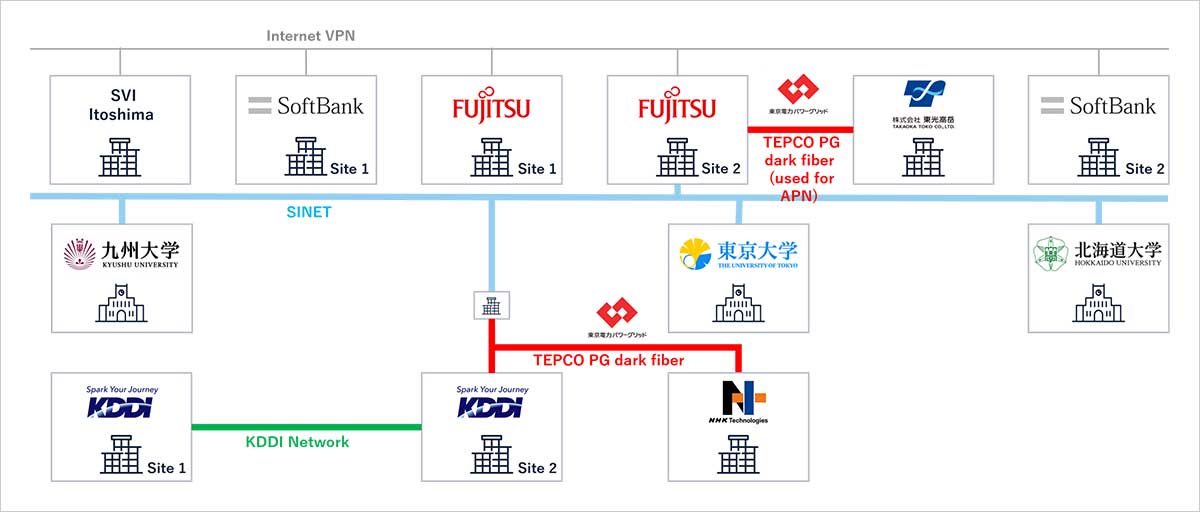
The Demonstration will establish a wide-area network utilizing the Science Information NETwork (SINET) operated by the National Institute of Informatics (NII) and optical fibers for power security (dark fiber) held by TEPCO PowerGrid. Additionally, the configuration of directly connecting some DC sections with an all-optical network will be verified. By connecting academic and industrial DC clusters to this network, an environment capable of collaborative Wide-Area WLS will be realized.
During WLS execution, an orchestrator*3, functioning as the heart of the Virtual Hyperscaler, will play a role in optimizing the shifting method. Specifically, by utilizing the orchestrator, information such as power supply and demand, market information, GPU utilization, battery status, and network conditions will be collected and analyzed to determine and control workload placement.
To verify the elements necessary for social implementation, multiple sub-projects are planned. These will be implemented in stages, from foundational demonstrations establishing the basics of Wide-Area WLS between universities nationwide to advanced demonstrations verifying the effectiveness of WLS technology, including integrated control with RE and storage batteries, and orchestration.
3. Roles of Each Participating Organization
Organization Role
| Participating Organizations | Role |
|---|---|
| MESH-X | Overall demonstration coordination, orchestrator study and development, SVI Itoshima demonstration |
| NHK Technologies | Provision of DC infrastructure and advancement of the demonstration |
| Kyushu University | Provision of SINET connectivity and advancement of the demonstration |
| KDDI | Provision of communications and DC infrastructure, as well as advancement of the demonstration |
| SoftBank | Provision of DC infrastructure, development of the WLS platform, advancement of the demonstration, and studies on cross-platform interoperability |
| Takaoka Toko | Provision of DC infrastructure and advancement of the demonstration |
| The University of Tokyo | Provision of SINET connectivity, advancement of the demonstration, and support for its evaluation |
| TEPCO Power Grid | Provision of communications infrastructure using dark fiber and advancement of the demonstration |
| TEPCO Holdings | Development of the Watt-Bit collaboration vision, provision of advisory input for the demonstration, and support for its evaluation |
| Fujitsu | Provision of DC infrastructure, development of the wide-area WLS platform, and advancement of the demonstration |
| Hokkaido University | Provision of SINET connectivity and advancement of the demonstration |
| Morgenrot | Advance of feasibility study and PoC toward GPU as a Service implementation |
Future Plans
Based on the results obtained from this demonstration, the 12 organizations will expand operations by increasing the number of DC sites and participating businesses. Specifically, the 12 organizations will formulate an open operational model and common interfaces that allow multiple businesses to connect with each other, and will also consider the design of business models for social implementation and common rules and governance essential for business implementation.
In the future, the 12 organizations aim to standardize the technologies and operational models established through this initiative as open specifications internationally, and to globally disseminate this new social infrastructure originating from Japan as a developing ecosystem.
- [Notes]
-
-
*1
the Multi-Stakeholder Collaborative Wide-Area Workload Shift (WLS) Demonstration Consortium:
A consortium formed by 12 organizations to promote the practical application of WLS, which realizes optimal operation of computing resources distributed throughout Japan, by collaborating with stakeholders in power, communications, DCs, academia, and other fields. -
*2
Adopted on July 15, 2026, by the Ministry of Internal Affairs and Communications:
(https://www.soumu.go.jp/menu_news/s-news/01kiban04_02000279.html). -
*3
Orchestrator:
A system that collects and analyzes data such as the operating status of multiple DCs and power supply and demand, and determines the optimal placement of workloads.
-
*1
- All company or product names mentioned herein are trademarks or registered trademarks of their respective owners.
- Information provided in this press release is accurate at time of publication and is subject to change without advance notice.