Press Releases 2026
SoftBank Corp. and Yaskawa Electric Corporation Demonstrate a Deformable Object Manipulation System Using "AI Data Center GPU Cloud" as
a Physical AI Development Platform
In collaboration with NVIDIA, companies streamline the process from robot motion data collection to
AI training and evaluation, and deployment on physical robots
July 13, 2026
SoftBank Corp.
SoftBank Corp. (President & CEO: Junichi Miyakawa, "SoftBank") and Yaskawa Electric Corporation (Representative Director, Chairman of the Board and President: Hiroshi Ogasawara, "Yaskawa Electric"), in cooperation with NVIDIA, have demonstrated a deformable object manipulation system developed by Yaskawa Electric, using the "AI Data Center GPU Cloud*1" being developed by SoftBank as a development platform for Physical AI. *2
By utilizing this development platform, the companies can streamline development processes ranging from the collection of robot motion data to AI training and evaluation, as well as application to physical robots, enabling the rapid and easy introduction of Physical AI. In this demonstration, SoftBank and Yaskawa Electric confirmed that deformable objects requiring advanced control decisions can be handled stably by enabling AI to learn in real time and provide accurate instructions to robots.
Going forward, SoftBank aims to accelerate the adoption of Physical AI among companies through the provision of a Physical AI development platform. SoftBank also aims to realize an environment in which companies can use data and knowledge obtained in the field to improve their own Physical AI models and more easily expand them to other operations and robots.
- [Notes]
-
- *1For details on the "AI Data Center GPU Cloud," please refer to the press release dated May 25, 2026, "SoftBank to Launch ‘AI Data Center GPU Cloud' Powered by ‘Infrinia AI Cloud OS' as Part of its Neocloud Business in October 2026."
- *2Physical AI refers to technology that enables robots to analyze and interpret data from sensors, cameras, and external systems through AI, allowing them to perform flexible and complex physical movements based on AI-driven decisions.
- *1
Background
To implement Physical AI in society, it is important to establish a development platform that streamlines complex development processes, including the collection of robot motion data, AI model training, simulation-based evaluation, and deployment on physical robots, enabling not only robotics experts but also a wide range of engineers to quickly and easily introduce Physical AI into real-world operations.
To this end, SoftBank has developed a Physical AI development support tool that runs on the "AI Data Center GPU Cloud." By utilizing NVIDIA Omniverse libraries, which enable the creation of robot simulation environments, and NVIDIA Cosmos open world models and the NVIDIA Physical AI Factory Blueprint, this tool can streamline the series of development processes required for the introduction of Physical AI.
Conventional robot control assumes that the shape and position of the target object are predetermined, making stable handling of deformable objects such as strings, cloth, and bags, which vary from task to task, one of the more challenging areas. To address this challenge, Yaskawa Electric has developed a deformable object manipulation system that utilizes VLA (Vision-Language-Action), which generates robot motions based on visual information and task instructions, to recognize, grasp, and manipulate such deformable objects.
With the aim of putting the development support tool and the deformable object manipulation system into practical use, SoftBank and Yaskawa Electric conducted a demonstration of wire harness handling, a task that requires the advanced decision-making capabilities of Physical AI.
Physical AI Development Support Tool Running on the "AI Data Center GPU Cloud"
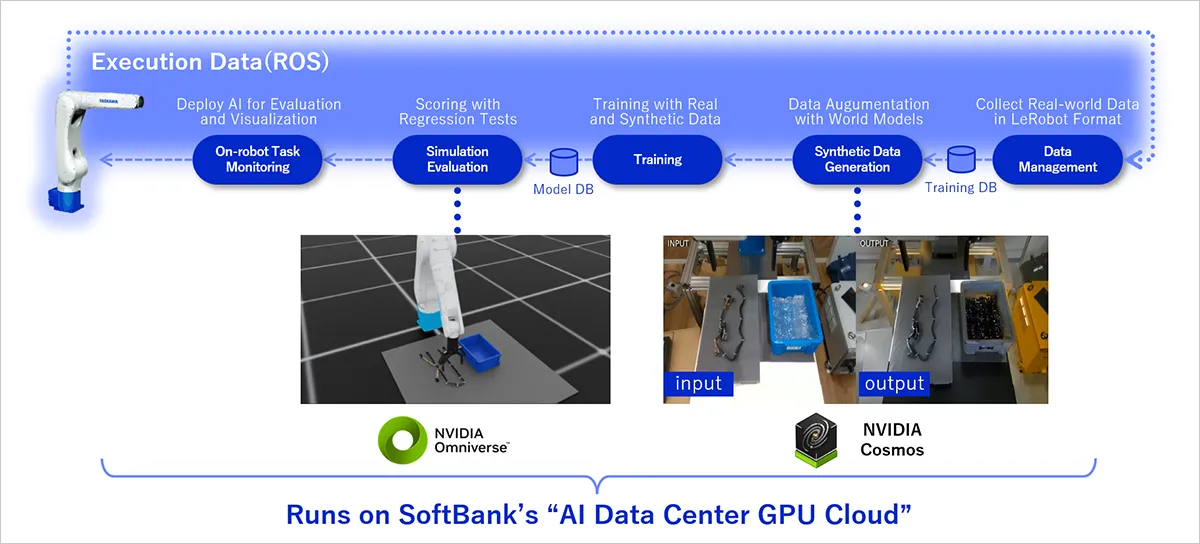
The Physical AI development support tool developed by SoftBank enables development processes to be conducted in an integrated manner on the "AI Data Center GPU Cloud," from the collection of robot motion data and data augmentation (synthetic data generation) to AI model training, simulation-based evaluation, and deployment on physical robots.
Overview of the Development Process
(1) Robot Data Collection and Data Augmentation
First, robots are connected to the "AI Data Center GPU Cloud," where motion data and sensor information are collected and stored. Based on this data, synthetic data is generated using NVIDIA Cosmos. By augmenting data in this way, data that is difficult to collect in sufficient quantities using physical robots alone can be supplemented and utilized for AI model training.
(2) AI Model Training and Simulation-Based Evaluation
Next, AI models are trained using the computing resources of the "AI Data Center GPU Cloud." Engineers can improve models using the collected and augmented data while monitoring training progress through a GUI (Graphical User Interface) running on the GPU Cloud. Before deploying the trained model to physical robots, it is evaluated on a simulator integrated with NVIDIA Omniverse libraries. By verifying robot behavior across multiple tasks in a simulation environment, engineers can determine whether the trained model can be applied to the target task while maintaining its basic performance.
(3) Deployment on Physical Robots
After these processes, the verified AI model is deployed to physical robots.
By using this tool, companies can efficiently establish a Physical AI development environment and advance the learning cycle on the "AI Data Center GPU Cloud." In addition, by making it easier to introduce Physical AI into worksites, companies can utilize data obtained from physical robots, AI model execution data, and synthetic data collected across multiple operations and sites as assets in accordance with their own management policies, and expand their use to other operations.
Deformable Object Manipulation System
The "deformable object manipulation System" developed by Yaskawa Electric is a system that uses VLA to recognize the state of target objects based on visual information obtained from cameras and other sources, as well as task instructions, and enables robots to grasp and manipulate those objects.
Deformable objects such as strings, cloth, and bags are objects whose shapes and positions change with each task, and are prone to sagging, tangling, bending, and variations in grasping positions. As a result, stable handling of such objects is difficult using conventional rule-based control alone, which assumes that shape and position of the target object are predetermined.
Accordingly, the deformable object handling system is configured to separate the motions that can be handled reliably with conventional robot control from the motions for which Physical AI is effective, such as recognizing the state of deformable objects and making grasping position decisions, and to incorporate Physical AI into existing robot systems as a functional module.
Demonstration Overview
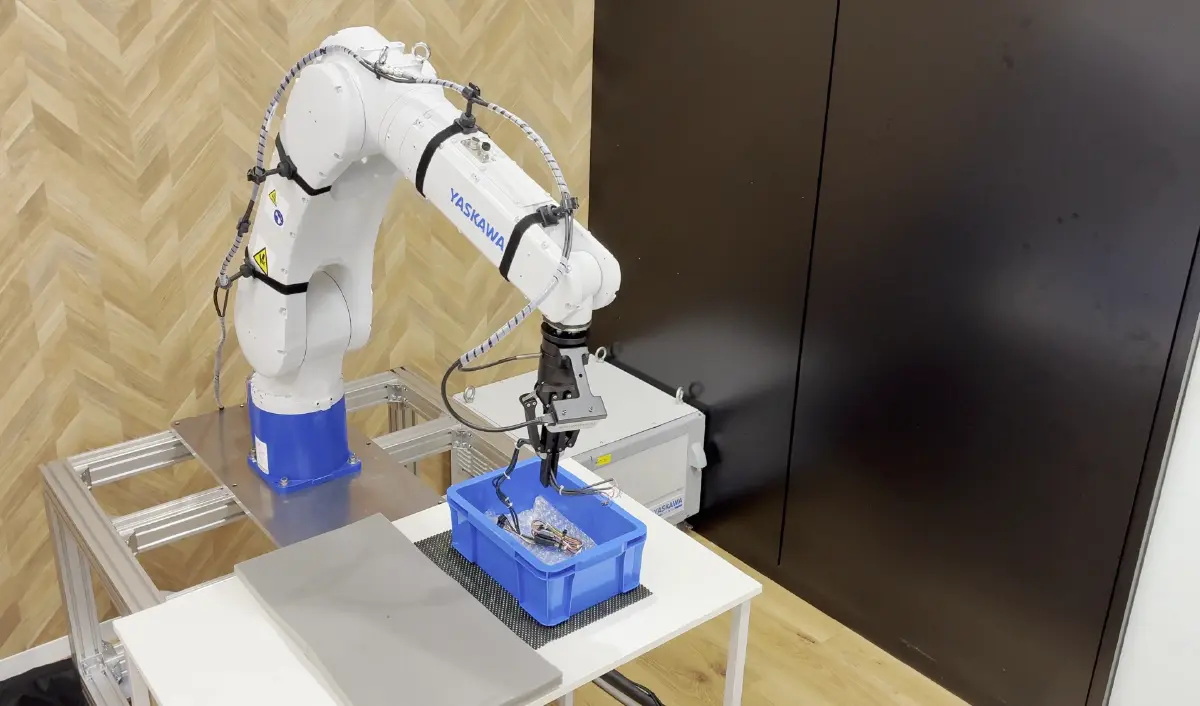
In this demonstration, as a use case for manipulating deformable objects, SoftBank's Physical AI development support tool and Yaskawa Electric's deformable object manipulation system were applied to the task of placing wire harnesses, whose shapes and arrangements change with each task, into a box. Through this demonstration, the companies confirmed not only that Physical AI could be introduced quickly, but also that deformable objects could be handled stably, with the robot recognizing the state of wire harnesses based on visual information and AI learning in real time to provide accurate instructions to the robot.
Future Outlook
SoftBank and Yaskawa Electric will continue to promote the development of robot systems utilizing Physical AI and verify their application to more advanced tasks. SoftBank will also expand its verification of Physical AI using the "GPU Cloud," work to advance robot development by utilizing various types of data, and further enhance its development platform.
For Yaskawa Electric's press release regarding this matter, please refer to the URL below:
https://www.yaskawa-global.com/newsrelease/news/179651
- SoftBank, the SoftBank name and logo are registered trademarks or trademarks of SoftBank Group Corp. in Japan and other countries.
- Other company, product and service names in this press release are registered trademarks or trademarks of the respective companies.