Press Releases 2026
SoftBank Corp. and Lenovo Announce Collaboration
to Develop Next-Generation Cellular PCs for
Enterprise Customers
Companies aiming to realize Zero Trust security by combining URSP and mobile network functions
March 2, 2026
SoftBank Corp.
Lenovo Japan LLC
SoftBank Corp. (President & CEO: Junichi Miyakawa, "SoftBank") and Lenovo Japan LLC (President: Taro Hiyama, "Lenovo") today announced a collaboration to develop of next-generation cellular PCs for enterprise customers that are designed to realize security based on Zero Trust principles. This initiative combines URSP*1, a feature of 5G Standalone (5G SA)*2, with authentication and security capabilities provided by mobile networks, to respond to rising enterprise security risks in the AI era.
1. Changes in the enterprise network environment and the Need for Zero Trust
Traditionally, enterprise network security has been built around a perimeter-based model that separates internal (trusted) environments from external (untrusted) ones. However, with the expansion of cloud services, the decentralization of enterprise systems, the widespread adoption of remote work, and the growing use of mobile environments for business operations, communication paths and endpoint devices have become increasingly diversified. As a result, conventional approaches alone are no longer sufficient to address risks such as unauthorized access to internal corporate networks. Looking ahead, as AI adoption accelerates across enterprises, the coexistence of automated processing and human-driven operations is expected to further increase the complexity of network and device management, heightening security risks. Against this backdrop, Zero Trust security — which assumes no inherent trust in users or devices and enforces strict authentication and continuous verification — has gained significant attention.
2. Joint development of next-generation cellular PCs for the AI era
In response to these challenges, SoftBank and Lenovo have been conducting joint research on the potential application of URSP to cellular PCs. Building on the results of this research, the two companies are now jointly developing next-generation enterprise cellular PCs to support enterprise security in the AI era.
This initiative aims to natively embed Zero Trust security mechanisms into cellular PCs by combining URSP-based traffic control with authentication and security capabilities provided by mobile networks. Rather than relying solely on endpoint-based countermeasures or traditional VPN (Virtual Private Network) solutions, this approach enables security measures that are tightly integrated with the network layer.
As a result, enterprise IT administrators will be able to centrally design and operate secure access control to corporate systems, as well as traffic separation by usage or business function. Furthermore, even in future IT environments where human operations and AI-driven processing coexist, communications can be securely controlled in accordance with enterprise-defined policies.
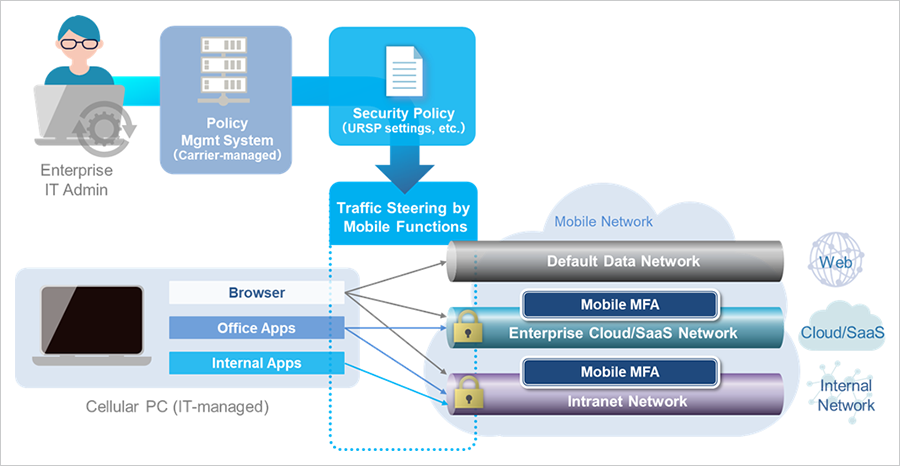
(1)Key features
- Destination- and application-level traffic control using URSP
- Integration with authentication functions on the mobile network
- Policy-based control according to device, user, and communication status
(2)Overview and results of the joint research
In their joint research conducted to date, the companies successfully achieved the world's first*3 proof-of-concept applying URSP, standardized by 3GPP(3rd Generation Partnership Project), to a commercial PC (ThinkPad X1 Carbon). The demonstration confirmed that various types of traffic originating from the PC can be controlled according to applications and defined policies. Furthermore, by combining URSP-based traffic control with authentication functions provided by the mobile network, the companies confirmed that access control can be dynamically applied according to the state of devices and users.
These results demonstrate the potential to evolve URSP-based traffic control in combination with mobile network authentication and security functions into functional building blocks for security solutions based on Zero Trust principles.
Ryuji Wakikawa, VP and Head of Research Institute of Advanced Technology at SoftBank, commented:
"In future IT environments, people, devices, and AI will become highly interconnected, making secure connectivity infrastructure based on Zero Trust principles indispensable. This initiative leverages advanced network control functions of 5G SA, including URSP, to integrate PCs with mobile networks and commercialize 5G laptops as enterprise-grade business terminals. By optimizing security and traffic control at the communication layer, we will expand the value of 5G SA into enterprise IT infrastructure."
Yasumichi Tsukamoto, Executive Vice President and Head of Development at Lenovo Japan, commented:
"Lenovo aims to help enterprises and individuals unlock the value of AI faster and more reliably through the promotion of Hybrid AI*4.
Hybrid AI refers to an approach that optimally combines multiple execution environments — including devices (such as PCs), edge, on-premises, and cloud — as well as Personal AI, Enterprise AI, and Public AI. This enables AI to be deployed in the most appropriate location based on data residency and requirements such as security, governance, latency, and cost. Through this hybrid approach, Lenovo supports customers end-to-end, from implementation and deployment to ongoing operations, while reducing the complexity of AI adoption. In the era of Hybrid AI, as PCs — serving as edge devices — increasingly collaborate with enterprise on-premises servers to enable AI utilization, the importance of 5G AI PCs capable of connecting to highly secure networks from anywhere has grown significantly. In this joint proof-of-concept, we successfully integrated URSP-based traffic control and mobile network authentication capabilities into ThinkPad, a platform long trusted by enterprise customers. This confirmed that On-Device AI leveraging local PC data and Enterprise AI utilizing on-premises data within corporate networks can securely interoperate over a protected network environment.
These results demonstrate that Hybrid AI can be realized with strong security without requiring additional VPN deployments. Building on this proof-of-concept, enterprise customers will be able to maintain consistent policy-based access control and security even in environments where AI processing locations and data flows dynamically change. Lenovo will continue to collaborate with SoftBank to redefine next-generation ThinkPad for the Hybrid AI era and deliver secure IT infrastructure that enables enterprises to confidently adopt AI."
- [Notes]
-
- *1URSP (User Equipment Route Selection Policy) is a policy mechanism in 5G that specifies characteristics of network routes.
- *25G SA refers to a Standalone-mode commercial 5G network.
- *3According to research conducted by SoftBank and Lenovo.
- *4Lenovo's Hybrid AI enables AI processing to be performed in an optimal location from device to cloud, simultaneously achieving the secure use of highly confidential data, fast responses, and cost optimization.
- *1
- SoftBank, the SoftBank name and logo are registered trademarks or trademarks of SoftBank Group Corp. in Japan and other countries.
- Other company, product and service names in this press release are registered trademarks or trademarks of the respective companies.