Press Releases 2026
SoftBank Corp. Develops Technologies to
Simplify and Reduce Power Consumption of
Base Station Antenna for 6G
"Functional Beam Shaping Lens Antenna" developed with AGC
and successfully demonstrated in outdoor field tests
March 19, 2026
SoftBank Corp.
SoftBank Corp. ("SoftBank") has collaborated with AGC Inc. ("AGC") to develop a "Functional Beam Shaping Lens Antenna," a new base station antenna configuration designed for simplification and energy efficiency in the 6G era, and has successfully demonstrated it in outdoor field tests. The "Functional Beam Shaping Lens Antenna" was developed by combining SoftBank's communication area and antenna beam design technologies with AGC's metasurface lens technology*1. The simplified antenna configuration enables a reduction in power consumption of up to one-eighth compared to conventional antenna systems*2.
Furthermore, the field tests have confirmed that the "Functional Beam Shaping Lens Antenna" can maintain communication coverage and quality consistent with those of conventional Massive MIMO antennas. In the future, the utilization of this antenna is expected to help reduce the burden of installing and operating base stations for high frequency bands (6 GHz and above).
Background of development
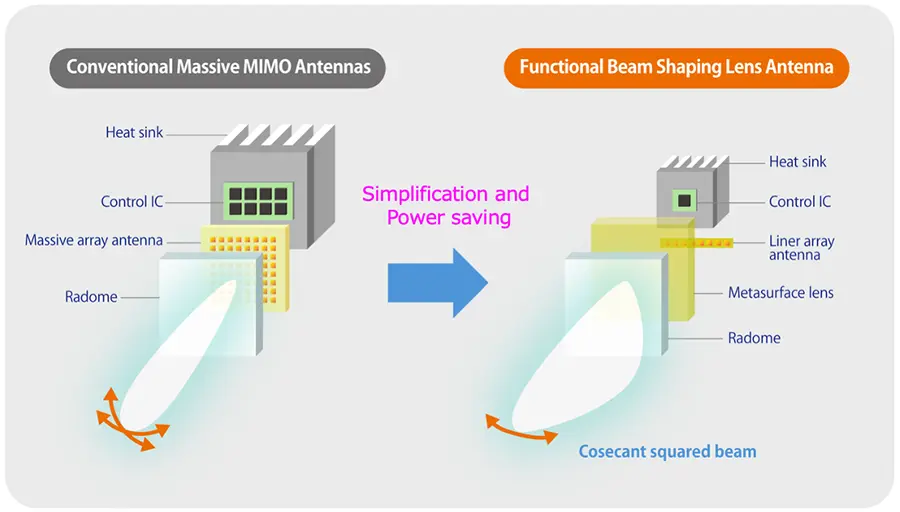
As AI services become more widespread, mobile data traffic is projected to surge. Addressing this demand requires the effective use of high frequency bands to achieve wideband, high speed, and high capacity connectivity. Because high frequency bands suffer from high propagation loss and have limited coverage, Massive MIMO antennas are used to provide high directivity in specific directions. However, conventional antenna configurations perform beamforming*3 in both horizontal and vertical directions to follow moving users. This requires a large number of control ICs (integrated circuits), leading to challenges such as high power consumption and increased installation and operational burdens due to the larger equipment size required for heat sinks. To address these challenges, SoftBank and AGC have jointly developed the "Functional Beam Shaping Lens Antenna," a new base station antenna configuration with the aim of simplifying equipment and reducing power consumption.
Configuration of "Functional Beam Shaping Lens Antenna"
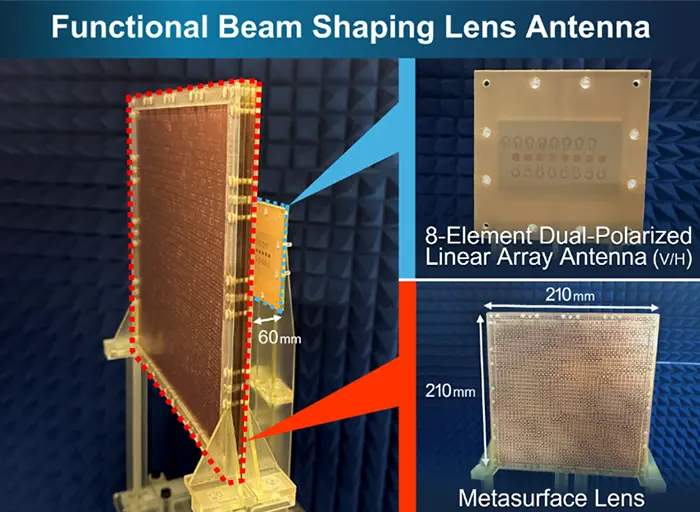
The newly developed "Functional Beam Shaping Lens Antenna" has reduced the number of antenna elements required for vertical beam shaping to one-eighth or less compared to conventional systems by adopting AGC's metasurface lens. This reduces the number of control ICs and related components, enabling a reduction in power consumption by up to one-eighth compared to conventional models*2. Consequently, this is expected to lead to smaller and more lightweight heat sinks.
In addition, for the vertical beam, we have adopted a "cosecant squared beam" characteristic, which maintains consistent communication quality regardless of the distance between the base station and the device based on SoftBank's coverage design and antenna beam design technologies, to enable stable communication. Furthermore, for the horizontal beam, the microstructure is carefully designed so that the metasurface lens does not interfere with horizontal beamforming, thereby maintaining both radio wave radiation from the array antenna and dynamic beam control.
Field tests overview
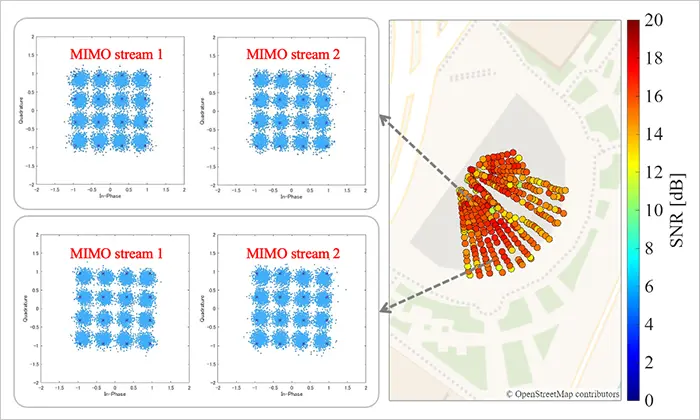
SoftBank conducted field tests in Minato-ku, Tokyo, to evaluate the effectiveness of the "Functional Beam Shaping Lens Antenna" using millimeter-wave band (center frequency: 29.7 GHz). In these field tests, 5G signals were transmitted by varying the distance between the "Functional Beam Shaping Lens Antenna," acting as a base station, and a dipole antenna representing a UE (User Equipment). We confirmed the formation of the communication coverage by measuring the SNR (Signal-to-Noise Ratio) and evaluated the communication quality based on the received signal distribution of 16QAM*4.
As a result, we confirmed that a stable SNR of 15 dB or higher was obtained at almost all measured locations, regardless of the distance between the antennas. Furthermore, the received signal distribution remained clear, with the 16 signal points distinctly identifiable without distortion, confirming that the communication was stable. The results suggest that the "Functional Beam Shaping Lens Antenna" can provide a stable communication coverage and quality consistent with conventional Massive MIMO antennas.
Detailed Measurement Environment
| Base Station side | Functional Beam Shaping Lens Antenna (height: 8 m) |
|---|---|
| UE side | Dipole antenna (Mounted on a measurement trolley) |
| Frequency band | Center Frequency: 29.7 GHz (millimeter-wave) |
| Bandwidth | 100 MHz |
For details on the technologies for simplifying and reducing power consumption in base station antennas, and the demonstration experiments, please refer to the SoftBank Research Institute of Advanced Technology's blog.
SoftBank is committed to advancing the development of the "Functional Beam Shaping Lens Antenna" with the goal of practical application in base stations, contributing to the realization of sustainable 6G communication networks.
- [Notes]
-
- *1A technology that enables precise control over the direction and spread of radio waves by arranging microscopic structures on a thin substrate.
- *2Theoretical values comparing the estimated number of control ICs (integrated circuits) required to achieve the same frequency band and coverage in conventional Massive MIMO antennas configurations versus configurations utilizing "Functional Beam Shaping Lens Antenna."
- *3Synthesizing radio waves from array antenna and concentrating them for radiation in a specific direction.
- *4A method that creates 16 distinct states by varying the amplitude and phase of a signal, then transmits data by assigning each state to a specific data value.
- *1
- SoftBank, the SoftBank name and logo are registered trademarks or trademarks of SoftBank Group Corp. in Japan and other countries.
- Other company, product and service names in this press release are registered trademarks or trademarks of the respective companies.
- About the SoftBank Research Institute of Advanced Technology
-
Guided by its mission to implement new technologies into society, SoftBank Corp.'s Research Institute of Advanced Technology promotes R&D and business creation for advanced technologies that support next-generation social infrastructure, including AI-RAN and Beyond 5G/6G, as well as telecommunications, AI, computing, quantum technologies, and technologies in the space and energy sectors. Through industry-academia collaboration and joint research with universities, research institutions and partner companies in Japan and abroad, the SoftBank Research Institute of Advanced Technology is contributing to the creation of global businesses and a sustainable society. For more details, please visit the official website.