Press Releases 2026
SoftBank Corp. Successfully Demonstrates Dynamic Nullforming to Suppress Radiowave Interference
from Fast-moving Aerial Base Stations and Maintain Communication Quality of Terrestrial Networks
Technology enables spectrum sharing between Non-Terrestrial Networks such as HAPS
and terrestrial networks
April 21, 2026
SoftBank Corp.
SoftBank Corp. (President & CEO: Junichi Miyakawa, "SoftBank") today announced it newly developed a dynamic nullforming technology that suppresses radiowave emissions in a specific direction while tracking changes in the position and attitude of an aerial vehicle caused by circling flight. The technology suppresses radiowave interference from Non-Terrestrial Networks (NTN), such as stratospheric-based High Altitude Platform Station (HAPS) systems, to maintain the communication quality of terrestrial networks. SoftBank also successfully conducted a field trial that achieved spectrum sharing between aerial and terrestrial base stations.
In the field trial conducted in December 2025 on Hachijo Island, Tokyo, SoftBank mounted a base station equipped with dynamic nullforming technology on a light aircraft and transmitted radiowaves while directing a null, an area in which radiowave emissions are suppressed, toward a terrestrial base station from an aircraft flying at a high speed at an altitude of approximately 3,000 meters. As a result, SoftBank confirmed that by stably suppressing radiowave interference in the vicinity of the terrestrial base station, it is possible to provide wide-area communication services from an aerial base station without significantly degrading the communication quality of the terrestrial network. In this field trial, SoftBank utilized its proprietary 5G cylindrical antenna*1 and high-capacity communications payload.*2
SoftBank will continue to advance initiatives to achieve more efficient spectrum utilization by leveraging the knowledge gained from this field trial while aiming to implement spectrum sharing technologies between NTN such as HAPS and terrestrial networks.
Background
SoftBank is conducting research and development on spectrum sharing technologies so HAPS can provide communication services using the same frequency bands as terrestrial base stations. Previously, through a field trial of nullforming technology using a high-altitude tethered aerostat,*3 SoftBank confirmed that it could suppress radiowave interference in the vicinity of terrestrial base stations from a base station mounted on a tethered aerostat hovering at a fixed point. However, in the case of aircraft such as heavier-than-air (HTA) type*4 HAPS that fly and circle at a high speed, the direction of the terrestrial base station as viewed from the aircraft is constantly changing. To address this, SoftBank newly developed a dynamic nullforming technology, which suppresses radiowave emissions in a specific direction while tracking changes in the position and attitude of the aircraft.
A portion of this research and development was conducted as part of "R&D on Technologies for HAPS Mobile Broadband Communications" (JPJ012368C07701), a proposal selected in 2023 by the National Institute of Information and Communications Technology ("NICT") in Japan for its "Innovative ICT Fund Projects for Beyond 5G/6G" program.
Overview of dynamic nullforming technology
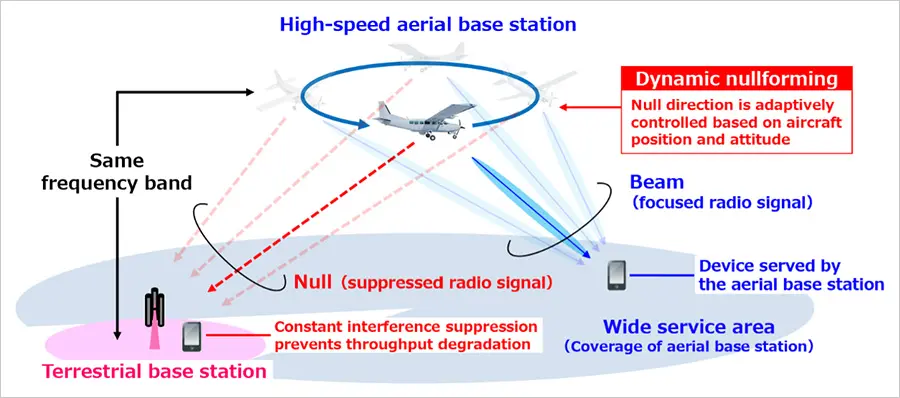
Dynamic nullforming technology dynamically controls the null direction according to the position and attitude of an aircraft in flight (Fig. 1). While beamforming is used to concentrate radiowaves toward communication devices communicating with the aerial base station, the technology continuously directs a null toward the vicinity of the terrestrial base station to reduce radiowave interference. By dynamically controlling the null direction, the technology suppresses deterioration in communication quality, including throughput degradation in terrestrial communication networks, thereby enabling spectrum sharing between aerial and terrestrial base stations.
Overview of field trial
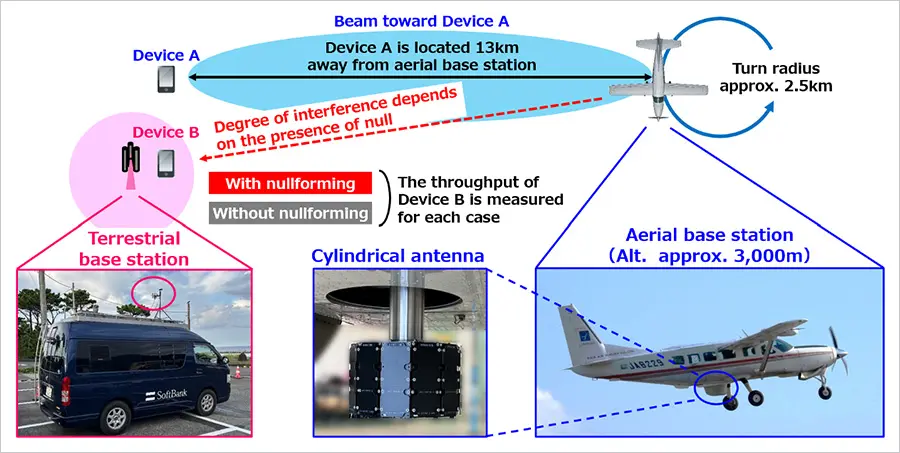
In this field trial, SoftBank mounted a base station (aerial base station) on a light aircraft simulating a HAPS aerial vehicle, transmitted radiowaves in the 1.7 GHz band to form a wide communication service area, and evaluated the effectiveness of dynamic nullforming technology in an environment where a base station installed on a vehicle (terrestrial base station) used radiowaves in the same frequency band (Fig. 2). The light aircraft flew in a circular path at an altitude of approximately 3,000 meters and reached a maximum ground speed of more than 200 km/h. Under these conditions, SoftBank placed Device A, which communicated with the aerial base station (approximately 13 km from the aerial base station), near Device B, which communicated with the terrestrial base station, and measured changes in Device B's throughput with and without dynamic nullforming technology.
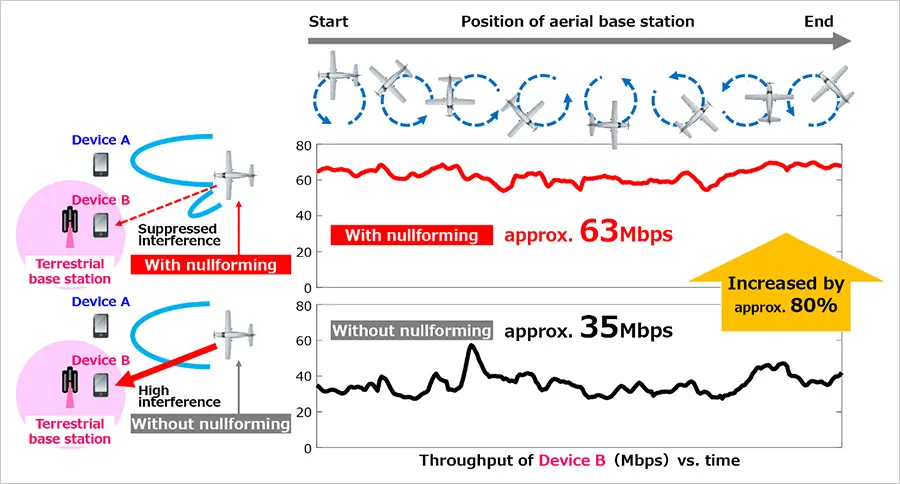
As a result of the field trial, SoftBank confirmed that applying dynamic nullforming technology improved the average throughput of Device B, which communicated with the terrestrial base station, by approximately 80% (Fig. 3). In addition, the technology reduced radiowave interference even under conditions in which the position and attitude of the aircraft were constantly changing, thereby improving the stability of Device B's throughput. These results demonstrate that by utilizing dynamic nullforming technology, it is possible to provide wide-area communication services from aerial base stations such as HAPS without significantly degrading the communication quality of terrestrial networks.
- [Notes]
-
- *1For more details on the cylindrical antenna, see SoftBank Corp.'s notice dated September 2, 2021: SoftBank Corp. and HAPSMobile Accelerate High Altitude Platform Station (HAPS) R&D to Provide Stable and High-quality Connectivity for Future Commercial Services.
- *2For more details on the high-capacity payload, see SoftBank Corp.'s press release dated September 18, 2025: SoftBank Corp. Develops High-capacity 6-cell Capable HAPS Payload, Delivers 5G Connectivity from the Sky in Field Trial.
- *3For more details, see SoftBank Corp.'s press release dated June 26, 2024: SoftBank Corp. Successfully Demonstrates Nullforming Technology to Achieve Spectrum Sharing Between HAPS and Terrestrial Base Stations.
- *4HTA (Heavier Than Air) refers to HAPS aircraft, such as airplanes, that remain aloft by generating lift.
- *1
- SoftBank, the SoftBank name and logo are registered trademarks or trademarks of SoftBank Group Corp. in Japan and other countries.
- Other company, product and service names in this press release are registered trademarks or trademarks of the respective companies.