Press Releases 2026
SoftBank Corp. Open-sources AITRAS Orchestrator
to Expand AI-RAN Ecosystem
Open-sourcing enables resource optimization across multi-cluster environments
February 18, 2026
SoftBank Corp.
SoftBank Corp. ("SoftBank") announced it contributed a new capability, called the Dynamic Scoring Framework, to the Open Cluster Management project*1 as an upstream open-source contribution. The Dynamic Scoring Framework is one of the key components of the AITRAS Orchestrator, which enables AI-RAN orchestration. Through this open-sourcing effort, SoftBank aims to foster the AI-RAN ecosystem and expects that RAN vendors and mobile network operators will actively leverage open-source software—including the Dynamic Scoring Framework—to drive greater innovation in the field of AI-RAN.
By leveraging standardized orchestration capabilities through open source, operators will be able to focus more resources on differentiated service development and operational innovation.
- [Note]
-
- *1An open-source project focused on multi-cluster and multi-cloud scenarios for Kubernetes applications.
- *1
Background
In recent years, under the AI-RAN concept, there has been growing interest—particularly among telecommunications service providers—in going beyond traditional RAN deployments to leverage AI capabilities, such as AI inference, within networks to create new value.
At the same time, AI inference platforms typically consist of heterogeneous resources, including GPUs (graphics processing units), CPUs, and various accelerators. It is also becoming increasingly common for these platforms to span multiple sites and multiple clusters. Operational complexity is increased in such environments, as service providers must determine, based on current conditions, which cluster should host a given workload.
To efficiently manage both AI workloads and RAN workloads on a common platform, an orchestrator that can centrally manage multiple clusters and diverse resource types—and make optimal decisions based on the current situation—is essential.
About the Dynamic Scoring Framework
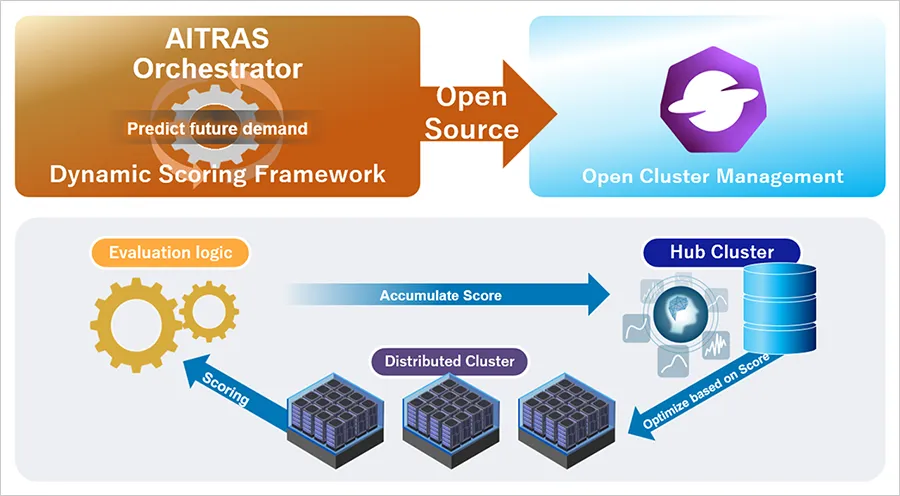
SoftBank is driving the development of the Dynamic Scoring Framework, a core function of its AI-RAN Orchestrator. The Dynamic Scoring Framework enables the collection and evaluation of resource status in each cluster, across multiple clusters. By using the scoring results, the AI-RAN Orchestrator can conduct resource management with optimization.
For example, scoring GPUs along multiple dimensions—such as power consumption and application performance—and selecting resources or changing configurations in line with specific requirements can be realized.
SoftBank has already implemented concrete optimization examples using these evaluation metrics and is conducting validations under conditions that assume real-world operations.
Overview of the initiative
The Dynamic Scoring Framework is implemented as an add-on for Open Cluster Management (OCM). OCM enables the management of multiple Kubernetes clusters, as well as policy control and enforcement through its Policy Framework.
The Dynamic Scoring Framework is a framework that enables efficient and scalable execution of "scoring" based on user-defined evaluation criteria across multi-cluster environments. Using this framework, users can perform scoring based on the criteria they consider important and leverage the results to achieve optimization of infrastructure resources.
Another noteworthy aspect of this framework is that it is aligned with the architecture of the AI-RAN Platform & Infrastructure Orchestrator published by the AI-RAN Alliance. This architecture represents a common understanding derived from discussions within the Alliance's Working Group 2 (WG2), which focuses on AI-and-RAN use cases.
Furthermore, this initiative is being pursued in collaboration with Red Hat, Inc. ("Red Hat"), with a view to integrate and scale across its entire enterprise open source portfolio, including Red Hat OpenShift and Red Hat Advanced Cluster Management for Kubernetes.
AITRAS Orchestrator covers not only "macro-level" resource optimization across multiple clusters, but also covers "micro-level" resource optimization within a Kubernetes cluster. As an example, SoftBank is working in collaboration with Red Hat to integrate the AITRAS Orchestrator with llm-d*2. Specifically, based on the characteristics of the models being executed and the resource conditions of each cluster, the AITRAS Orchestrator determines the optimal resource configuration for the llm-d environment. Through this approach, SoftBank verifies that model performance is improved in vLLM*3 and llm-d environments.
- [Notes]
-
- *2An open source framework designed to efficiently orchestrate vLLM runtime engines
- *3An open source execution platform designed to enable fast and efficient AI inference of large language models (LLMs)
- *2
Future Plans
More information about this collaboration will be available at Red Hat's booth at MWC Barcelona 2026.
Through the open-sourcing of the Dynamic Scoring Framework, SoftBank will continue to build a foundation for more sophisticated decision-making and efficient operation of AI inference workloads across multi-cluster environments. By collaborating with partners such as Red Hat, as well as with the open-source community, SoftBank aims to advance AI-RAN and drive innovation in telecommunications infrastructure.
Ryuji Wakikawa, Vice President and Head of the Research Institute of Advanced Technology at SoftBank Corp., said:
"By open-sourcing the Dynamic Scoring Framework, a key component of the AITRAS Orchestrator, we are opening the door for RAN vendors and mobile network operators to drive innovation in AI-RAN orchestration. We believe this initiative will energize the AI-RAN ecosystem and accelerate the adoption of AI-RAN through collaboration with the open-source community."
Tushar Katarki, global head of product, GenAI Foundation Model Platforms at Red Hat said:
"At Red Hat, we firmly believe in the power of open source innovation. SoftBank's efforts to bring the Dynamic Scoring Framework to the open source community and enable its AITRAS Orchestrator with community-driven technologies, such as llm-d, aligns perfectly with Red Hat's open source vision. Designed from the ground up to be composable and extensible, llm-d enables partners to build differentiated orchestration layers on top of a common, open source inference platform. This collaboration validates llm-d as the enterprise foundation for AI inference optimization across diverse deployment scenarios."
Arpit Joshipura, SVP/GM Networking + Edge + IOT, at The Linux Foundation said:
"The contribution of Dynamic Scoring Framework to Linux Foundation helps reduce complexities of AI-RAN in 5G/6G networks, and can be generalized to solve broader industry challenges. By upstreaming this technology, SoftBank is empowering the global open-source community with a robust, data-driven orchestration tool furthering their leadership in AI networking."
- SoftBank, the SoftBank name and logo are registered trademarks or trademarks of SoftBank Group Corp. in Japan and other countries.
- Other company, product and service names in this press release are registered trademarks or trademarks of the respective companies.
- About the SoftBank Research Institute of Advanced Technology
-
Guided by its mission to implement new technologies into society, SoftBank Corp.'s Research Institute of Advanced Technology promotes R&D and business creation for advanced technologies that support next-generation social infrastructure, including AI-RAN and Beyond 5G/6G, as well as telecommunications, AI, computing, quantum technologies, and technologies in the space and energy sectors. Through industry-academia collaboration and joint research with universities, research institutions and partner companies in Japan and abroad, the SoftBank Research Institute of Advanced Technology is contributing to the creation of global businesses and a sustainable society. For more details, please visit the official website.