Press Releases 2026
SoftBank Corp. and Ericsson
Successfully Demonstrate Low-Latency,
High-Reliability Network-enabled
Physical AI With AI-RAN
Companies achieve stable Physical AI through dynamic AI processing offloading
and communication network optimization
February 27, 2026
SoftBank Corp.
SoftBank Corp. (President & CEO: Junichi Miyakawa, "SoftBank") and Ericsson (NASDAQ: ERIC) announced they successfully conducted a proof-of-concept (PoC) aimed at realizing low-latency and highly reliable communication networks required for Physical AI*1.
In this collaboration, SoftBank's real-time processing technology leveraging the MEC platform of AI-RAN under development was coordinated with a 5G network leveraging network features from Ericsson, enabling the integrated coordination of robots, communication networks, and computing resources, and achieving low-latency and highly reliable control.
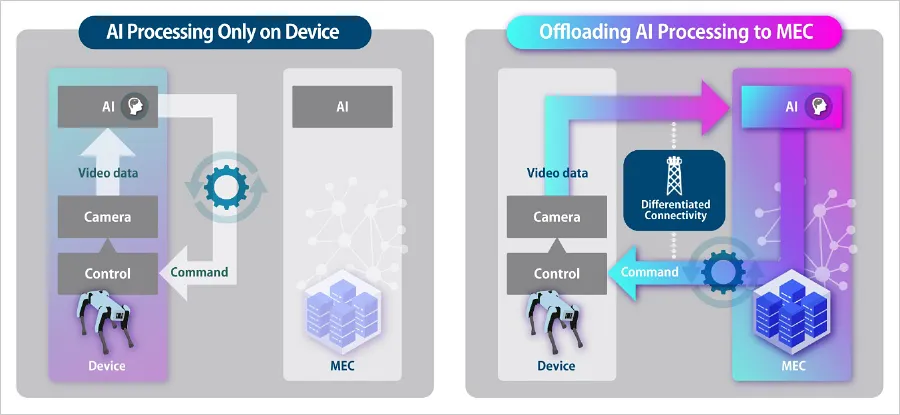
As a result, it was confirmed that, in accordance with the robot's operational status and required processing tasks, AI processing—previously performed directly on the robot—can be dynamically offloaded to the MEC environment. Additionally, the communication network can be optimized through the implementation of differentiated connectivity*2 using Ericsson network functions, such as network slicing and priority control, enabling the realization of stable Physical AI.
- [Notes]
-
- *1Physical AI refers to technology that enables robots to analyze and interpret data from sensors, cameras, and external systems through AI, allowing them to perform flexible and complex physical movements based on AI-driven decisions.
- *2Differentiated connectivity refers to functionalities that secures deterministic performance (bandwidth and latency) through 5G SA core and 5G RAN software, such as network slicing.
- *1
Background and network challenges for implementing Physical AI
In recent years, interest in Physical AI—where robots accurately perceive their surroundings and make flexible decisions and actions—has been growing rapidly. However, the AI processing required for such flexible decision-making and actions varies greatly depending on the situation. In scenarios requiring advanced decision-making, the computational resources available on the robot itself may be insufficient.
Building on this momentum, SoftBank and Ericsson are advancing the validation of Physical AI use cases as part of their joint research and development on AI-RAN. By leveraging the technologies of both companies to connect robots with external computing resources, they aim to realize more flexible and advanced decision-making capabilities and operations.
When AI processing is offloaded to external computing resources via a communication network, it is essential not only to ensure low-latency and highly reliable communications, but also to integrally and dynamically control the robot, the communication network, and computing resources. However, in conventional networks, AI processing and radio access network (RAN) control are designed separately, making flexible control based on the use of external computing resources difficult. This has been a key challenge in implementing Physical AI.
Overview of the Proof-of-Concept
To address these challenges, SoftBank and Ericsson combined SoftBank's real-time processing technology leveraging the MEC platform of AI-RAN with a 5G network utilizing network features from Ericsson to build an AI processing offload foundation that enables integrated coordination and control of robots, the communication network, and external computing resources. This offload foundation enables optimal control of robots through a mechanism that dynamically switches, depending on the situation, between executing AI processing on the robot itself and executing it on the MEC platform as an external computing resource. In addition, by realizing differentiated connectivity—such as network slicing and priority control—based on diverse requirements including latency, throughput, and reliability required for each application, the communication network can be optimized, enabling low-latency and highly reliable control. As a result, it was confirmed that while lightweight AI processing and decision-making can be performed by the robot itself, AI processing can be offloaded to the MEC platform when more advanced decision-making is required, thereby enabling the robot to perform more flexible and sophisticated judgments and operations.
Because the system can automatically switch to the optimal AI processing pattern depending on the situation, it enables stable operation of Physical AI, including the following capabilities:
-
- Dynamic control and optimization of computing resources to enable Physical AI
-
By dynamically offloading AI processing to the MEC platform according to the robot's operational state, processing load, and the complexity of decision-making tasks, efficient operation of Physical AI applications is enabled.This allows robotic systems to leverage scalable compute resources when needed, enabling more flexible movements, improved task execution, and optimization of battery usage while reducing the need for on-device compute.
-
- Low-latency, highly reliable connectivity through differentiated connectivity
-
Connectivity required for robot control and AI processing offload is dynamically optimized using differentiated connectivity features such as network slicing and priority handling.
Future outlook
Throughout this demonstration, SoftBank and Ericsson have identified the key network requirements for implementing Physical AI in real-world environments such as manufacturing, logistics, and infrastructure maintenance. Building on the insights gained from this experiment and related initiatives, SoftBank and Ericsson are committed to realizing next-generation networks that will power the era of Physical AI.
Ryuji Wakikawa, Vice President and Head of the Research Institute of Advanced Technology at SoftBank Corp., commented:
"SoftBank has been advancing the development of AI-RAN technologies that evolve the role of communication infrastructure, as well as real-time processing technologies leveraging MEC platforms, to address societal challenges. By further enhancing the mechanism built this time for dynamically offloading AI processing and a low-latency, highly reliable network, SoftBank aims to realize Physical AI capable of more flexible and advanced decision-making."
Jawad Manssour, President and Representative Director of Ericsson Japan K.K., commented:
"Physical AI applications such as robotics require networks that can adapt in real time to changing compute and connectivity demands. Through our collaboration with SoftBank, and leveraging Ericsson's differentiated connectivity, we are demonstrating how AI processing can be dynamically offloaded and supported across edge infrastructure. This enables a new class of AI-driven services on RAN while maintaining the performance and reliability operators expect from Ericsson networks."
- SoftBank, the SoftBank name and logo are registered trademarks or trademarks of SoftBank Group Corp. in Japan and other countries.
- Other company, product and service names in this press release are registered trademarks or trademarks of the respective companies.
- About the SoftBank Research Institute of Advanced Technology
-
Guided by its mission to implement new technologies into society, SoftBank Corp.'s Research Institute of Advanced Technology promotes R&D and business creation for advanced technologies that support next-generation social infrastructure, including AI-RAN and Beyond 5G/6G, as well as telecommunications, AI, computing, quantum technologies, and technologies in the space and energy sectors. Through industry-academia collaboration and joint research with universities, research institutions and partner companies in Japan and abroad, the SoftBank Research Institute of Advanced Technology is contributing to the creation of global businesses and a sustainable society. For more details, please visit the official website.