Value Creation Process
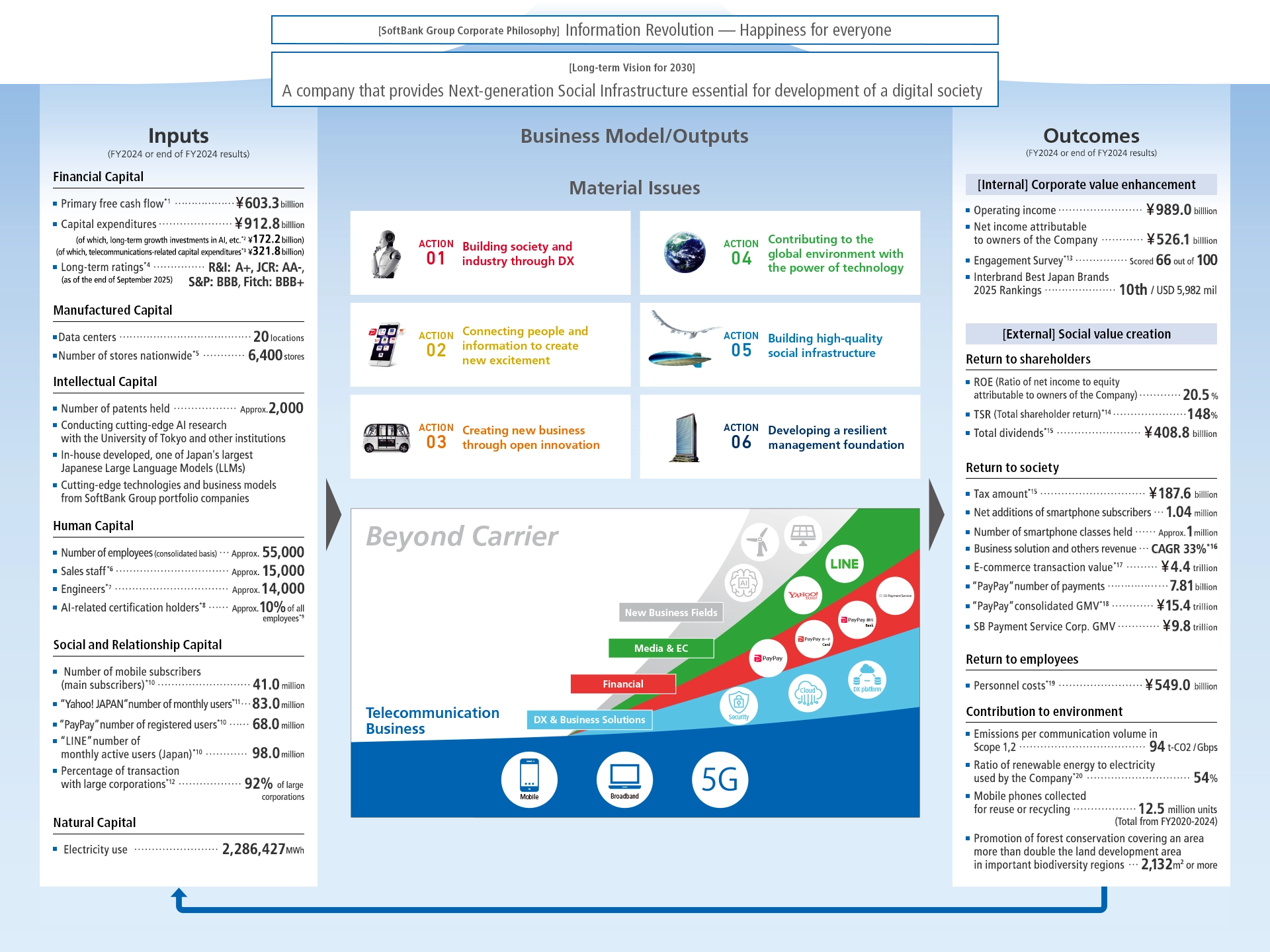
Maximizing corporate value, centered on the Beyond Carrier strategy
We aim to maximize our corporate value by pursuing sustainable growth in our telecommunications business while going beyond just being a telecommunications carrier to actively roll out new businesses in the information and technology fields. By serving as a catalyst for digitalization across society and solving social issues, we aim to become the Corporate Group needed most by people around the world.
Financial Capital
Characteristics and initiatives
of our Group
Financial soundness
We consider primary free cash flow (FCF)*1 to be a key management indicator. To invest for growth while maintaining high level of shareholder returns, we generate a stable and high level of primary FCF*1. At the same time, we emphasize net leverage ratio—which indicates how many times our net interest-bearing debt is to EBITDA—as an indicator of financial discipline, thereby maintaining a sound financial position.Key challenges identified
- ・ Balancing medium- to long-term growth with high level of shareholder returns
- ・ Relatively low shareholders' equity ratio
- ・ Maintaining and improving long-term ratings
Future initiatives
- ・ Continuing to generate stable primary free cash flow
- ・ Enhancing shareholders' equity through medium- to long-term profit growth
- ・ Securing a stable funding base
- ・ Adhering to financial discipline
Manufactured Capital
Characteristics and initiatives
of our Group
Promoting initiatives to build
"Next-generation Social Infrastructure"
Key challenges identified
- ・ Securing land and power required for distributed AI data centers
- ・ Securing renewable energy to operate the distributed AI data centers
Future initiatives
- ・ Close collaboration with national and local governments, as well as electric power companies
- ・ Securing a stable power supply through long-term Power Purchase Agreements (PPAs)
Intellectual Capital
Characteristics and initiatives
of our Group
Technology development through active collaboration with universities, research institutions, and companies
We established the Research Institute of Advanced Technology in April 2022 to promote R&D for implementing new technologies in society. In addition, we are developing one of Japan's largest Japanese LLMs. We are also achieving efficient technology development that leverages mutual strengths by actively collaborating with external institutions such as the University of Tokyo.Key challenges identified
- ・ Active creation, protection, and utilization of intellectual property
- ・ Acceleration of technology development for medium- to long-term growth
Future initiatives
- ・ Strengthening our Group's IP governance and developing IP human resources
- ・ Fostering a culture that generates highly original and outstanding inventions Company-wide
- ・ Collaboration with universities, research institutions, and companies
- ・ Securing the necessary R&D budget
Human Capital
Characteristics and initiatives
of our Group
Promoting a shift of human resources
to new business areas
Key challenges identified
- ・ Securing high-market-value talent (such as AI engineers and DX professionals)
- ・ Improving employee engagement
Future initiatives
- ・ Establishing competitive compensation
- ・ Providing learning content through "SBU Tech (SoftBank University Tech)"
- ・ Supporting the acquisition of AI-related qualifications and certifications
- ・ Promoting the optimization of various HR systems through Engagement Survey analysis
- ・ Promoting initiatives that enable diverse talent to thrive
- ・ Communicating our vision and business strategy through Employee Town Hall meeting and all-hands morning assemblies
Natural Capital
Characteristics and initiatives
of our Group
Initiatives to achieve "Net Zero"
In addition to "Carbon Neutral 2030," which aims to achieve zero greenhouse gas (GHG) emissions from our own business processes and energy consumption by FY2030, we are also working to achieve "Net Zero." This initiative aims for zero emissions of all GHG related to our business activities (supply chain emissions) by FY2050.Key challenges identified
- ・ Balancing sustainable business growth with the reduction of greenhouse gas emissions
Future initiatives
- ・ Implementing energy-saving measures through cutting-edge technology and promoting the shift to renewable energy
- ・ Holding briefings for suppliers and formulating guidelines to reduce greenhouse gas emissions throughout the supply chain
- [Notes]
-
- *1Primary free cash flow is a measure calculated by adding back the amounts spent as long-term growth investments to adjusted free cash flow (excluding LY Group, PayPay, etc.). Adjusted free cash flow (excluding LY Group, PayPay, etc.) = free cash flow + (proceeds from the securitization of installment sales receivables – repayments thereof) - free cash flow of the LY Group, PayPay, etc. + other items such as dividends received from A Holdings Corporation and investment in PayPay Securities Corporation. "LY Group, PayPay, etc." refers to A Holdings Corporation, LY Corporation and its subsidiaries (LY Group), B Holdings Corporation, PayPay Corporation, PayPay Card Corporation, PayPay Securities Corporation, etc. Long-term growth investments include investments in AI computing infrastructure and AI data centers.
- *2Includes investments in AI computing infrastructure and AI data centers.
- *3Capital expenditures of the Consumer and Enterprise segments. Acceptance basis; excludes investments in devices for rental services, shared equipment (contributions by other operators), and the impact of adopting IFRS 16 "Leases."
- *4R&I: Rating and Investment Information, Inc., JCR: Japan Credit Rating Agency, Ltd., S&P: S&P Global Ratings Japan Inc., Fitch: Fitch Ratings Japan Limited
- *5Total of "SoftBank" and "Y!mobile" directly managed stores, agents, mass merchandisers, and other retail channels (as of March 31, 2025)
- *6Number of SoftBank Corp. sales staff (as of March 2025)
- *7Total of the engineers in SoftBank Corp., LY Corporation, SB Technology Corp., PayPay Corporation, ZOZO, Inc., etc. (as of April 1, 2025)
- *8Number of holders of JDLA Deep Learning for GENERAL and JDLA Deep Learning For ENGINEER organized by the Japan Deep Learning Association (JDLA)
- *9SoftBank Corp. on a standalone basis
- *10As of March 31, 2025
- *11Average monthly users from January to October 2024, based on Nielsen's "TOPS OF 2024: DIGITAL IN JAPAN, Top 10 by Total Digital Reach in Japan." Does not include overlap of smartphone and PC users.
- *12The percentage of listed companies in Japan with annual sales exceeding ¥100 billion that conducted business with SoftBank Corp. in FY2024
- *13The Engagement Survey (formerly Employee Satisfaction) was redefined in FY2023 and is scored on a 100-point scale (up to 49: Low, 50-64: Normal, 65-74: High, 75+: Very high).
- *14(Share price of the Company's common stock on the Tokyo Stock Exchange at the end of FY2024 + cumulative dividends per common share from FY2022 to FY2024) / (share price of the Company's common stock on the Tokyo Stock Exchange at the end of FY2022) x 100
- *15Presented on a consolidated cash flow basis
- *16The two-year CAGR for FY2023 and FY2024
- *17Total transaction values of domestic shopping business, reuse business, other (merchandise), ASKUL Corporation's BtoB-related, domestic services, domestic digital content and overseas e-commerce
- *18Based on the definition prior to PayPay Bank Corporation becoming a subsidiary in April 2025.
- *19Wages and benefits for employees and officers (on the basis of the Consolidated Statement of Income breakdown of expenses by nature)
- *20Total of SoftBank Corp. and Wireless City Planning Inc.
- *1
Social and Relationship Capital
Characteristics and initiatives
of our Group
Overwhelming business foundation
A key feature is our massive user base in Japan, which includes not only mobile subscribers but also users of "LINE," "Yahoo! JAPAN," and "PayPay."Leveraging the customer touchpoints we have cultivated, we create new value while generating Group synergies.
Key challenges identified
Future initiatives