Environmental Management


Environmental Management Environmental Management

SoftBank considers global environmental problems to be important management issues and has established environmental action guidelines and built an environmental management system and management structure to promote efforts by all executives and employees to reduce our environmental impact.

Environmental action guidelines

The Company has established these guidelines under the oversight of the Board of Directors to ensure that all executives and employees work together to reduce our environmental impact and fulfill accountability for implementing these guidelines. Through its business activities, the Company proactively works to maintain and preserve the global environment, thereby contributing to the sustainable development of society. The scope of these guidelines includes Group companies, suppliers, and business partners, and covers all facilities and equipment, distribution and logistics, business expansion through M&A and the establishment of joint ventures, and entry into new businesses.

  • Comply with environmental laws, ordinances and other regulations and requirements.
  • Establish an Environment Committee under the oversight of the Executive Officer in Charge of ESG Promotion to establish an environmental management system, set environmental targets for reduction of greenhouse gas emissions, energy saving, resource saving, waste reduction, and water use reduction, and to continue to improve our environmental performance to solve issues such as climate change countermeasures and resource depletion.
  • Promote environmental-friendly green procurement in our purchase of office equipment and supplies.
  • Strive to provide telecommunications services, etc. which help reduce the environmental load and contribute to the reduction of greenhouse gas emissions across society as a whole.
  • Take into account the business impact on ecosystems and promote initiatives to conserve biodiversity.
  • We strive to provide environmental education to our employees while also announcing the details of these guidelines and our environmental information both internally and externally. We will consult with external stakeholders regarding the implementation of these guidelines and work together to reduce our environmental impacts.

Environmental management system

To promote environmentally responsible corporate activities and undertake proactive environmental conservation initiatives, the Company has established the Environmental Action Guidelines and built an environmental management system and corresponding administrative framework. The Company places particular emphasis on preventing global warming, promoting the recycling of used mobile phones, conserving resources, and restricting the use and content of specific hazardous substances as prescribed by the RoHS Directive.* Through these efforts, the Company seeks to conduct business activities with greater consideration for the environment.

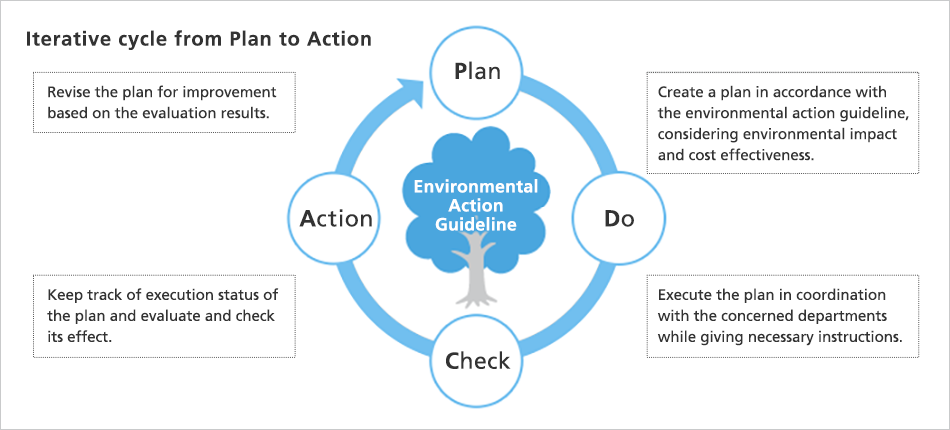
As environmental awareness continues to rise across society, companies are being called on to fulfill increasingly diverse roles, including providing environmentally conscious products and services, complying with a wide range of environmental regulations, and making corporate activities smarter through energy and resource efficiency. To respond swiftly to these trends and expectations, the Company implements the PDCA cycle within its environmental management system and continuously improves its practices.

To advance its environmental management system, the Company has obtained ISO 14001 certification, the international standard for environmental management systems, for a total of 18 sites, including its headquarters building, network centers, and data centers, that have been designated as Type 1 or Type 2 energy management factories.

[Note]
  1. *
    An EU regulation that restricts the use of hazardous substances in electrical and electronic equipment.
Environmental management system

For more information on the certification body and the Company's ISO 14001 certification status, please see here.

Structure

To establish an environmental management framework aligned with the international standard ISO 14001, the Company has established the Environment Committee as a cross-divisional body responsible for reviewing all environmental matters under the supervision of the Executive Officer in charge of ESG Promotion. Through this structure, the Company promotes environmental conservation activities on a company-wide basis.
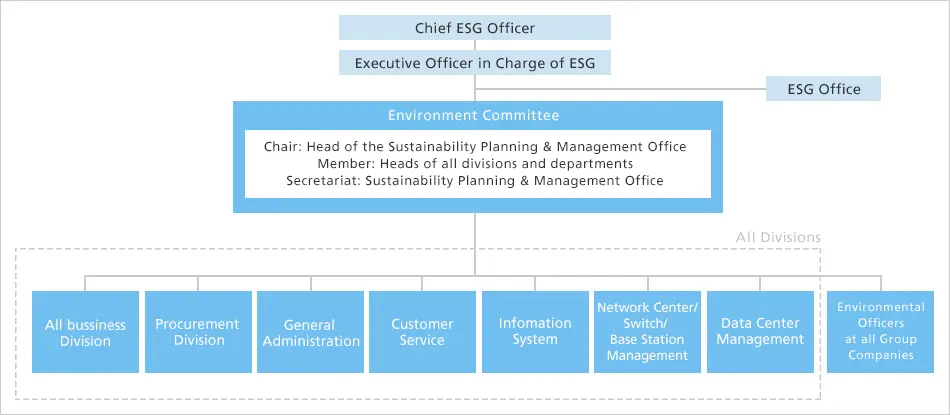
Structure

Compliance with environmental laws and regulations
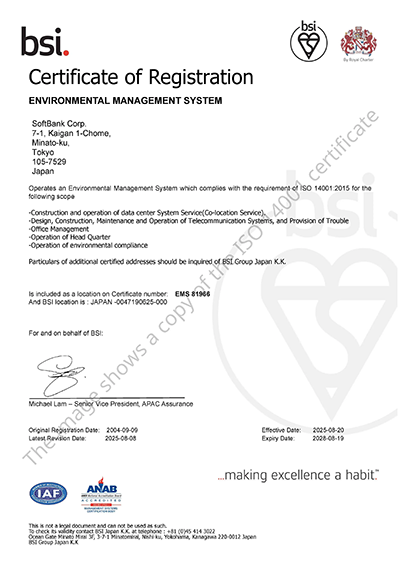
A copy of the ISO 14001 certificate

Within the framework of its environmental management system, the Company works to ensure compliance with environmental laws and regulations. In FY2025, the Company recorded no violations of environmental laws or regulations, including those relating to air pollution, water pollution, and soil contamination prevention.

The Company also conducts regular internal audits to confirm that its environmental management system conforms to the requirements of ISO 14001 and is being implemented effectively in line with its environmental targets. Based on the results of these audits, the Company identifies issues, takes corrective action, and reviews its environmental management system in order to achieve continuous improvement. As a result of external audits, the Company maintained its ISO 14001 certification in FY2025.

[Note]
  1. *
    The image above shows a copy of the ISO 14001 certificate.
    The principal registered scope of the Company’s ISO 14001 certification is as follows.
    • Process & Data Management Unit, Customer Engagement Department
    • Tokyo No. 4 Data Center
    • Sapporo Data Center
    • Kitakyushu e-PORT Center
    • Kitakyushu e-PORT No. 2 Center
    • Oita Data Center
    • East Japan Network Center (Hokkaido and Tohoku)
    • Kanto Network Center (Kanto)
    • Kansai Network Center (Tokai, Kansai and Hokuriku)
    • West Japan Network Center (Chugoku, Shikoku and Kyushu)
    • HR and General Affairs Division
    • CSR Division
    • Process & Data Management Unit, Customer Engagement Department
    • Tokyo No. 4 Data Center
    • Sapporo Data Center
    • Kitakyushu e-PORT Center
    • Kitakyushu e-PORT No. 2 Center
    • Oita Data Center
    • East Japan Network Center (Hokkaido and Tohoku)
    • Kanto Network Center (Kanto)
    • Kansai Network Center (Tokai, Kansai and Hokuriku)
    • West Japan Network Center (Chugoku, Shikoku and Kyushu)
    • HR and General Affairs Division
    • CSR Division

Environmental targets and results

To promote corporate activities that contribute to the preservation and enhancement of the global environment through the proper operation of the environmental management system, the Company has established environmental targets.

FY2026

Category Objectives Main measures
Contributing to climate change countermeasures through technology and business Net zero (Scope 1, 2 and 3*1) by FY2050*2*3; Carbon neutrality (Scope 1 and 2*1) by FY2030*2*3
  • Procurement of environmental value certificates
  • New procurement of electricity generated from renewable energy
  • Implementation of various energy-saving measures
  • Offices, etc.: measures implemented in cooperation with building owners
Carbon-neutral electricity ratio: 60% in FY2026; 100% in FY2030*2
Creation and expansion of energy-related businesses by FY2030
Realizing a circular economy Recycling and reuse rate relative to new mobile handset sales: 20% or more Promotion of handset recycling and reuse; Proper disposal of waste
Industrial waste recycling rate: 98% in FY2026; 99% in FY2030
Coexisting with the global environment through biodiversity conservation

Achieve Nature Positive 2030:

  • Promote forest conservation in areas at least twice the size of land developed in key biodiversity areas
  • Promote initiatives such as tree planting that contribute to watershed conservation equivalent to 1% of water use at newly developed data centers*4*5
Promote initiatives to reduce the impact of business on biodiversity
Compliance with environmental laws and regulations Proper disposal of industrial waste Thorough compliance with laws and regulations
Proper handling of waste CFCs
Proper management of plastics
Proper disposal of PCBs
Proper handling of fuel oil A
[Notes]
  1. *1
    Scope 1: direct greenhouse gas emissions from the Company's own operations; Scope 2: indirect emissions from the use of electricity, heat, and steam supplied by other companies; Scope 3: indirect emissions other than Scope 1 and 2, including emissions from the supply chain related to the Company's activities.
  2. *2
    Applicable companies: the Company and its consolidated subsidiaries.
  3. *3
    Owner-received electricity, which had been included in Scope 3 through FY2024 and represents electricity consumption associated with the use of equipment installed outside the Company's premises, is calculated as part of Scope 2 from FY2025
  4. *4
    Equivalent to 1% of the daily data center water consumption.
  5. *5
    One-unit equivalent is an estimated value based on the Company's model usage, and the required tree planting for watershed conservation is 2 hectares or more.

FY2025

Category Objectives Result
Climate change countermeasures Net zero (Scope 1, 2 and 3*1) by FY2050*2; Carbon neutrality (Scope 1 and 2*1) by FY2030*2 Scope 1 and 2: reduced by 44,000 t-CO2 year on year*7; Scope 3: emissions increased due to the expansion of the calculation boundary and business growth
Ratio of renewable energy to electricity used by the Company*3: 50% or more by FY2030*4 Approximately 20 million kWh of renewable energy supplied annually
Renewable energy ratio: 65%*2 66%*7

Contribution to CO2 emission reduction across society:

  • Expand household energy-saving services through electricity apps and other means
  • Create and expand climate change-related businesses

Expansion of household energy-saving services through electricity apps and other means:

  • Approximately 1.3 million participating households

Creation and expansion of climate change-related businesses:

  • Expanded sales of renewable energy plans
  • Sales of the agency purchasing service for non-fossil certificates
Promoting a circular economy Total number of used mobile phones collected for reuse or recycling: 14 million from FY2020 to FY2025 15.32 million units
Recycling rate of decommissioned base station telecommunications equipment: 99% or more annually 99% or more
Industrial waste recycling rate: improve by 1% annually Improved by 2.3%
Biodiversity conservation

    Achieve Nature Positive 2030:

  • Promote forest conservation in areas at least twice the size of land developed in key biodiversity areas
  • Promote initiatives such as tree planting that contribute to watershed conservation equivalent to 1% of water use at newly developed data centers*5*6
  • Forest conservation activities of 2,437 square meters
  • Tree planting and related activities equivalent to one unit: 2.5 hectares
Promote initiatives related to the conservation of biodiversity and natural capital
  • Cumulative number of participants in coral conservation activities: 13,831*8*9
Realizing a prosperous society through the spread of renewable energy Promoting the adoption of renewable energy through the provision of renewable electricity plans and related offerings
  • CO2 emissions reduced through the provision of Shizen Denki*10: 26,000 t-CO2
  • CO2 emissions reduced through environmental options for corporate customers: 17,000 t-CO2
Compliance with environmental laws and regulations Proper disposal of industrial waste Appropriate responses implemented in accordance with laws and regulations
Proper handling of waste CFCs
Proper management of plastics
Proper disposal of PCBs
[Notes]
  1. *1
    Scope 1: direct greenhouse gas emissions from the Company's own operations; Scope 2: indirect emissions from the use of electricity, heat, and steam supplied by other companies; Scope 3: indirect emissions other than Scope 1 and 2, including emissions from the supply chain related to the Company's activities.
  2. *2
    Applicable companies: the Company and its consolidated subsidiaries.
  3. *3
    Total for the Company and Wireless City Planning Inc.
  4. *4
    Procurement of renewable energy electricity such as wind and solar power.
  5. *5
    Equivalent to 1% of daily data center water consumption
  6. *6
    One-unit equivalent is an estimated value based on the Company's model usage, and the required tree planting for watershed conservation is 2 hectares or more
  7. *7
    Excluding figures for electricity supplied through building owners, consistent with the definition used when the target was set
  8. *8
    As of March 31, 2026, cumulative from 2019
  9. *9
    Total cumulative participation, including planting events, beach cleanups, and donations
  10. *10
    Electricity with effectively 100% renewable energy through the use of non-fossil certificates designated as renewable energy

Major initiatives

Environmental education

The Company provides environmental education through e-learning to help employees acquire basic environmental knowledge and raise their awareness. The e-learning program covers themes such as reducing energy consumption, cutting waste, and improving water-use efficiency. It enables each employee to deepen awareness and understanding of environmental issues while learning broadly about the Company's environmental management initiatives.

To enable more effective use of time, these e-learning programs are also available on iPhone and iPad. In FY2025, the environmental education participation rate for all employees was 78.9%.

In addition, the contribution evaluation used to assess work results and contributions to the organization incorporates materiality KPIs related to climate change and other factors, and the results are reflected in bonus determinations.